
Table of Contents
How Do You Build a Winning Pharma Launch Plan in 2026?
A winning pharma launch plan is built by defining the market, identifying growth drivers, positioning clearly against competitors, aligning stakeholders, and executing through measurable KPIs.
Success depends on structured planning, not promotional intensity.
You must integrate data, team capability, and market access early.
Without this, most launches fail within the first year.
What makes pharma launches succeed or fail?
Most pharmaceutical launches do not fail because of poor promotion.
They fail because of poor planning.
Data shows that a large percentage of launches miss expected performance targets due to incorrect assumptions and weak execution alignment.
The real reasons behind failure:
- Wrong positioning
- Weak market understanding
- Overestimated forecasts
- Poor stakeholder engagement
- Disconnected execution
A pharma launch is not an event.
It is a system of decisions and actions over time.
What are the core components of a pharma launch plan?
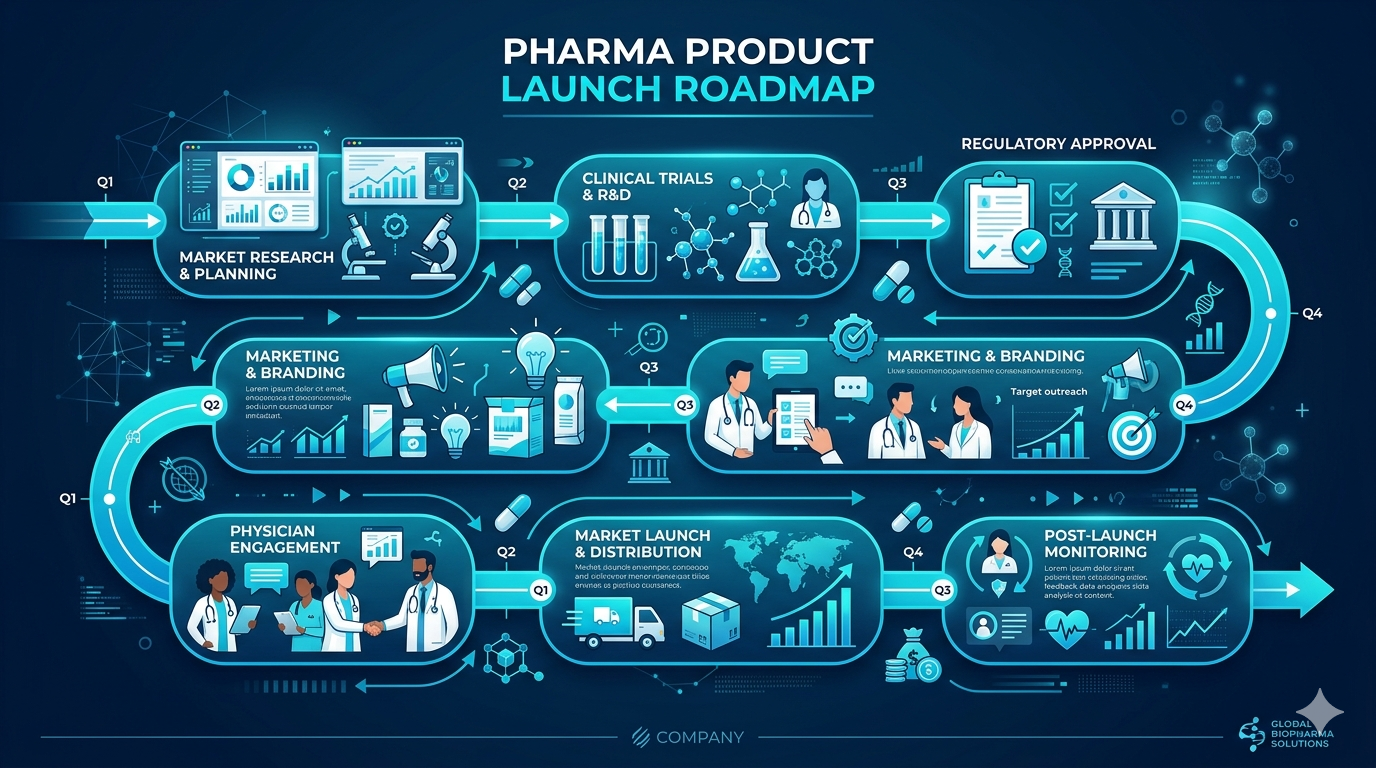
A structured pharma launch plan must include:
1. Market definition
- Target indications
- Patient segments
- Market size and growth
2. Competitive landscape
- Key competitors
- Market leaders
- Switching opportunities
3. Customer segmentation
- Specialties
- Prescribing behavior
- Influence networks
4. Positioning strategy
- Clinical value
- Economic value
- Differentiation
5. Growth drivers
- New prescriptions
- Switching
- Repeat usage
- Market expansion
6. Execution plan
- Sales force
- Events
- Digital
- KOL engagement
7. KPIs and tracking
- Sales growth
- Market share
- Rx behavior
This structure aligns with best practices where marketing must guide product strategy across development and launch stages.
You may like to read: Why Pharma Launches Fail: 9 Critical Mistakes
How do you identify real growth drivers?
Most teams focus only on increasing prescriptions.
That is incomplete.
Real growth comes from four levers:
1. New patients
Capturing untreated or newly diagnosed patients
2. Switching
Moving patients from competitors
3. Repeat usage
Ensuring persistence and adherence
4. Market expansion
Entering new indications or segments
Real example from a launch plan:
In one real case, growth was structured as:
- 70% new prescriptions
- 10% switching from competitors
- 20% repeat usage
This type of breakdown allows you to:
- Forecast accurately
- Allocate resources correctly
- Track performance clearly
How do you build a strong positioning strategy?
Positioning is not messaging.
It is a decision system.
A strong pharma positioning must answer:
- Why this product?
- Why now?
- Why for this patient?
- Why instead of competitors?
Key positioning principles:
- Focus on one core advantage
- Align with clinical reality
- Support with evidence
- Reinforce across all channels
Example logic:
If competitors dominate in one indication, you can:
- Expand into a new indication
- Reposition for a different specialty
- Focus on affordability or accessibility
This is how brands create space in saturated markets.
How do you align stakeholders effectively?
Modern pharma launches are no longer doctor-only.
Success depends on engaging:
- Physicians
- KOLs
- Payers
- Institutions
- Patients
Research shows that payers and access stakeholders can influence a large portion of product success, yet they are often under-prioritized.
Practical stakeholder strategy:
- Map influence networks
- Prioritize top-impact stakeholders
- Align messaging per segment
- Track engagement impact
How do you build the execution plan?
Execution must be structured, not reactive.
Key pillars:
1. Sales force deployment
- Targeting strategy
- Coverage model
- Call frequency
2. Medical and scientific engagement
- Conferences
- CME activities
- Clinical discussions
3. KOL activation
- Advocacy building
- Speaker programs
- Scientific alignment
4. Patient awareness
- Education campaigns
- Digital initiatives
Important principle:
Execution should follow strategy, not replace it.
How do you track performance and adjust?
A launch plan without tracking is blind.
Essential KPIs:
- Sales growth
- Market share
- Rx behavior
- Coverage metrics
- Activity effectiveness
Best practice:
Track performance in real time, not quarterly.
Because:
- Markets change quickly
- Competitors react fast
- Delayed action kills momentum
How can tools improve your launch execution?
This is where most pharma teams fail.
They rely on:
- Static plans
- Excel sheets
- Manual tracking
Instead, you should use structured tools:
1. Marketing Plan Generator
Use it to build your launch plan with:
- Clear structure
- Defined assumptions
- Actionable steps
2. Manager Effectiveness Heatmap
Use it to:
- Identify team gaps
- Detect execution risks
- Improve field performance
3. Turnover Index
Baes on Herzberg Two-factor theory Use it to:
- Predict team instability
- Protect launch continuity
4. Excel Chart Builder
Use it to:
- Turn raw data into insights
- Visualize performance
- Support decision-making
These tools transform your launch from:
- Static plan → dynamic system
What is the biggest mistake in pharma launch planning?
The biggest mistake is:
Treating launch as a marketing activity instead of a business system
What this leads to:
- Misaligned teams
- Poor forecasts
- Weak execution
- Lost market share
What you should do instead:
Build your launch as:
- A system
- A process
- A measurable engine
Final Insight
A pharma launch does not fail at execution.
It fails at the thinking level before execution begins.
If your:
- Growth drivers are unclear
- Positioning is weak
- Team is misaligned
No amount of promotion will fix it.
What to do next
Before launching your next product:
- Define your growth model
- Validate your assumptions
- Structure your execution
- Equip your team with tools
Because in pharma:
The market does not reward effort
It rewards structured execution