
Table of Contents
How Do You Build a Pharma Go-To-Market Strategy Step by Step?
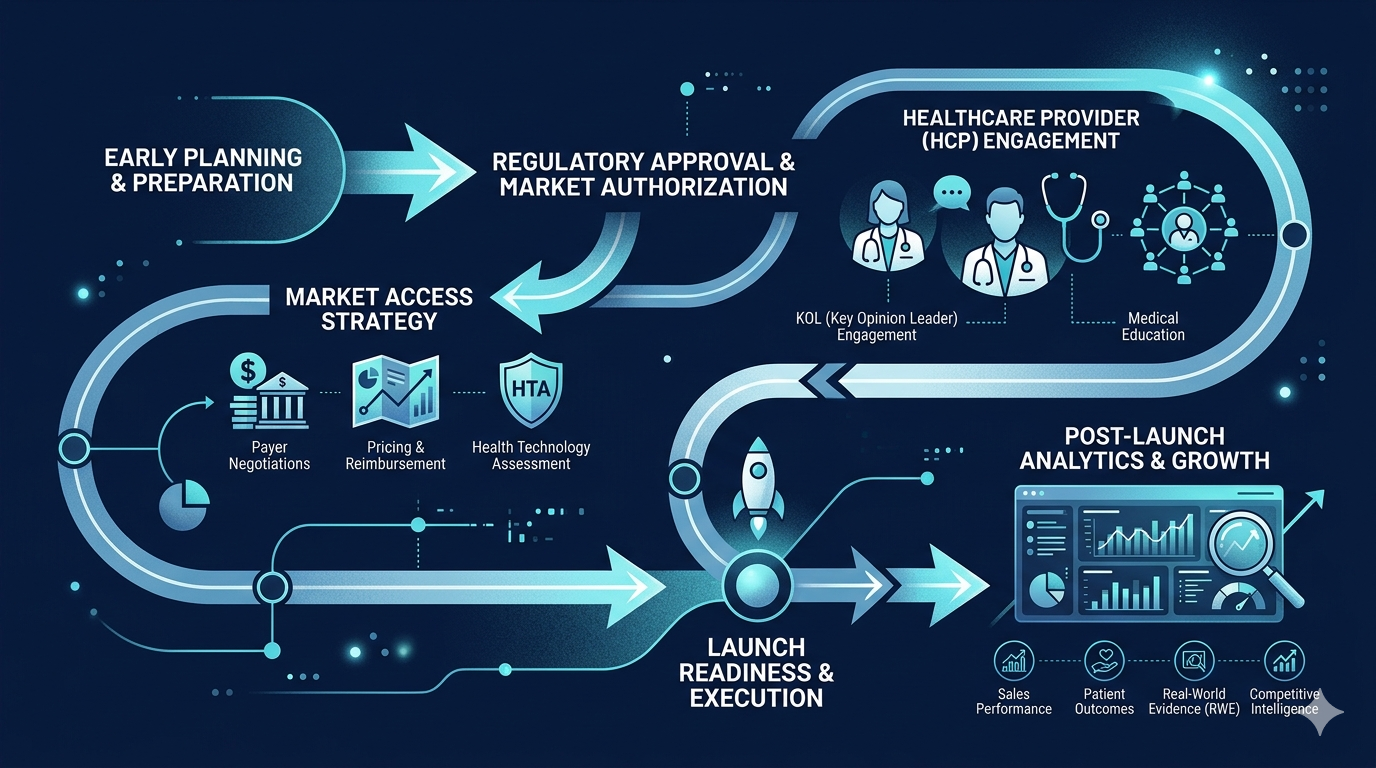
A pharma go-to-market strategy is the structured plan used to bring a product to market successfully through segmentation, positioning, stakeholder alignment, market access, channel execution, and KPI tracking.
It defines who to target, how to win, and how to scale adoption after launch.
Without a clear go-to-market strategy, even strong products underperform.
Success comes from coordinated execution, not isolated marketing activities.
What is a pharma go-to-market strategy?
A pharma go-to-market strategy is the commercial blueprint that translates product potential into market performance.
It answers six critical questions:
- Which market opportunity should we pursue?
- Which customers matter most?
- How should we position the product?
- How will we gain access and adoption?
- Which channels will drive growth?
- How will success be measured?
Why this matters
Many pharma teams confuse go-to-market with promotion.
Promotion is only one part of the system.
A real go-to-market strategy includes:
- Market selection
- Stakeholder influence
- Pricing and access
- Sales deployment
- Demand generation
- Performance optimization
👉 As explained in
🔗 Related Post: How to Build a Pharma Launch Plan: 7 Proven Steps
A launch plan activates execution.
A go-to-market strategy determines how you win.
Why do pharma go-to-market strategies fail?
Most failures happen because teams focus on internal plans instead of market reality.
Common causes include:
- Weak segmentation
- Generic positioning
- No access strategy
- Poor forecasting
- Misaligned teams
- Slow response after launch
Industry launch research shows that many products miss expectations because planning assumptions fail to match actual market behavior
What are the 7 steps to build a pharma go-to-market strategy?
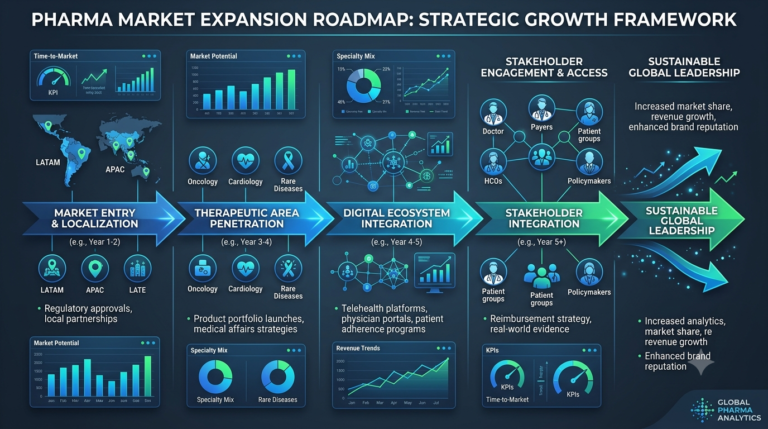
Step 1: Define the real market opportunity
Start with the market, not the product.
You need to understand:
- Disease burden
- Patient flow
- Current treatment patterns
- Unmet needs
- Growth trends
- Competitor intensity
Example from real planning models
Strong launch plans evaluate:
- Sources of business
- New patients vs add-on patients
- Channel contribution
- Specialty influence
This type of structured market mapping appears in advanced brand planning materials
Key question:
Where is the most profitable and achievable opportunity?
Step 2: Segment customers and stakeholders
Not all customers create equal impact.
In pharma, “customer” can mean:
- Prescribers
- KOLs
- Institutions
- Payers
- Pharmacists
- Patients
Segment by factors such as:
- Prescription volume
- Influence level
- Specialty relevance
- Openness to switching
- Geographic importance
Why this matters
The same message should not be delivered to all stakeholders.
Research shows modern pharma performance depends on engaging multiple stakeholder groups, not only physicians
Step 3: Build a differentiated positioning strategy
If your positioning sounds like every competitor, adoption slows.
Your positioning must answer:
- Why this product?
- Why now?
- Why for this patient?
- Why over alternatives?
Strong positioning examples:
- Better tolerated in chronic use
- More convenient dosing
- Stronger economic value
- Advantage in specific patient subgroup
Weak positioning examples:
- Effective and safe
- Trusted quality
- Great results
Those claims are too generic.
👉 As discussed in
🔗 Related Post: Why Pharma Launches Fail: 9 Critical Mistakes
Weak positioning is one of the most common launch killers.
Step 4: Design market access and pricing logic
A product cannot grow if patients cannot access it.
Your strategy must include:
- Reimbursement pathway
- Tender or institutional access
- Insurance inclusion
- Pricing scenarios
- Competitive affordability
Important shift in modern pharma
Payers increasingly demand evidence, value, and budget predictability rather than simple brand claims
Strategic question:
What proof will decision-makers need to support access?
Step 5: Build the channel and execution model
Now define how demand will be created.
Typical channels include:
- Field force promotion
- Medical education
- KOL advocacy
- Conferences
- Digital awareness
- Institutional engagement
Channel mix should depend on:
- Product maturity
- Target specialty
- Geography
- Competition intensity
- Budget
Example:
A specialty product may rely more on:
- KOL engagement
- Medical affairs
- Scientific events
A broad primary care product may rely more on:
- Field force scale
- Coverage frequency
- High-volume targeting
Step 6: Forecast scenarios and allocate resources
Forecasting is not guessing revenue.
A forecast is a belief about future performance based on assumptions used for planning and investment decisions
Build three scenarios:
- Conservative case
- Base case
- Accelerated case
Then allocate resources accordingly:
- Headcount
- Marketing budget
- Samples
- Events
- Digital support
Common mistake:
One aggressive forecast with no fallback plan.
Step 7: Launch, measure, and adapt quickly
No plan survives first market contact unchanged.
After launch, track:
- Sales growth
- Market share
- Rx behavior
- Switching rate
- Coverage effectiveness
- Access wins/losses
👉 As explained in
🔗 Related Post: Pharma KPIs That Matter: 8 Proven Metrics Guide
Metrics should drive decisions, not decorate dashboards.
Winning teams do this:
- Review weekly signals
- Reallocate fast
- Double down on what works
- Stop low-return activity
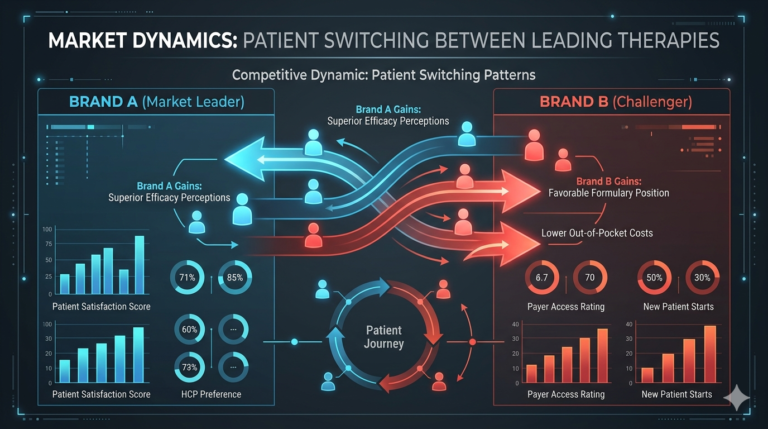
How does switching fit into go-to-market strategy?
In many established categories, growth depends on competitor conversion.
That means your go-to-market strategy must include:
- Competitor target list
- Switching triggers
- Comparative messaging
- Patient selection logic
👉 Read next:
🔗 Related Post: Pharma Switching Strategy: 6 Proven Ways to Win
How can tools improve go-to-market execution?
Strategy without systems becomes slow.
Use structured tools to accelerate execution.
1. Marketing Plan Generator
Use it to:
- Build structured plans
- Define objectives
- Organize tactics and timelines
2. Excel Chart Builder
Use it to:
- Turn sales files into insights
- Compare regions
- Visualize trends fast
3. Manager Effectiveness Heatmap
Use it to:
- Detect execution gaps
- Improve leadership quality
- Strengthen field performance
4. Turnover Index
Use it to:
- Predict people risk
- Protect launch continuity
- Reduce disruption during critical periods
What is the biggest mistake in go-to-market planning?
The biggest mistake is assuming a good product sells itself.
It does not.
Markets reward:
- Clarity
- Access
- Consistency
- Speed of adaptation
Products fail when companies rely on product strength while competitors build stronger systems.
Final Insight
A pharma go-to-market strategy is not a presentation deck.
It is an operating model for winning adoption.
If your team cannot clearly explain:
- Who matters most
- Why they should choose you
- How access will happen
- What success looks like
Then your strategy is incomplete.
The strongest brands are rarely the loudest.
They are usually the most organized.
Related Guides You Should Review Next
🔗 Related Post: How to Build a Pharma Launch Plan: 7 Proven Steps
🔗 Related Post: Why Pharma Launches Fail: 9 Critical Mistakes
🔗 Related Post: Pharma KPIs That Matter: 8 Proven Metrics Guide
🔗 Related Post: Pharma Switching Strategy: 6 Proven Ways to Win