

Table of Contents
How Do You Build a Pharma Indication Expansion Strategy That Drives Growth?
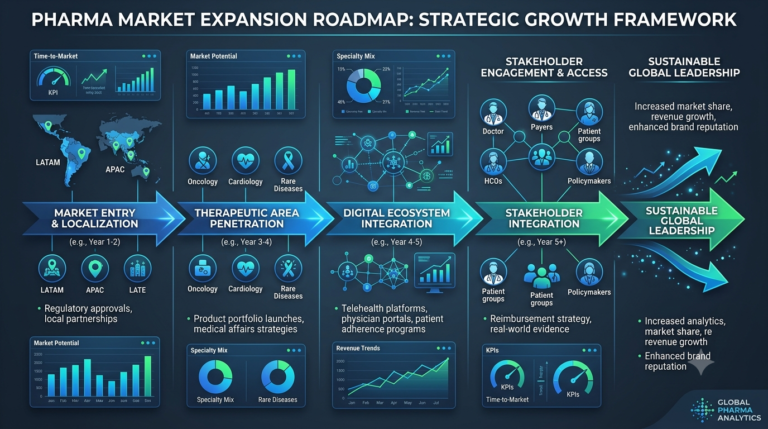
A pharma indication expansion strategy is built by identifying new clinical opportunities, validating unmet needs, aligning stakeholders, and executing targeted positioning and market activation plans.
It allows brands to unlock new patient segments and extend lifecycle value.
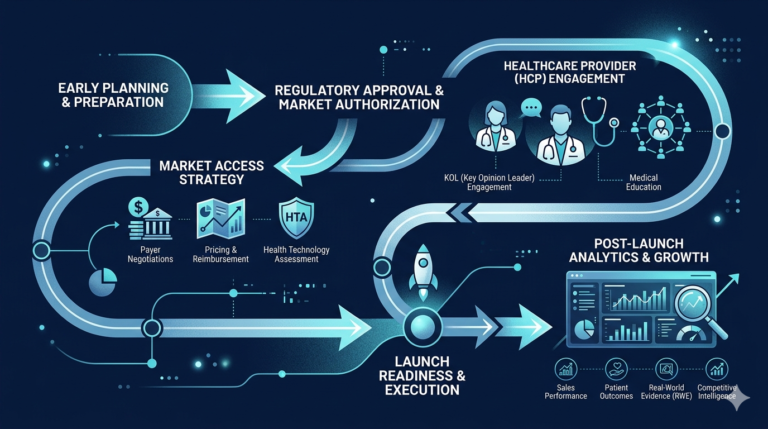
Successful expansion requires more than clinical approval. It requires commercial readiness.
Without strategic planning, new indications fail to translate into real growth.
What is indication expansion in pharma?
Indication expansion is the process of extending a drug’s use into:
- New diseases
- New patient populations
- New clinical settings
Why it matters:
- Increases market size
- Extends product lifecycle
- Drives additional revenue
- Strengthens brand positioning
Important distinction:
Clinical approval ≠ commercial success
👉 Many products gain new indications but fail to convert them into market performance.
Why do most indication expansion strategies fail?
Most failures happen because companies assume:
👉 “If we have the indication, the market will adopt”
Reality:
New indications require:
- New positioning
- New stakeholders
- New behavior change
Common failure reasons:
- No clear target specialty
- Weak evidence communication
- Poor stakeholder alignment
- No execution focus
- Lack of awareness
👉 As explained in
🔗 Related Post: Why Pharma Launches Fail: 9 Critical Mistakes
Strategy gaps always show up during execution.
What are the 6 steps to build a successful pharma indication expansion strategy?
Step 1: Identify the right expansion opportunity
Not all indications are worth pursuing.
Evaluate based on:
- Market size
- Growth potential
- Competitive intensity
- Unmet need
- Accessibility
Strategic thinking:
You are not choosing an indication.
You are choosing a growth engine.
👉 Strong planning frameworks analyze:
- Sources of business
- New patient contribution
- Add-on patient potential
Step 2: Understand the new customer and specialty
Each indication comes with a different audience.
Example:
- Pain → Orthopedics
- Mood disorders → Psychiatrists
- Chronic disease → Internal Medicine
What changes:
- Prescribing behavior
- Decision drivers
- Scientific expectations
Key mistake:
Using the same strategy across different specialties
Step 3: Build a new positioning strategy
Your old positioning may not work.
You must redefine:
- Value proposition
- Clinical relevance
- Competitive differentiation
Example positioning shift:
- From pain relief → mood stabilization
- From symptom control → quality of life improvement
👉 As explained in
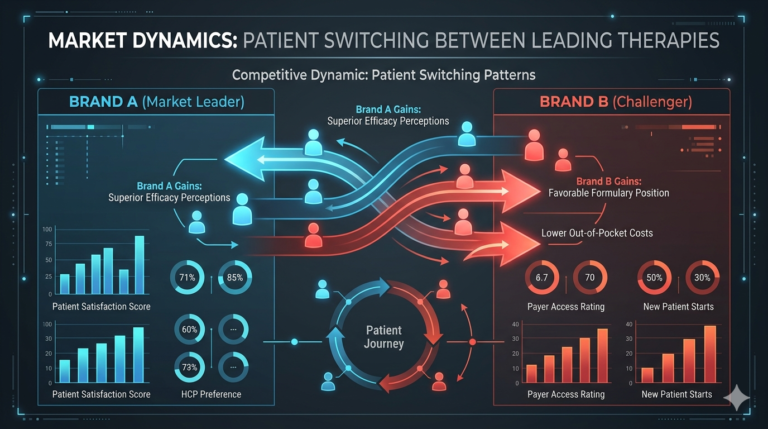
🔗 Related Post: Pharma Switching Strategy: 6 Proven Ways to Win
Positioning must solve a real problem to drive adoption.
Step 4: Validate with evidence and insights
New indications require strong validation.
Tools include:
- Clinical trials
- Real-world evidence
- Surveys
- Case studies
Example approach:
- Clinical survey across target physicians
- Real patient cases
- Evidence-based discussions
Why it matters:
Doctors do not adopt based on claims.
They adopt based on confidence.
Step 5: Activate stakeholders and channels
Each indication requires a tailored activation plan.
Key channels:
- Scientific events
- CME programs
- KOL advocacy
- Conferences
- Institutional engagement
Stakeholder importance:
Modern pharma requires engagement beyond physicians.
Research shows that multiple stakeholders influence adoption and must be engaged strategically
Example strategy:
- Partner with specialty societies
- Sponsor educational programs
- Engage top experts
Step 6: Track performance and scale
Expansion is not a one-time effort.
Track:
- Rx growth by indication
- Market share in new segment
- Adoption by specialty
- Awareness metrics
👉 As explained in
🔗 Related Post: Pharma KPIs That Matter: 8 Proven Metrics Guide
KPIs must reflect real behavior change.
Then:
- Optimize strategy
- Scale successful channels
- Refine messaging
How does indication expansion connect to lifecycle management?
Indication expansion is a core part of lifecycle management.
It helps:
- Extend product relevance
- Delay decline phase
- Increase long-term revenue
Strategic view:
A product is not static.
It evolves across:
- Indications
- Markets
- positioning
How does forecasting support indication expansion?
Expansion must be forecasted properly.
👉 As explained in
🔗 Related Post: How Do You Forecast a Pharma Launch Accurately?
You must:
- Estimate uptake
- Model scenarios
- Validate assumptions
Key factors:
- Adoption speed
- Stakeholder acceptance
- Competitive reaction
How can tools improve indication expansion execution?
1. Marketing Plan Generator
Use it to:
- Structure expansion strategy
- Align stakeholders
- Define execution plan
2. Excel Chart Builder
Use it to:
- Track adoption trends
- Compare indication performance
- Visualize growth
3. Manager Effectiveness Heatmap
Use it to:
- Identify execution gaps
- Strengthen field performance
4. Turnover Index
Use it to:
- Maintain team stability
- Protect expansion momentum
👉 Expansion success depends on execution consistency
What is the biggest mistake in indication expansion?
The biggest mistake is:
👉 Treating expansion as a clinical milestone, not a commercial strategy
What this leads to:
- Low adoption
- Weak awareness
- Missed revenue
Correct approach:
Treat each indication as:
- A new mini-launch
- With its own strategy and execution
Final Insight
Indication expansion is one of the most powerful growth levers in pharma.
But only if executed correctly.
If you:
- Understand the new market
- Adapt your positioning
- Align stakeholders
- Execute with precision
You unlock exponential growth.
If not:
👉 The indication exists only on paper
Related Guides You Should Review Next
🔗 Related Post: How to Build a Pharma Launch Plan: 7 Proven Steps
🔗 Related Post: Why Pharma Launches Fail: 9 Critical Mistakes
🔗 Related Post: Pharma Switching Strategy: 6 Proven Ways to Win
🔗 Related Post: Pharma KPIs That Matter: 8 Proven Metrics Guide
🔗 Related Post: How Do You Forecast a Pharma Launch Accurately?