
Table of Contents
How Do You Build a Pharma Market Access Strategy That Drives Adoption?
A pharma market access strategy is built by aligning pricing, reimbursement, evidence generation, stakeholder engagement, and commercial execution to ensure patients can access and afford treatment.
Without market access, even clinically strong products struggle commercially.
Modern pharma success depends on payer acceptance as much as physician adoption.
Market access is no longer a support function. It is a core growth driver.
What is market access in pharma?
Market access is the process of ensuring a pharmaceutical product becomes:
- Available
- Reimbursed
- Affordable
- Adopted within healthcare systems
It includes:
- Pricing strategy
- Reimbursement planning
- Insurance inclusion
- Institutional access
- Stakeholder alignment
Important reality:
A product can receive regulatory approval and still fail commercially.
👉 Commercial success depends on whether healthcare systems actually support usage.
Why has market access become critical in modern pharma?
Healthcare systems have changed significantly.
Today’s environment includes:
- Budget pressure
- Cost control policies
- Reimbursement restrictions
- Value-based decision-making
Research shows that payers and health technology assessment stakeholders can influence a major portion of market success, yet many companies still underinvest in access planning
This means:
Winning requires more than promotion.
Why do pharma market access strategies fail?
Most failures happen because companies:
- Focus only on physicians
- Ignore payer expectations
- Delay access planning
- Lack economic evidence
Common mistakes:
- Weak pricing logic
- Generic value proposition
- No reimbursement preparation
- Poor stakeholder mapping
👉 As explained in
🔗 Related Post: Why Pharma Launches Fail: 9 Critical Mistakes
Commercial gaps usually start before launch execution begins.
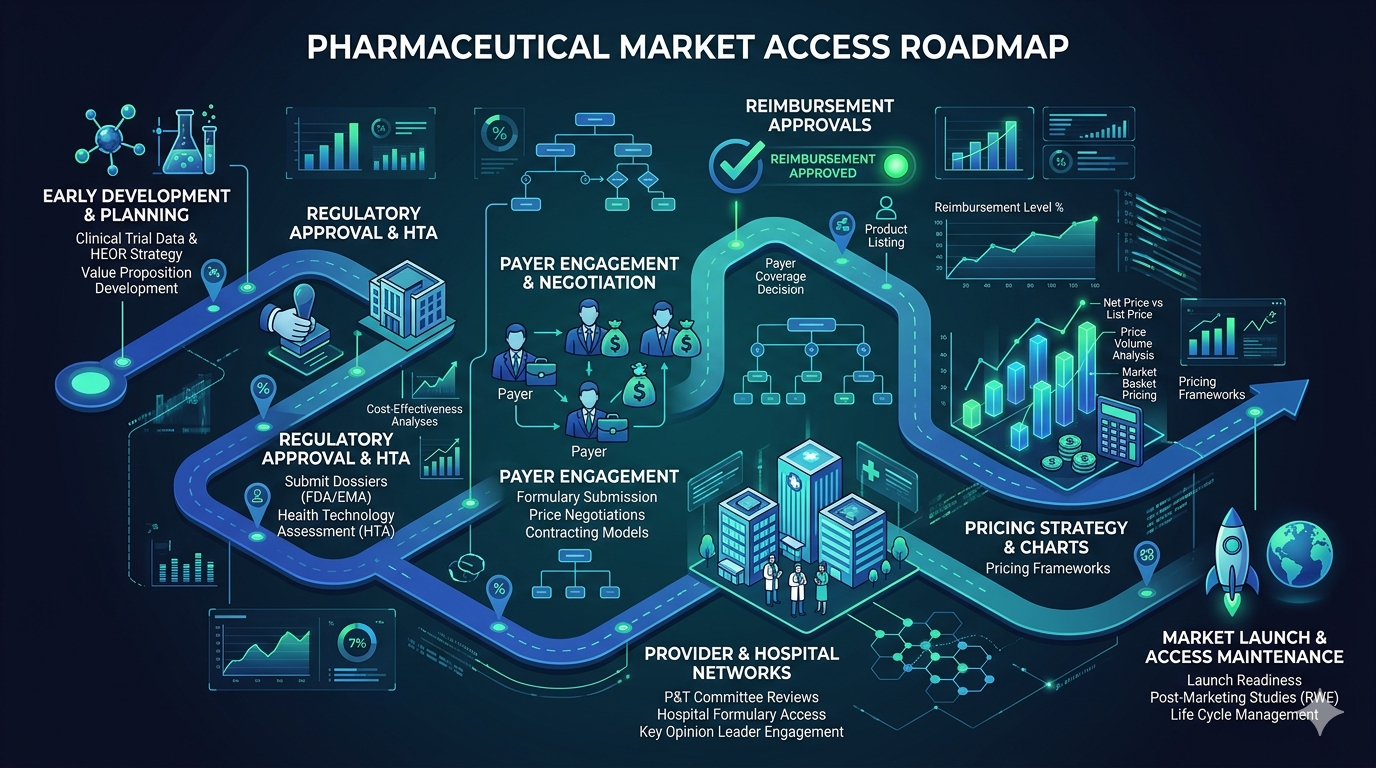
What are the 7 steps to build a pharma market access strategy?
Step 1: Understand the access environment
Every market operates differently.
You must evaluate:
- Reimbursement systems
- Insurance structure
- Government regulations
- Institutional purchasing dynamics
- Access restrictions
Important question:
Who actually controls patient access?
Examples:
- Insurance providers
- Government agencies
- Hospital committees
- Tender systems
Step 2: Build a strong value proposition
Access decisions depend on value, not promotion.
Your value proposition should demonstrate:
- Clinical benefit
- Economic benefit
- Quality-of-life improvement
- Healthcare system value
Weak value proposition:
- “High quality product”
Strong value proposition:
- Reduces hospitalization burden
- Improves adherence
- Decreases long-term treatment cost
Important shift:
Modern healthcare systems increasingly prioritize measurable value over brand reputation.
Step 3: Develop pricing strategy early
Pricing is not a final step.
It is a strategic decision.
Your pricing strategy should consider:
- Competitive landscape
- Patient affordability
- Reimbursement probability
- Market elasticity
Why this matters:
Incorrect pricing can:
- Block access
- Reduce adoption
- Trigger payer resistance
👉 As explained in forecasting and launch planning frameworks, pricing assumptions directly influence growth expectations and demand modeling
Step 4: Generate evidence that supports access
Clinical efficacy alone is no longer enough.
Decision-makers want evidence such as:
- Real-world outcomes
- Pharmacoeconomic value
- Comparative effectiveness
- Budget impact analysis
Practical methods include:
- Clinical surveys
- Real-world studies
- Outcomes research
- Local market evidence
Why it matters:
Evidence reduces adoption resistance.
Step 5: Engage stakeholders early
Market access is multi-stakeholder by nature.
Key stakeholders include:
- Payers
- KOLs
- Institutions
- Guideline committees
- Healthcare authorities
Research shows companies that engage stakeholders early improve launch readiness and alignment significantly
Best practice:
Start access conversations before launch.
Step 6: Align commercial and medical execution
Access teams cannot operate separately from commercial teams.
Strong alignment includes:
- Shared positioning
- Consistent messaging
- Unified objectives
- Coordinated field execution
Common mistake:
Medical, marketing, and sales teams operating independently.
Result:
- Mixed communication
- Weak stakeholder trust
- Slow adoption
Step 7: Track access KPIs continuously
Access strategy must be measurable.
Key market access KPIs:
- Reimbursement wins
- Institutional listings
- Tender success rate
- Insurance inclusion
- Patient affordability metrics
👉 As discussed in
🔗 Related Post: Pharma KPIs That Matter: 8 Proven Metrics Guide
KPIs should drive strategic decisions, not just reporting.
How does market access connect to go-to-market strategy?
Market access is one of the foundations of go-to-market success.
👉 As explained in
🔗 Related Post: How Do You Build a Pharma Go-To-Market Strategy Step by Step?
Go-to-market strategy determines:
- Who you target
- How you position
- How adoption happens
Market access determines:
👉 Whether adoption is even possible.
How does forecasting support market access planning?
Access barriers directly affect forecasting accuracy.
Your forecast must consider:
- Reimbursement timing
- Access restrictions
- Pricing pressure
- Competitive access advantages
👉 As explained in
🔗 Related Post: How Do You Forecast a Pharma Launch Accurately?
Forecast assumptions must reflect market reality.
How can tools improve market access execution?
1. Marketing Plan Generator
Use it to:
- Structure access planning
- Align stakeholders
- Define execution roadmap
2. Excel Chart Builder
Use it to:
- Visualize access KPIs
- Track institutional performance
- Compare reimbursement progress
3. Manager Effectiveness Heatmap
Use it to:
- Improve cross-functional execution
- Identify leadership gaps
4. Turnover Index
Use it to:
- Protect continuity in key accounts
- Reduce disruption risk during launch periods
👉 Market access success depends heavily on organizational consistency.
What is the biggest misconception about market access?
The biggest misconception is:
👉 “Market access is only pricing and reimbursement”
Reality:
Market access is:
- Strategic
- Commercial
- Clinical
- Organizational
It influences:
- Adoption
- Growth
- Sustainability
Final Insight
In modern pharma:
👉 Clinical approval opens the door
👉 Market access determines whether patients actually enter
The strongest brands are not only clinically effective.
They are:
- Accessible
- Affordable
- Supported by evidence
- Aligned with healthcare system priorities
Without access:
Even excellent products remain commercially weak.
Related Guides You Should Review Next
🔗 Related Post: How to Build a Pharma Launch Plan: 7 Proven Steps
🔗 Related Post: How Do You Build a Pharma Go-To-Market Strategy Step by Step?
🔗 Related Post: How Do You Forecast a Pharma Launch Accurately?
🔗 Related Post: Pharma Sales Force Effectiveness: 8 Proven Frameworks
🔗 Related Post: Pharma KPIs That Matter: 8 Proven Metrics Guide