
Table of Contents
How Do You Build a Pharma Sales Force Effectiveness Framework?
A pharma sales force effectiveness framework is built by aligning targeting, execution quality, coaching, KPIs, and field capabilities into one measurable system.
High-performing sales teams do not rely on activity volume alone.
They focus on impact, consistency, and strategic execution.
Without structured field force management, even strong launch strategies fail in the market.
What is pharma sales force effectiveness?
Pharma sales force effectiveness measures how efficiently and strategically the field team converts activity into market impact.
It is not simply about:
- Number of visits
- Coverage volume
- Call frequency
Real effectiveness means:
- Better targeting
- Stronger engagement
- Higher conversion
- Sustainable market share growth
Important distinction:
Busy teams are not always effective teams.
👉 As explained in
🔗 Related Post: Pharma KPIs That Matter: 8 Proven Metrics Guide
Activity metrics alone do not reflect real performance.
Why is sales force effectiveness critical in pharma?
In pharma, the field force remains one of the strongest commercial assets.
The sales force influences:
- Prescribing behavior
- Stakeholder engagement
- Brand perception
- Market penetration
Poor field execution creates:
- Weak adoption
- Low ROI
- Inconsistent growth
Strong execution creates:
- Better switching
- Higher loyalty
- Faster uptake
👉 As discussed in
🔗 Related Post: Pharma Switching Strategy: 6 Proven Ways to Win
Competitive growth depends heavily on execution quality.
What are the 8 pillars of sales force effectiveness?
1. Strategic targeting
Not all customers deserve equal attention.
Strong targeting considers:
- Prescription potential
- Influence level
- Specialty relevance
- Switching probability
Common mistake:
Equal coverage for all doctors.
Better approach:
Prioritize based on:
- Potential
- Influence
- Strategic value
2. Clear segmentation
Segmentation improves message relevance and execution efficiency.
Typical segmentation layers:
- A/B/C doctors
- Specialty segmentation
- Geographic segmentation
- Behavioral segmentation
Why this matters:
Different doctors require:
- Different messages
- Different frequency
- Different engagement style
3. Message quality and positioning
Execution fails when messaging lacks clarity.
Effective field messaging must be:
- Clinically relevant
- Short
- Memorable
- Differentiated
Weak messaging examples:
- “Effective and safe”
- “High quality”
Strong messaging examples:
- Better tolerability profile
- Dual indication benefit
- Better patient compliance
👉 As explained in
🔗 Related Post: How Do You Build a Pharma Go-To-Market Strategy Step by Step?
Positioning determines adoption speed.
4. Activity quality, not quantity
This is one of the biggest gaps in pharma execution.
Many companies track:
- Number of calls
- Number of visits
- Number of events
But rarely track:
- Message impact
- Behavioral change
- Prescription conversion
Important principle:
Ten weak visits are worse than three strategic visits.
5. Coaching and managerial effectiveness
Managers are execution multipliers.
Strong managers improve:
- Team discipline
- Message consistency
- Performance accountability
- Skill development
Weak managers create:
- Execution gaps
- High turnover
- Poor morale
👉 This is why structured manager assessment is critical.
Practical approach:
Use the Manager Effectiveness Heatmap to:
- Detect leadership gaps
- Identify coaching needs
- Improve execution quality
6. KPI alignment and tracking
Field teams must understand:
- What success means
- How it is measured
- What actions influence outcomes
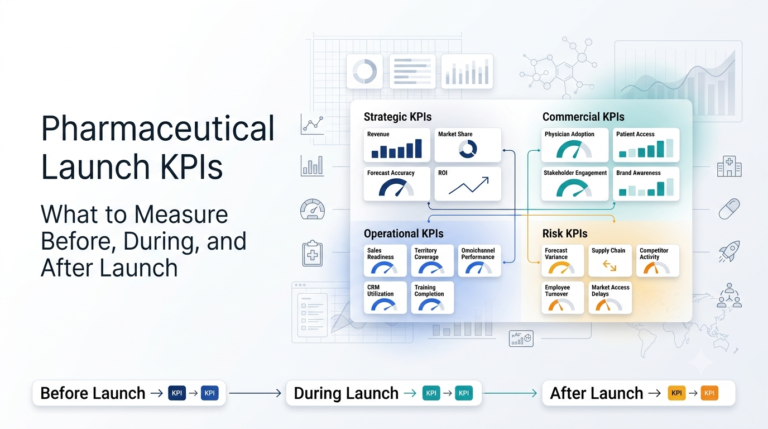
Essential KPIs include:
- Market share growth
- Coverage quality
- Rx behavior
- Switching rate
- Activity effectiveness
Best practice:
Track both:
- Activity metrics
- Business impact metrics
👉 As discussed in
🔗 Related Post: Pharma KPIs That Matter: 8 Proven Metrics Guide
KPIs should drive decisions, not reporting only.
7. Team stability and retention
High turnover destroys execution continuity.
Impact of turnover:
- Lost relationships
- Weak territory ownership
- Delayed execution
- Lower morale
This is especially dangerous during launches.
Practical solution:
Use the Turnover Index to:
- Predict retention risk
- Identify unstable teams
- Protect execution continuity
8. Real-time performance visibility
Most pharma teams react too late.
Why?
Because reporting is:
- Slow
- Fragmented
- Hard to visualize
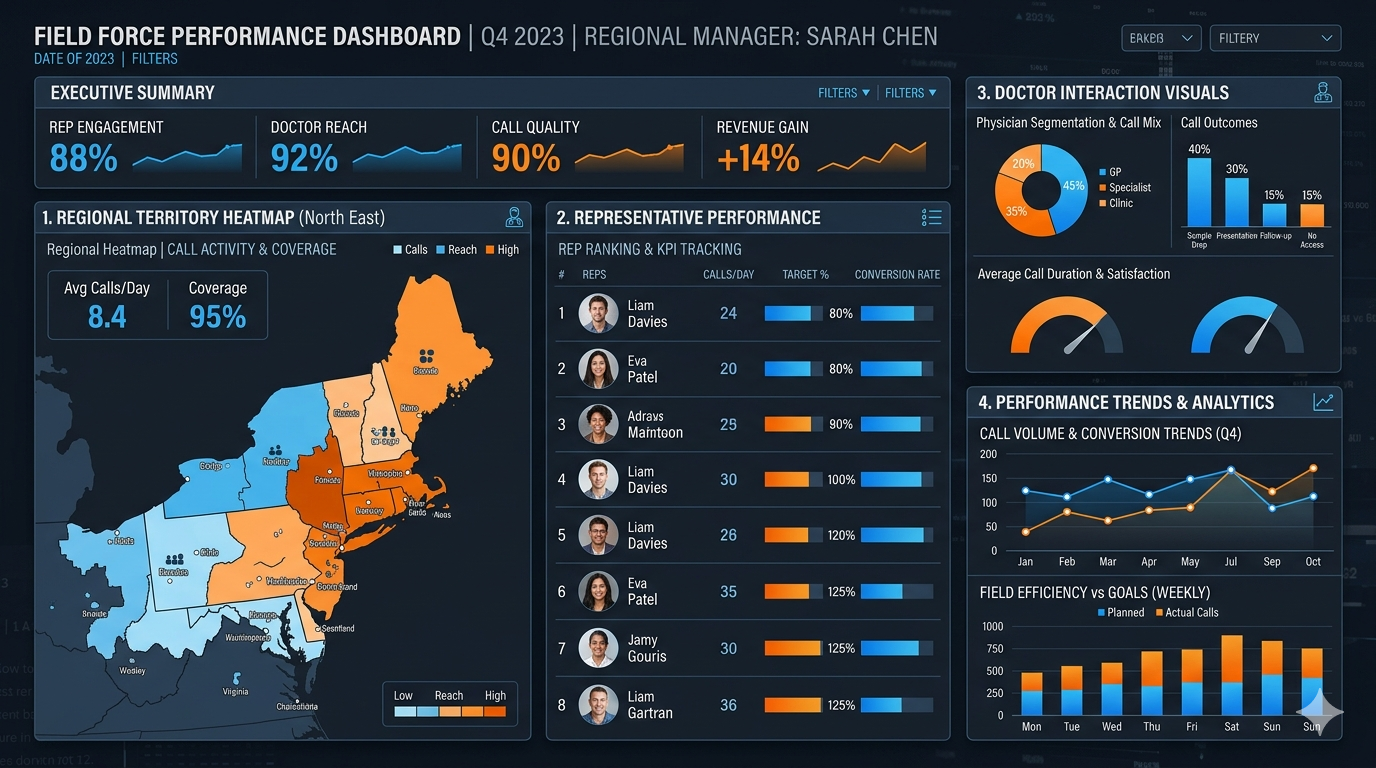
Modern field management requires:
- Fast dashboards
- Trend visualization
- Territory comparisons
Practical solution:
Use the Excel Chart Builder to:
- Transform raw sales data into insights
- Compare regions and reps
- Detect performance gaps quickly
How does sales force effectiveness connect to launch success?
Launch strategy without execution is theory.
👉 As explained in
🔗 Related Post: How to Build a Pharma Launch Plan: 7 Proven Steps
Execution determines whether strategy reaches the market effectively.
Strong field execution improves:
- Adoption speed
- Switching rate
- Stakeholder engagement
- Market penetration
How does forecasting support sales force planning?
Field force investment should align with forecast expectations.
👉 As explained in
🔗 Related Post: How Do You Forecast a Pharma Launch Accurately?
Forecasting helps determine:
- Team size
- Territory allocation
- Resource prioritization
Common mistake:
Overspending before validating market traction.
What are the biggest mistakes in sales force management?
1. Measuring activity only
Leads to motion without impact.
2. Poor targeting
Wastes field resources.
3. Weak coaching
Creates inconsistent execution.
4. Delayed reporting
Slows decision-making.
5. Ignoring turnover risk
Destroys continuity.
What does a high-performing pharma field force look like?
A strong field force is:
- Strategically targeted
- Well-coached
- KPI-driven
- Consistent
- Adaptive
It operates as a system, not individuals working independently.
Final Insight
Sales force effectiveness is not about making teams work harder.
It is about making execution:
- Smarter
- More focused
- More measurable
The best pharma companies do not win because they have more representatives.
They win because:
👉 Their field systems are stronger
👉 Their managers are better
👉 Their execution is more consistent
Related Guides You Should Review Next
🔗 Related Post: How to Build a Pharma Launch Plan: 7 Proven Steps
🔗 Related Post: Pharma KPIs That Matter: 8 Proven Metrics Guide
🔗 Related Post: Pharma Switching Strategy: 6 Proven Ways to Win
🔗 Related Post: How Do You Forecast a Pharma Launch Accurately?
🔗 Related Post: How Do You Build a Pharma Go-To-Market Strategy Step by Step?