
Table of Contents
How Do You Build a Pharma Dashboard for Better Decision-Making?
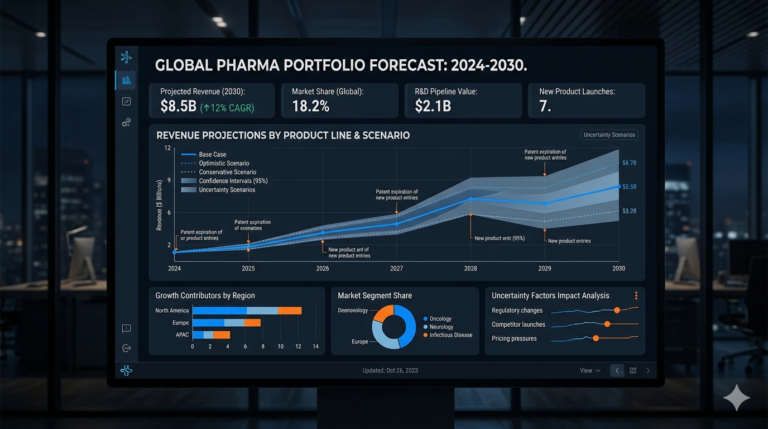
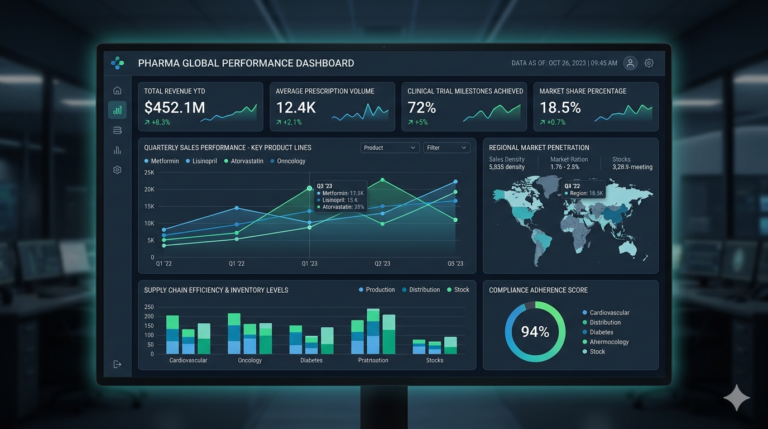
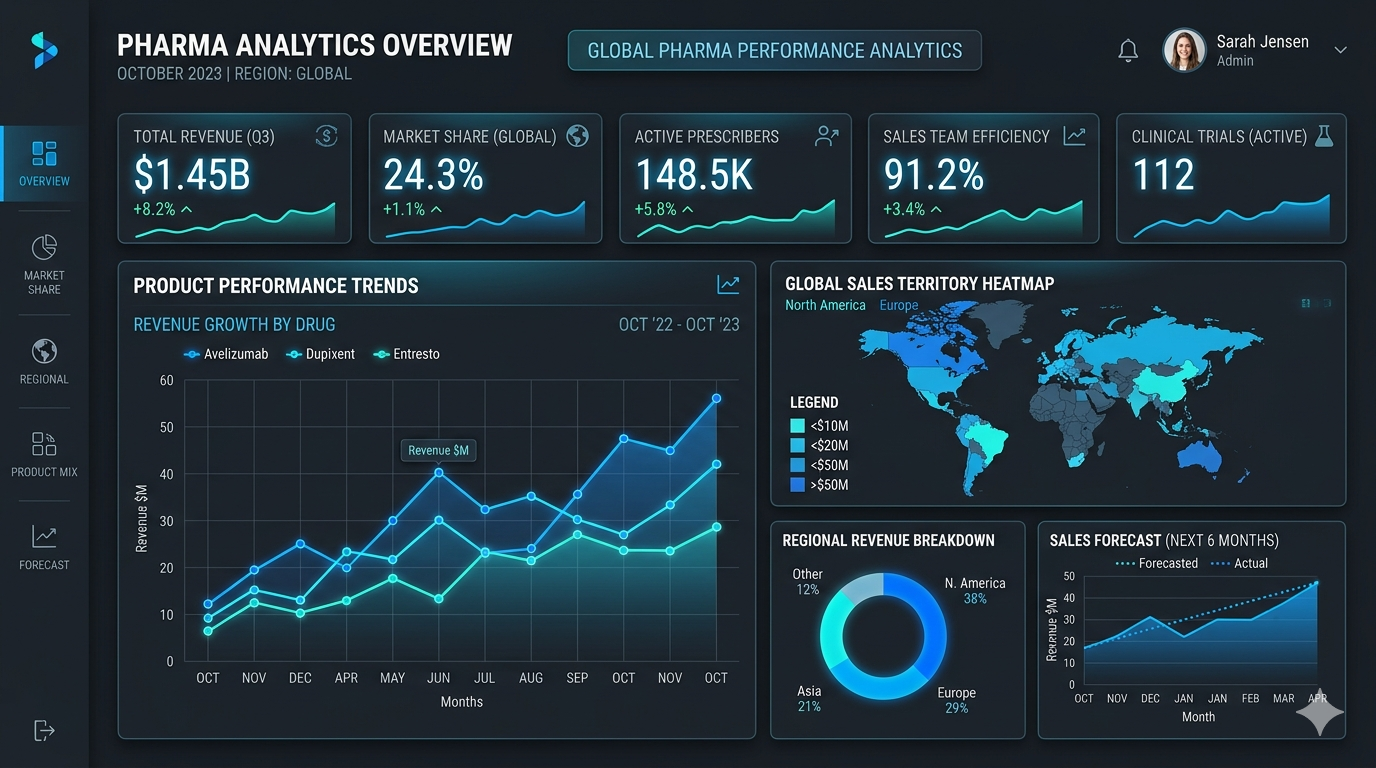
A pharma dashboard is a structured decision-making system that transforms commercial, sales, market access, and forecasting data into actionable insights.
Strong dashboards improve visibility, speed, and execution quality across the organization.
They help teams identify risks, opportunities, and performance gaps early.
Without dashboards, pharma decision-making becomes slow, fragmented, and reactive.
What is a pharma dashboard?
A pharma dashboard is a centralized visualization system used to monitor:
- Commercial performance
- Sales effectiveness
- Market dynamics
- Forecast accuracy
- Stakeholder engagement
- Operational KPIs
Important distinction:
A dashboard is not just reporting.
It should help teams answer:
- What is happening?
- Why is it happening?
- What should we do next?
Weak dashboards show data only.
Strong dashboards drive decisions.
Why are dashboards critical in pharma?
Modern pharma generates enormous amounts of data.
Typical data sources include:
- Sales data
- CRM systems
- Market research
- Access reports
- Forecasting models
- Territory performance
The problem:
Most companies have data but lack visibility.
Result:
- Slow decisions
- Poor prioritization
- Delayed action
- Weak execution
👉 As explained in
🔗 Related Post: Pharma Commercial Excellence: 8 Proven Framework Pillars
Commercial excellence depends on execution visibility and alignment.
What should a pharma dashboard include?
A high-quality dashboard should combine:
- Strategic KPIs
- Operational KPIs
- Forecasting indicators
- Commercial performance metrics
Important principle:
Dashboards must support decision-making, not information overload.
What are the 7 core dashboard areas pharma companies should track?
1. Sales performance dashboard
This is the foundation of most pharma dashboards.
Key metrics include:
- Sales growth
- Market share
- Territory performance
- Product contribution
- Trend analysis
Why it matters:
Sales dashboards help identify:
- Growth patterns
- Underperforming regions
- Commercial opportunities
Important:
Track both:
- Value growth
- Volume growth
2. Forecasting dashboard
Forecasting visibility is essential for commercial planning.
Key forecasting metrics:
- Forecast vs actual
- MAPE deviation
- Scenario comparison
- Growth assumptions
Forecasting should remain dynamic and continuously validated rather than static
Strong forecasting dashboards help teams:
- Adjust quickly
- Detect risk early
- Improve planning quality
👉 As discussed in
🔗 Related Post: How Do You Forecast a Pharma Launch Accurately?
Forecasting is a strategic decision system, not a finance exercise only.
3. KPI and commercial performance dashboard
This dashboard tracks strategic business health.
Important KPIs include:
- Market share
- Switching rate
- Access wins
- Adoption speed
- Rx behavior
Why this matters:
KPIs reveal:
- Whether strategy is working
- Whether execution is aligned
- Where corrective action is needed
👉 As explained in
🔗 Related Post: Pharma KPIs That Matter: 8 Proven Metrics Guide
KPIs should drive action, not passive reporting.
4. Sales force effectiveness dashboard
Execution quality should be measurable visually.
Important metrics include:
- Coverage quality
- Call effectiveness
- Territory performance
- Coaching performance
- Team productivity
Strong dashboards help managers:
- Compare territories
- Detect execution gaps
- Optimize field performance
👉 As discussed in
🔗 Related Post: Pharma Sales Force Effectiveness: 8 Proven Frameworks
Execution quality is one of the strongest competitive advantages.
5. Market access dashboard
Access metrics must be visible across teams.
Key access indicators include:
- Reimbursement approvals
- Institutional listings
- Tender performance
- Access delays
- Pricing impact
Why this matters:
Commercial performance depends heavily on market access conditions.
Research highlights increasing payer and stakeholder influence over commercial success
👉 As explained in
🔗 Related Post: Pharma Market Access Strategy: 7 Proven Success Steps
Access strategy should be monitored continuously.
6. Stakeholder and KOL engagement dashboard
Stakeholder influence should be tracked strategically.
Metrics may include:
- KOL engagement activity
- Scientific event participation
- Advocacy indicators
- Stakeholder coverage
Why this matters:
Stakeholder influence affects:
- Adoption
- Trust
- Competitive positioning
👉 As discussed in
🔗 Related Post: Pharma KOL Engagement: 7 Proven Strategy Principles
Strong engagement systems improve long-term market performance.
7. Organizational and risk dashboard
Commercial risk is not only financial.
Important operational risks include:
- Team turnover
- Leadership gaps
- Territory instability
- Resource imbalance
Strong organizations monitor:
- Stability
- Capability
- Execution continuity
Practical example:
Use the Turnover Index to:
- Predict instability risk
- Detect retention challenges
- Protect launch continuity
What makes a pharma dashboard effective?
Effective dashboards are:
- Clear
- Focused
- Actionable
- Fast to interpret
They prioritize:
- Trends over raw numbers
- Insights over data overload
- Decisions over reporting volume
Weak dashboards usually fail because they are:
- Too complex
- Too crowded
- Not linked to action
How should dashboards support leadership decisions?
Leadership dashboards should answer:
- Where are we winning?
- Where are we losing?
- What requires immediate action?
- What risks are emerging?
Strong dashboards improve:
- Strategic alignment
- Speed of decision-making
- Cross-functional coordination
Most importantly:
They reduce reaction time.
How can tools improve pharma dashboard building?
1. Excel Chart Builder
This is the core operational tool.
Use it to:
- Turn Excel data into visual dashboards
- Build trend analysis
- Compare territories and products
- Detect performance gaps quickly
Why this matters:
Most pharma data already exists in Excel.
The challenge is turning it into insights.
2. Marketing Plan Generator
Use it to:
- Align dashboard metrics with strategy
- Define KPI structures
- Organize commercial priorities
3. Manager Effectiveness Heatmap
Use it to:
- Visualize leadership quality
- Identify coaching needs
- Improve execution visibility
4. Turnover Index
Use it to:
- Track organizational risk
- Protect operational stability
👉 Dashboards become powerful when connected to operational systems.
What are the biggest dashboard mistakes in pharma?
1. Tracking too many metrics
Creates confusion instead of clarity.
2. Reporting without interpretation
Data alone does not create decisions.
3. Delayed updates
Old data creates slow reactions.
4. No strategic alignment
Metrics disconnected from business goals become useless.
5. Ignoring operational risk indicators
Commercial dashboards should include organizational visibility.
Final Insight
A dashboard is not a reporting screen.
It is a commercial intelligence system.
The best pharma organizations use dashboards to:
- Detect signals early
- Adapt faster
- Improve alignment
- Make better decisions consistently
In pharma:
👉 Data is abundant
👉 Decision clarity is rare
The companies that outperform competitors usually:
- Visualize performance better
- React faster
- Connect insights to execution more effectively
Related Guides You Should Review Next
🔗 Related Post: Pharma Commercial Excellence: 8 Proven Framework Pillars
🔗 Related Post: How Do You Forecast a Pharma Launch Accurately?
🔗 Related Post: Pharma KPIs That Matter: 8 Proven Metrics Guide
🔗 Related Post: Pharma Sales Force Effectiveness: 8 Proven Frameworks
🔗 Related Post: Pharma Market Access Strategy: 7 Proven Success Steps
🔗 Related Post: Pharma KOL Engagement: 7 Proven Strategy Principles