
Table of Contents
How Do You Build a Pharma Scenario Planning Framework?
A pharma scenario planning framework is a structured process for evaluating multiple future possibilities and preparing strategic responses before they occur.
Strong scenario planning improves agility, forecasting quality, and decision-making under uncertainty.
Weak planning assumes a single future and often leaves organizations unprepared.
The most resilient pharma companies do not predict the future perfectly. They prepare for multiple futures.
What is scenario planning in pharma?
Scenario planning is the process of exploring alternative future outcomes that may affect commercial performance.
It helps organizations evaluate:
- Market changes
- Competitive actions
- Access risks
- Regulatory shifts
- Launch outcomes
- Growth opportunities
Important reality:
Forecasts are based on assumptions.
Assumptions can change.
Scenario planning prepares organizations for uncertainty.
Why is scenario planning important?
Pharma markets are highly dynamic.
Unexpected events may include:
- Competitor launches
- Generic entry
- Reimbursement changes
- Guideline updates
- Supply challenges
- Economic pressures
Organizations that prepare only for one outcome often:
- React slowly
- Miss opportunities
- Increase risk exposure
Scenario planning improves:
- Strategic flexibility
- Decision quality
- Organizational readiness
Important principle:
Planning is not about certainty.
It is about preparedness.
Why do scenario planning efforts fail?
Many organizations confuse forecasting with scenario planning.
Forecasting asks:
What is most likely?
Scenario planning asks:
What else could happen?
Common mistakes:
- One forecast only
- Ignoring uncertainty
- Unrealistic assumptions
- No action plans
- Failure to update scenarios
Result:
Organizations become vulnerable to surprises.
👉 As discussed in
🔗 Related Post: How Do You Forecast a Pharma Launch Accurately?
Forecasts should be tested against alternative outcomes.
What are the 7 steps of effective pharma scenario planning?
Step 1: Identify critical uncertainties
Start by identifying factors that could significantly influence outcomes.
Examples include:
- Competitor actions
- Market access decisions
- Adoption rates
- Pricing changes
- Regulatory developments
Important question:
What variables matter most?
Strong scenario planning focuses on high-impact uncertainties.
Step 2: Define key assumptions
Every strategic plan contains assumptions.
Examples:
- Market growth rates
- Launch timing
- Access success
- Stakeholder adoption
- Competitive behavior
Forecasting frameworks emphasize that assumptions are the foundation of future projections.
Important:
Document assumptions explicitly.
Because hidden assumptions create hidden risks.
Step 3: Build multiple future scenarios
Avoid relying on a single future.
Common scenario structure:
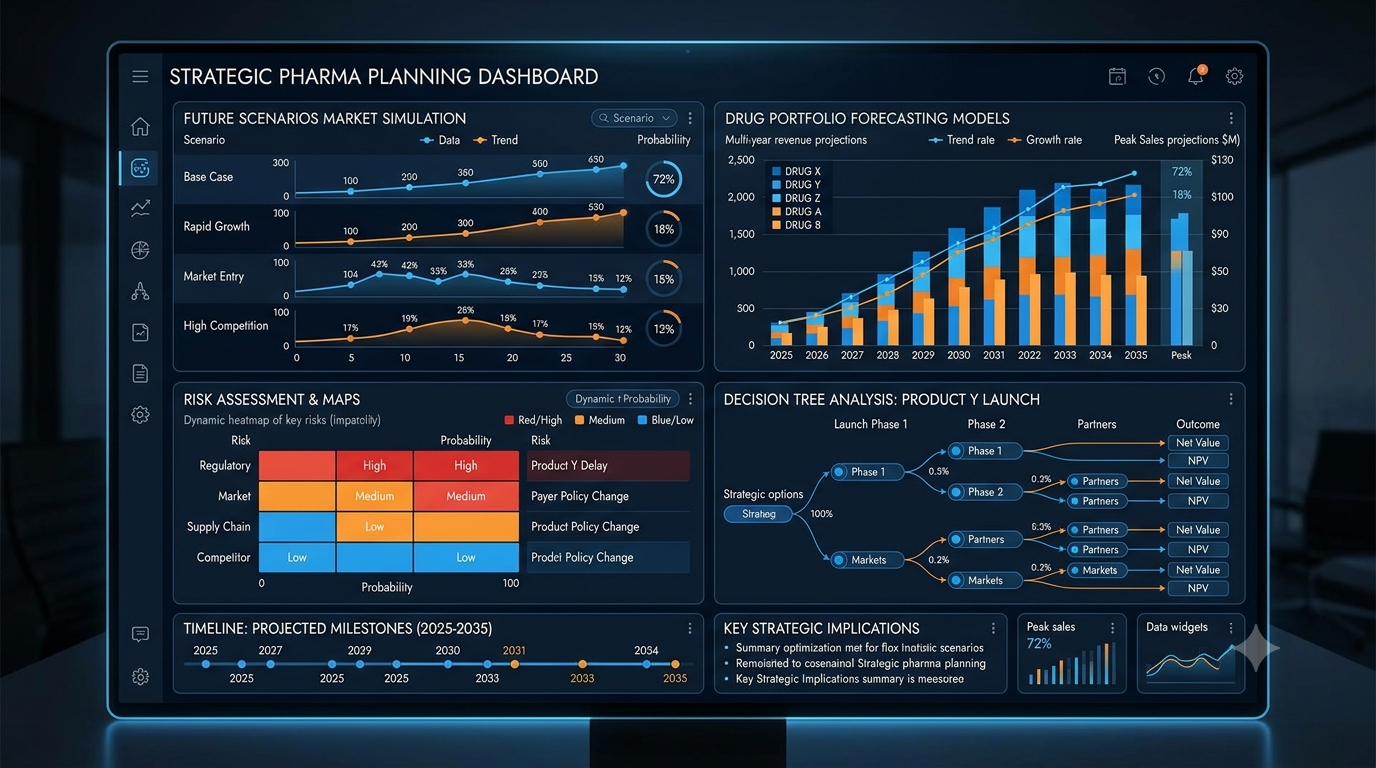
Base Case
Most likely outcome
Best Case
Stronger-than-expected performance
Worst Case
Significant challenges emerge
Why this matters:
Decision quality improves when alternatives are considered.
Step 4: Evaluate commercial impact
Each scenario should be analyzed strategically.
Assess:
- Revenue impact
- Market share impact
- Resource implications
- Stakeholder effects
- Portfolio consequences
Important:
Scenarios should support decisions.
Not simply generate discussion.
Step 5: Develop response strategies
Every scenario should have an action plan.
Example:
If competitor launch occurs:
- Adjust positioning
- Increase stakeholder engagement
- Refine messaging
Example:
If access restrictions increase:
- Strengthen evidence generation
- Expand payer engagement
Important principle:
Prepared responses reduce reaction time.
Step 6: Integrate scenarios into planning
Scenario planning should influence:
- Forecasting
- Resource allocation
- Portfolio decisions
- Launch preparation
Strong organizations connect scenarios directly to decision-making.
👉 As discussed in
🔗 Related Post: Pharma Resource Allocation: 7 Proven Strategy Principles
Resource decisions should reflect uncertainty.
Step 7: Review scenarios continuously
Markets evolve.
Assumptions change.
Competitors act.
Therefore:
Scenario planning should remain dynamic.
Review regularly:
- Forecast assumptions
- Market conditions
- Competitive developments
- Stakeholder behavior
Strong organizations update scenarios proactively.
How does scenario planning improve forecasting?
Forecasting estimates the future.
Scenario planning stress-tests it.
Together they help:
- Improve confidence
- Identify risk
- Evaluate alternatives
Important:
Scenario planning does not replace forecasting.
It strengthens forecasting.
👉 As discussed in
🔗 Related Post: How Do You Forecast a Pharma Launch Accurately?
Forecast quality improves when assumptions are challenged.
How does scenario planning support launch success?
Launches involve uncertainty.
Examples include:
- Adoption variability
- Competitor responses
- Market access challenges
- Stakeholder reactions
Scenario planning improves:
- Launch readiness
- Resource planning
- Risk mitigation
👉 As discussed in
🔗 Related Post: How to Build a Pharma Launch Plan: 7 Proven Steps
Prepared organizations launch more effectively.
How does scenario planning support competitive intelligence?
Competitive intelligence identifies potential threats.
Scenario planning prepares responses.
Together they help organizations:
- Anticipate disruption
- Reduce surprises
- Improve agility
👉 As discussed in
🔗 Related Post: Pharma Competitive Intelligence Framework
Intelligence becomes valuable when translated into action.
How does scenario planning support portfolio management?
Portfolio decisions involve uncertainty.
Scenario planning helps evaluate:
- Growth opportunities
- Resource priorities
- Investment risks
Important:
Different scenarios may require different portfolio strategies.
👉 As discussed in
🔗 Related Post: Pharma Portfolio Management Framework
Portfolio management should remain adaptive.
How can tools support scenario planning?
1. Marketing Plan Generator
Use it to:
- Structure strategic options
- Compare scenarios
- Align planning assumptions
2. Excel Chart Builder
Use it to:
- Visualize scenario outcomes
- Compare forecasts
- Present risk analysis
3. Manager Effectiveness Heatmap
Use it to:
- Assess organizational readiness
- Improve execution capability
4. Turnover Index
Use it to:
- Evaluate organizational risk
- Protect execution continuity
👉 Prepared strategies require prepared organizations.
What are the biggest scenario planning mistakes?
1. Assuming one future
Creates vulnerability.
2. Unrealistic assumptions
Reduces usefulness.
3. No response plans
Creates slow reactions.
4. Static scenarios
Markets evolve.
5. Poor cross-functional involvement
Limits perspective.
Final Insight
Scenario planning is not predicting the future.
It is preparing for uncertainty.
The strongest pharma organizations do not ask:
What will happen?
They ask:
What could happen, and are we ready?
In pharma:
👉 Uncertainty is unavoidable
👉 Unpreparedness is optional
Organizations that use scenario planning effectively usually:
- Make better decisions
- Respond faster
- Reduce risk
- Adapt more successfully
Related Guides You Should Review Next
🔗 Related Post: How Do You Forecast a Pharma Launch Accurately?
🔗 Related Post: Pharma Competitive Intelligence Framework
🔗 Related Post: Pharma Portfolio Management Framework
🔗 Related Post: Pharma Resource Allocation: 7 Proven Strategy Principles
🔗 Related Post: How to Build a Pharma Launch Plan: 7 Proven Steps
🔗 Related Post: Pharma Commercial Excellence: 8 Proven Framework Pillars