

Table of Contents
Pharmaceutical Marketing Plan vs. Product Launch Plan: Why You Need Both
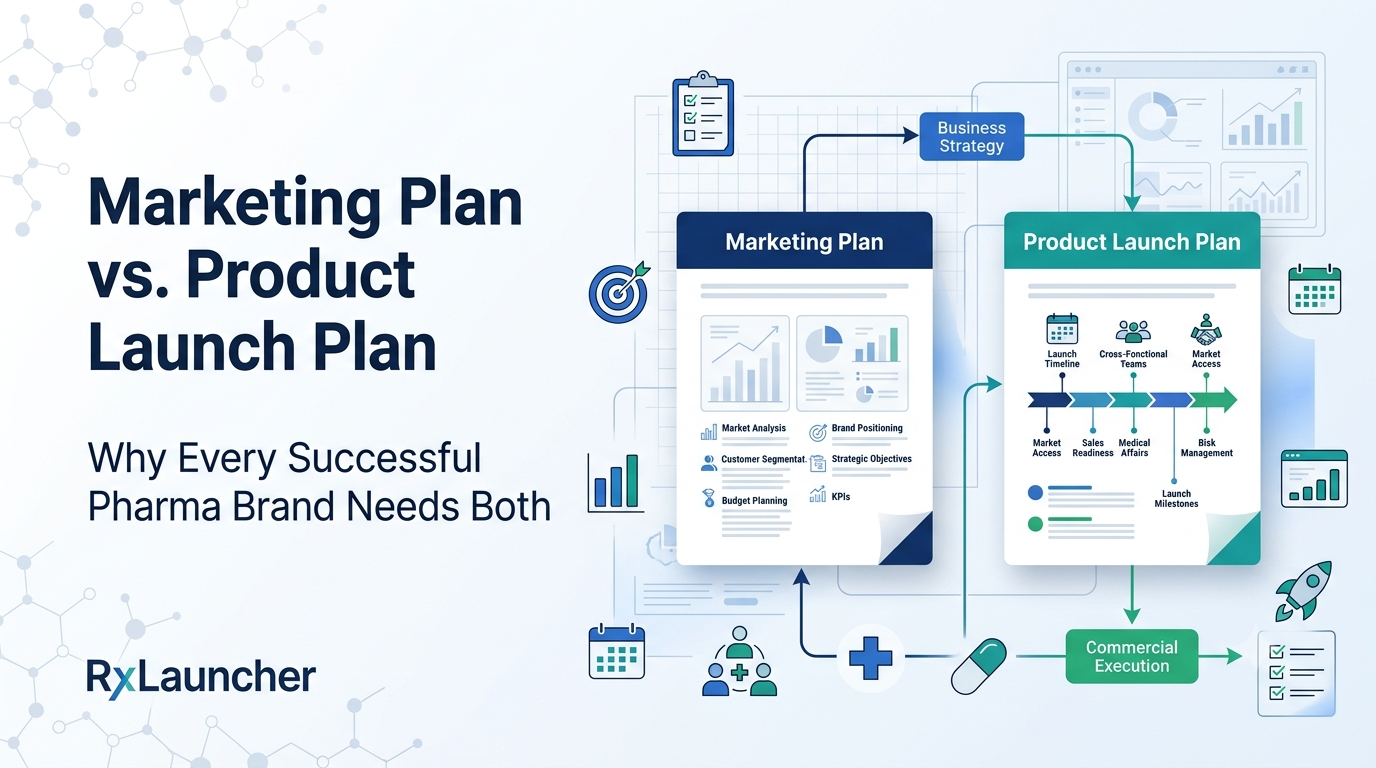
Many pharmaceutical professionals use the terms marketing plan and product launch plan interchangeably. While they are closely connected, they serve different purposes and answer different business questions.
A marketing plan defines how a brand will achieve its commercial objectives over time. A product launch plan focuses on successfully introducing a new product to the market during a critical period.
Organizations that understand the distinction between these two planning documents are better positioned to coordinate cross-functional activities, allocate resources effectively, and execute launches with greater confidence.
Rather than choosing one over the other, successful pharmaceutical companies use both as complementary components of a broader commercial strategy.
What Is a Pharmaceutical Marketing Plan?
A pharmaceutical marketing plan is a strategic document that outlines how a brand will achieve its business objectives within a defined period, typically one year.
It provides direction for commercial activities by defining:
- Business objectives
- Market analysis
- Customer segmentation
- Brand positioning
- Strategic initiatives
- Promotional activities
- Budget allocation
- Key performance indicators (KPIs)
The marketing plan serves as the organization’s long-term commercial roadmap.
Although it may evolve as market conditions change, its purpose is to maintain strategic focus throughout the brand lifecycle.
What Is a Pharmaceutical Product Launch Plan?
A product launch plan is a detailed execution plan designed to coordinate every activity required before, during, and immediately after the introduction of a new pharmaceutical product.
Unlike the marketing plan, the launch plan has a defined start and end point.
It aligns multiple business functions around a common objective: delivering a successful product launch.
Typical launch plan components include:
- Regulatory milestones
- Supply readiness
- Forecasting
- Market access activities
- Stakeholder engagement
- Sales force preparation
- Medical Affairs activities
- Launch communications
- Risk management
- Post-launch monitoring
The launch plan transforms strategic intentions into coordinated operational execution.
The Key Differences
Although both documents support commercial success, they answer different questions.
| Pharmaceutical Marketing Plan | Pharmaceutical Product Launch Plan |
|---|---|
| Focuses on long-term brand growth | Focuses on successful product introduction |
| Typically covers one business year | Covers the pre-launch and early post-launch period |
| Led primarily by Marketing | Cross-functional ownership |
| Defines commercial strategy | Coordinates commercial execution |
| Continues throughout the product lifecycle | Ends after launch stabilization |
Understanding these differences helps teams assign responsibilities more clearly and avoid duplicated effort.
How the Two Plans Work Together
The relationship between a marketing plan and a launch plan is not competitive—it is sequential and complementary.
The marketing plan establishes strategic direction.
The launch plan operationalizes that strategy during one of the most critical periods in a product’s lifecycle.
For example:
- The marketing plan defines target customer segments.
- The launch plan schedules stakeholder engagement activities.
- The marketing plan establishes brand positioning.
- The launch plan ensures every commercial function communicates that positioning consistently.
- The marketing plan defines KPIs.
- The launch plan monitors launch-specific performance indicators.
When both documents are aligned, commercial execution becomes more coordinated and effective.
Marketing Plan First, Launch Plan Second
One common mistake is developing a launch plan before the marketing strategy has been finalized.
Without a clear understanding of customer needs, competitive positioning, market access priorities, and commercial objectives, launch activities often become tactical rather than strategic.
An effective sequence is:
- Business Strategy
- Marketing Strategy
- Marketing Plan
- Product Launch Plan
- Commercial Execution
- Performance Review
- Lifecycle Management
This progression ensures that launch activities support long-term business goals rather than short-term operational milestones.
Common Mistakes
Organizations frequently encounter similar planning challenges.
Treating Both Plans as the Same Document
Although related, each serves a different purpose and should be developed independently while remaining closely aligned.
Marketing Working in Isolation
Launch success requires collaboration across Marketing, Medical Affairs, Market Access, Sales, Regulatory Affairs, Supply Chain, Finance, and Commercial Excellence.
Focusing Only on Launch Activities
A successful launch should contribute to long-term brand growth rather than achieving short-term awareness alone.
Neglecting Market Access
Commercial success depends on patient access as much as promotional effectiveness.
Failing to Update Plans
Both marketing plans and launch plans should be reviewed regularly as market conditions evolve.
Introducing the RxLauncher Marketing Plan & Launch Plan Integration Model™
RxLauncher recommends viewing planning as a connected commercial system rather than isolated documents.
The framework consists of seven stages:
- Business Strategy
- Marketing Strategy
- Marketing Plan
- Product Launch Plan
- Commercial Execution
- Performance Measurement
- Brand Lifecycle Management
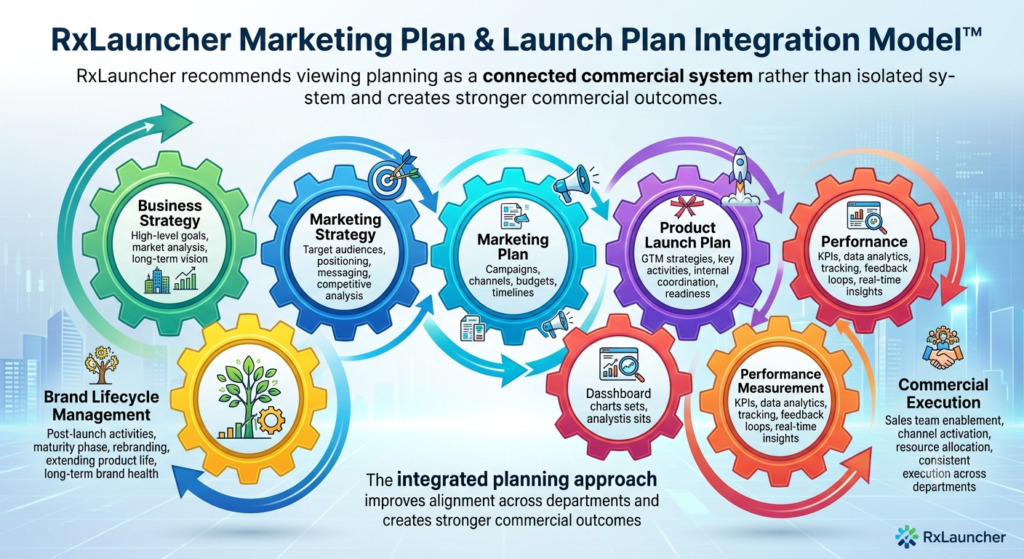
Using one integrated planning approach improves alignment across departments and creates stronger commercial outcomes.
Which Document Should You Build First?
In almost every situation, the answer is the marketing plan.
The marketing plan provides strategic direction by defining objectives, target customers, positioning, and commercial priorities.
The launch plan then translates that strategy into coordinated activities with clear ownership, timelines, and milestones.
When organizations reverse this sequence, launch execution often becomes reactive rather than strategic.
Final Thoughts
A pharmaceutical marketing plan and a product launch plan are not competing documents.
They are complementary planning tools that support different stages of commercial success.
The marketing plan defines where the brand is going.
The launch plan defines how the organization will get there during one of the most important periods in the product lifecycle.
Organizations that align these two planning disciplines are better equipped to execute launches, respond to market changes, and build sustainable commercial growth.
Recommended RxLauncher Tool
Planning becomes easier when every strategic objective, initiative, KPI, and timeline is organized in one structured framework.
Use the Marketing Plan Generator to build a practical pharmaceutical marketing plan that supports product launches, commercial execution, and long-term brand growth.
Continue Learning
Expand your launch planning knowledge with these related resources:
