
Table of Contents
How Do You Build a Pharma Commercial Excellence Framework?
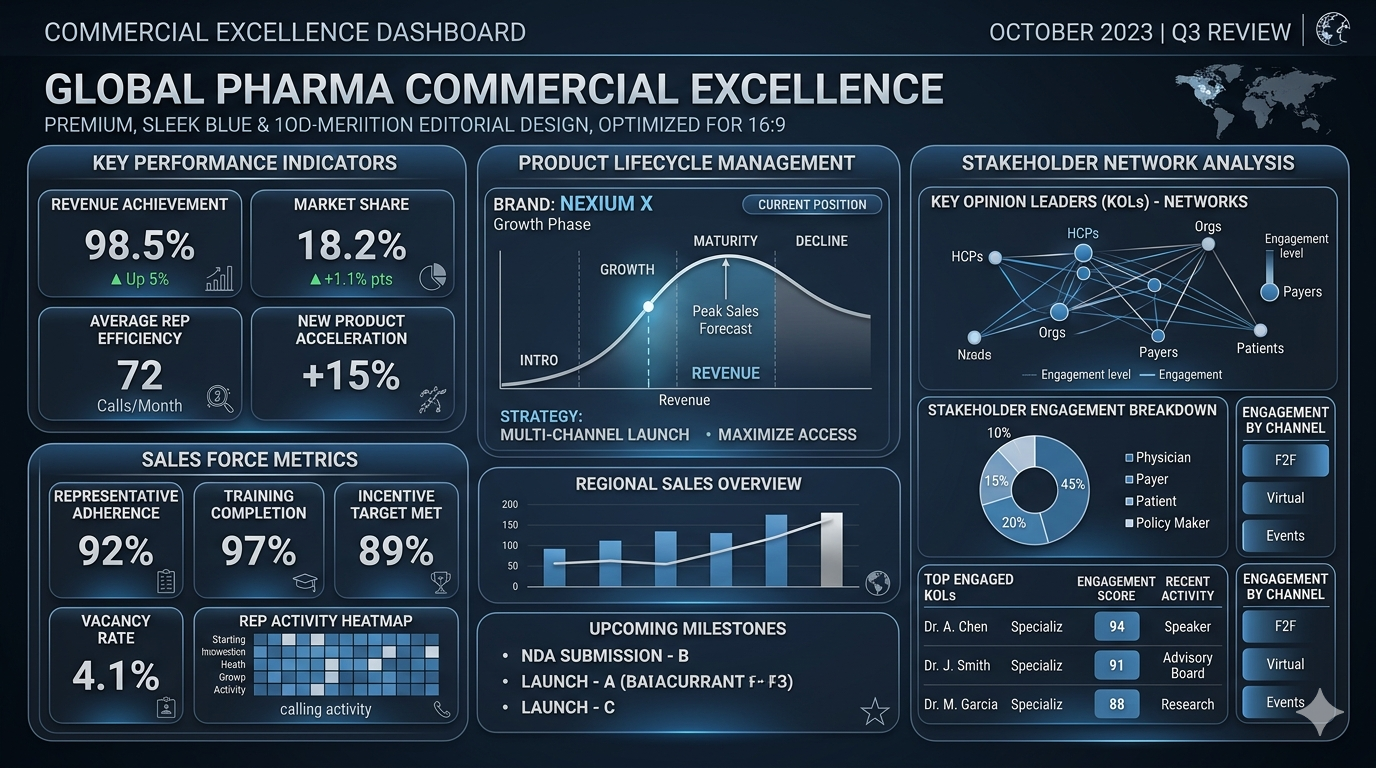
A pharma commercial excellence framework is built by integrating strategy, forecasting, execution, stakeholder engagement, KPI management, and organizational alignment into one measurable operating system.
Commercial excellence is not a department.
It is the ability to execute consistently across the entire product lifecycle.
Without structured commercial excellence, growth becomes unstable, reactive, and difficult to scale.
What is pharma commercial excellence?
Pharma commercial excellence is the structured capability to maximize commercial performance through:
- Better strategy
- Better execution
- Better decision-making
- Better organizational alignment
It combines:
- Launch planning
- Forecasting
- Sales force effectiveness
- KPI management
- Market access
- Stakeholder engagement
- Lifecycle optimization
Important distinction:
Commercial excellence is not:
- More activity
- More reporting
- More meetings
It is:
👉 Higher-quality execution across the entire commercial system
Why has commercial excellence become critical in pharma?
Modern pharma markets are increasingly complex.
Challenges include:
- Competitive saturation
- Access restrictions
- Stakeholder complexity
- Pricing pressure
- Rapid market shifts
Traditional commercial models struggle because they are:
- Fragmented
- Slow
- Activity-driven
- Poorly integrated
Strong commercial excellence creates:
- Faster decisions
- Better alignment
- More efficient growth
- Higher execution consistency
👉 As explained in
🔗 Related Post: Pharma Brand Lifecycle Management: 7 Proven Strategies
Long-term success requires continuous strategic adaptation.
What are the 8 pillars of pharma commercial excellence?
1. Strategic planning excellence
Everything starts with strategy quality.
Strong strategic planning includes:
- Market analysis
- Competitive assessment
- Positioning clarity
- Stakeholder mapping
- Growth driver identification
Weak planning leads to:
- Misaligned execution
- Poor prioritization
- Forecasting errors
👉 As discussed in
🔗 Related Post: How to Build a Pharma Launch Plan: 7 Proven Steps
Commercial performance depends heavily on structured launch planning.
2. Forecasting and business intelligence
Commercial excellence requires evidence-based decision-making.
Strong forecasting includes:
- Scenario modeling
- Market assumptions
- Competitive analysis
- Forecast validation
A forecast is fundamentally a structured belief about future performance based on assumptions and probability
Important principle:
Forecasts must support:
- Investment decisions
- Resource allocation
- Commercial prioritization
👉 As explained in
🔗 Related Post: How Do You Forecast a Pharma Launch Accurately?
Forecasting should remain dynamic and continuously validated.
3. Market access integration
Commercial excellence now depends heavily on access capability.
Strong organizations integrate:
- Pricing strategy
- Reimbursement planning
- Payer engagement
- Institutional access
Important reality:
Commercial success is impossible without patient access.
Research highlights that payer and stakeholder influence increasingly shape launch outcomes and long-term adoption
👉 As discussed in
🔗 Related Post: Pharma Market Access Strategy: 7 Proven Success Steps
Access strategy is now a core growth driver.
4. Sales force effectiveness
Execution quality determines market impact.
High-performing field systems include:
- Smart targeting
- Coaching systems
- KPI alignment
- Execution consistency
Common weakness:
Tracking activity without measuring impact.
Commercial excellence requires:
- Quality-focused execution
- Territory optimization
- Real-time visibility
👉 As explained in
🔗 Related Post: Pharma Sales Force Effectiveness: 8 Proven Frameworks
Field force effectiveness is one of the strongest competitive advantages in pharma.
5. Stakeholder and KOL engagement
Modern pharma requires influence management.
Important stakeholders include:
- Physicians
- KOLs
- Payers
- Institutions
- Guideline committees
Strong stakeholder engagement improves:
- Adoption
- Trust
- Access
- Competitive positioning
Important principle:
Scientific credibility drives sustainable influence.
👉 As discussed in
🔗 Related Post: Pharma KOL Engagement: 7 Proven Strategy Principles
Long-term stakeholder relationships create strategic advantage.
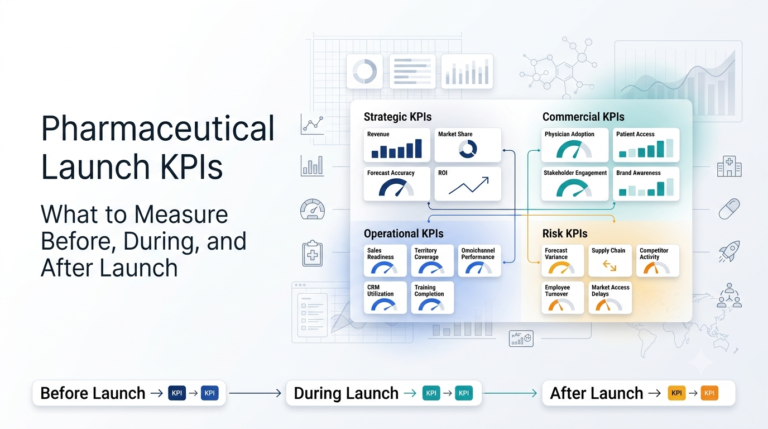
6. KPI and performance management
Commercial excellence requires measurable execution.
Strong KPI systems track:
- Market share
- Growth rate
- Switching rate
- Forecast accuracy
- Access wins
- Execution quality
Weak KPI systems create:
- Slow decisions
- Poor prioritization
- Operational blindness
👉 As explained in
🔗 Related Post: Pharma KPIs That Matter: 8 Proven Metrics Guide
KPIs should function as decision tools, not reporting dashboards only.
7. Organizational alignment and leadership
Commercial systems fail when teams work in silos.
Strong alignment includes:
- Shared objectives
- Cross-functional collaboration
- Consistent communication
- Leadership accountability
Common misalignment areas:
- Marketing vs sales
- Medical vs commercial
- Access vs field execution
Result of poor alignment:
- Mixed messaging
- Slow execution
- Reduced effectiveness
Research increasingly emphasizes the need for integrated commercial and stakeholder planning across product lifecycle stages
8. Lifecycle and growth optimization
Commercial excellence extends beyond launch.
Mature organizations continuously optimize:
- Brand positioning
- Indication expansion
- Resource allocation
- Competitive defense
- Portfolio performance
Important mindset:
Commercial excellence is continuous improvement, not static execution.
👉 As discussed in
🔗 Related Post: Pharma Indication Expansion: 6 Proven Growth Strategies
Growth opportunities must be managed proactively across lifecycle stages.
How do tools support commercial excellence?
Commercial excellence requires operational systems, not manual coordination.
1. Marketing Plan Generator
Use it to:
- Structure strategic planning
- Align execution
- Define commercial priorities
2. Excel Chart Builder
Use it to:
- Visualize KPIs
- Track trends
- Improve decision speed
3. Manager Effectiveness Heatmap
Use it to:
- Assess leadership quality
- Detect execution gaps
- Improve coaching effectiveness
4. Turnover Index
Use it to:
- Predict instability risk
- Protect execution continuity
- Improve organizational resilience
👉 Commercial excellence depends heavily on execution consistency and visibility.
What are the biggest mistakes in commercial excellence programs?
1. Treating excellence as reporting only
Creates bureaucracy without improvement.
2. Focusing only on sales metrics
Ignores strategic performance drivers.
3. Weak cross-functional alignment
Creates fragmented execution.
4. Delayed decision-making
Reduces agility.
5. Ignoring leadership quality
Weak managers weaken entire systems.
What does a high-performing commercial organization look like?
Strong organizations are:
- Strategically aligned
- KPI-driven
- Cross-functional
- Adaptive
- Evidence-based
They operate using systems, not isolated departments.
Most importantly:
They continuously improve execution quality.
Final Insight
Commercial excellence is not a project.
It is an operating philosophy.
The strongest pharma companies do not win because they:
- Spend the most
- Promote the loudest
They win because:
- Their systems are stronger
- Their execution is more disciplined
- Their decisions are faster and clearer
In pharma:
👉 Sustainable growth comes from operational excellence, not isolated success
The companies that dominate long term usually:
- Integrate strategy and execution early
- Measure continuously
- Adapt faster than competitors
Related Guides You Should Review Next
🔗 Related Post: How to Build a Pharma Launch Plan: 7 Proven Steps
🔗 Related Post: Pharma Brand Lifecycle Management: 7 Proven Strategies
🔗 Related Post: How Do You Forecast a Pharma Launch Accurately?
🔗 Related Post: Pharma Sales Force Effectiveness: 8 Proven Frameworks
🔗 Related Post: Pharma Market Access Strategy: 7 Proven Success Steps
🔗 Related Post: Pharma KOL Engagement: 7 Proven Strategy Principles
🔗 Related Post: Pharma KPIs That Matter: 8 Proven Metrics Guide