

Table of Contents
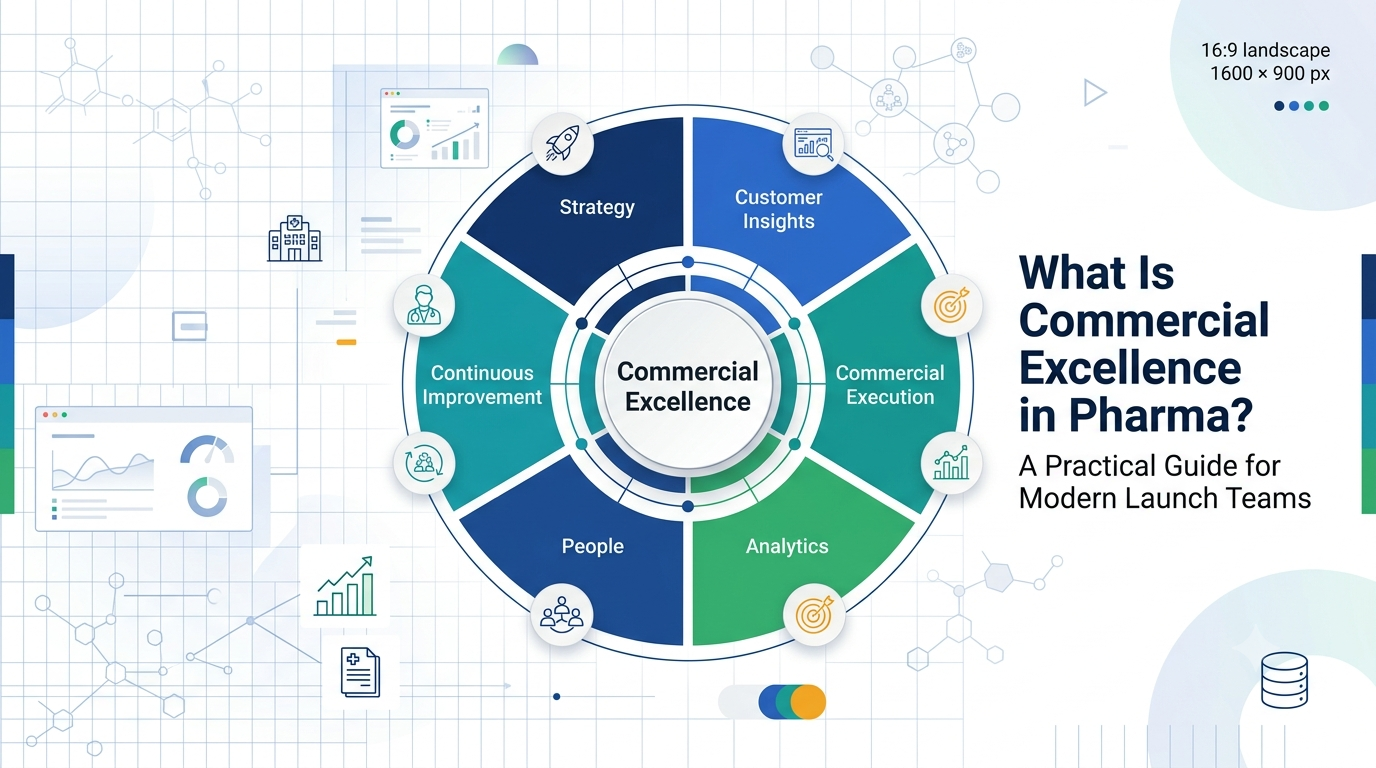
What Is Commercial Excellence in Pharma? A Practical Guide for Modern Launch Teams
Introduction
The pharmaceutical industry has never been more competitive. Companies are launching innovative therapies into increasingly complex healthcare systems while facing greater pricing pressure, tighter regulations, evolving customer expectations, and rapid digital transformation.
Success today depends on much more than developing an effective product.
Organizations must consistently translate scientific innovation into commercial success.
This is where Commercial Excellence becomes essential.
Many pharmaceutical companies associate Commercial Excellence with dashboards, sales force optimization, or process improvement. While these activities are important, they represent only part of a much broader discipline.
Commercial Excellence is the operating model that aligns strategy, people, processes, technology, and performance management to deliver sustainable business growth.
Rather than asking, “How can we sell more?”, Commercial Excellence asks a more strategic question:
“How can we consistently make better commercial decisions and execute them more effectively?”
Organizations that embrace Commercial Excellence build stronger launches, improve customer engagement, optimize resource allocation, strengthen cross-functional collaboration, and respond more effectively to market changes.
This guide explains what Commercial Excellence means in pharmaceutical organizations, why it matters, and how leaders can build a structured framework that continuously improves commercial performance.
What Is Commercial Excellence in Pharma?
Commercial Excellence is a structured approach to maximizing commercial performance by improving how an organization plans, executes, measures, and continuously optimizes its business activities.
It is not a department.
It is not a software platform.
It is not a one-time transformation project.
Commercial Excellence is an organizational capability that ensures every commercial decision supports the company’s long-term strategy while creating value for healthcare professionals, patients, healthcare systems, and shareholders.
Within pharmaceutical organizations, Commercial Excellence integrates multiple business functions, including:
- Marketing
- Sales
- Medical Affairs
- Market Access
- Commercial Excellence
- Business Intelligence
- Finance
- Supply Chain
- Regulatory Affairs
Instead of allowing these functions to operate independently, Commercial Excellence creates a common operating model where everyone works toward shared commercial objectives using aligned processes, standardized performance measures, and data-driven decision-making.
In simple terms:
Commercial Excellence is the discipline of turning commercial strategy into consistently excellent execution.
Why Commercial Excellence Matters in Pharma
Commercial success in today’s pharmaceutical market requires far more than a strong product portfolio.
Organizations operate within an environment shaped by increasing complexity.
Healthcare professionals expect more personalized engagement.
Patients have greater access to medical information than ever before.
Payers demand stronger evidence of value.
Competitors launch products faster and invest heavily in digital capabilities.
These changes have significantly increased the importance of Commercial Excellence.
Increasing Market Competition
Therapeutic areas continue to become more crowded.
Launching a new product no longer guarantees rapid market adoption.
Organizations must differentiate their brands through scientific value, customer experience, stakeholder engagement, and execution quality.
Commercial Excellence provides the discipline needed to compete effectively in saturated markets.
More Complex Stakeholder Networks
Commercial success depends on engaging multiple stakeholders rather than focusing solely on prescribers.
Launch teams increasingly work with:
- Physicians
- Pharmacists
- Nurses
- Patients
- Hospital administrators
- Procurement teams
- Payers
- Government authorities
- Key Opinion Leaders
Each stakeholder has different expectations and decision-making criteria.
Commercial Excellence ensures that engagement strategies remain coordinated across the entire healthcare ecosystem.
Data-Driven Decision Making
Pharmaceutical organizations generate enormous amounts of commercial data.
Sales reports.
CRM data.
Market research.
Forecasts.
Campaign analytics.
Medical insights.
The challenge is no longer collecting data.
The challenge is transforming information into actionable decisions.
Commercial Excellence establishes governance, dashboards, and review processes that help leadership focus on the metrics that truly influence business outcomes.
Better Resource Allocation
Commercial resources are always limited.
Organizations must decide:
- Which brands deserve additional investment?
- Which customer segments should receive greater attention?
- Which channels generate the strongest return?
- Which markets offer the highest growth potential?
Commercial Excellence supports these decisions through structured planning and objective performance measurement.
Sustainable Competitive Advantage
Many commercial improvements produce short-term gains.
Commercial Excellence focuses on building capabilities that create lasting competitive advantage.
Examples include:
- Strong forecasting capabilities
- High-performing launch teams
- Consistent customer engagement
- Effective governance
- Cross-functional collaboration
- Organizational learning
These capabilities improve every future launch rather than benefiting only a single product.
The Evolution of Commercial Excellence
Commercial Excellence has evolved significantly over the past two decades.
Understanding this evolution helps explain why modern Commercial Excellence extends far beyond sales optimization.
Phase 1: Sales Excellence
The initial focus centered on improving sales force productivity.
Organizations concentrated on:
- Sales targets
- Call frequency
- Territory alignment
- Incentive schemes
- Sales reporting
Success was primarily measured through sales volume.
Phase 2: Marketing Excellence
Companies began integrating marketing planning with sales execution.
New capabilities emerged, including:
- Brand planning
- Customer segmentation
- Positioning
- Promotional effectiveness
- Campaign measurement
Commercial performance became a shared responsibility between Marketing and Sales.
Phase 3: Cross-Functional Excellence
Healthcare systems became more complex.
Organizations expanded Commercial Excellence to include:
- Medical Affairs
- Market Access
- Business Intelligence
- Digital Engagement
- Customer Experience
Decision-making became increasingly collaborative.
Phase 4: Enterprise Commercial Excellence
Today’s leading pharmaceutical organizations view Commercial Excellence as an enterprise-wide capability.
It integrates:
- Strategy
- Launch planning
- Commercial execution
- Customer engagement
- Performance analytics
- Leadership
- Governance
- Continuous improvement
Rather than optimizing individual departments, Enterprise Commercial Excellence optimizes the entire commercialization system.
The RxLauncher Pharmaceutical Commercial Excellence Framework™
Commercial Excellence is often discussed as a broad concept, making it difficult to translate into practical action.
To simplify implementation, RxLauncher organizes Commercial Excellence into six interconnected pillars that together form a comprehensive operating model for pharmaceutical organizations.
These pillars should not be viewed as separate initiatives.
Each pillar strengthens the others, creating a continuous cycle of planning, execution, measurement, learning, and improvement.
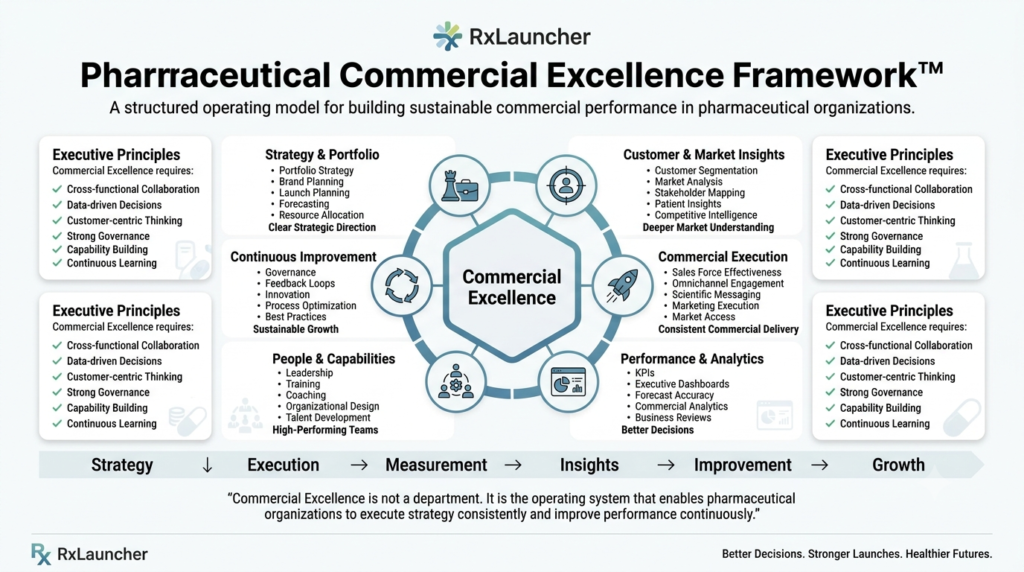
1. Strategy & Portfolio
Everything begins with a clear strategic direction.
Organizations must decide where to compete, which products to prioritize, how to allocate resources, and what commercial objectives they aim to achieve.
This pillar includes:
- Portfolio strategy
- Brand planning
- Product launch planning
- Forecasting
- Resource allocation
- Competitive positioning
Without a clear strategy, even excellent execution produces inconsistent results.
2. Customer & Market Insights
Successful commercialization depends on understanding the market before attempting to influence it.
Organizations should continuously develop insights into healthcare professionals, patients, healthcare systems, competitors, and emerging trends.
Core capabilities include:
- Customer segmentation
- Stakeholder mapping
- Market research
- Competitive intelligence
- Patient journey analysis
- Healthcare ecosystem analysis
Better insights lead to better commercial decisions.
3. Commercial Execution
Strategy only creates value when it is executed consistently across every customer touchpoint.
Commercial Execution transforms plans into measurable market actions.
Key components include:
- Sales Force Effectiveness
- Omnichannel engagement
- Scientific messaging
- Marketing campaigns
- Market Access execution
- Customer engagement planning
Organizations with strong execution capabilities create more consistent customer experiences and improve launch outcomes.
4. Performance & Analytics
Commercial Excellence requires objective measurement.
Organizations should establish meaningful KPIs, executive dashboards, forecasting processes, and structured business reviews that support timely decision-making.
Rather than measuring activity alone, Performance & Analytics should answer three fundamental questions:
- Are we achieving our strategic objectives?
- Where are performance gaps emerging?
- What actions should leadership take next?
This pillar transforms data into actionable insights.
5. People & Capabilities
Technology, dashboards, and well-designed processes cannot deliver Commercial Excellence on their own.
People remain the most important driver of commercial performance.
Organizations with similar products, budgets, and market opportunities often achieve very different results because their people possess different capabilities, leadership styles, and organizational cultures.
The People & Capabilities pillar focuses on developing the skills, behaviors, and leadership needed to execute commercial strategies consistently.
Core capabilities include:
- Leadership development
- Commercial capability building
- Sales coaching
- Marketing excellence
- Cross-functional collaboration
- Customer-centric thinking
- Digital skills
- Change management
High-performing pharmaceutical organizations view capability development as a continuous investment rather than a periodic training initiative.
They create environments where learning, coaching, and knowledge sharing become part of everyday commercial operations.
Ultimately, Commercial Excellence depends on people making better decisions every day.
6. Continuous Improvement
Markets evolve continuously.
Customer expectations change.
Competitors introduce new products.
Healthcare regulations are updated.
Digital technologies reshape customer engagement.
As a result, Commercial Excellence cannot remain static.
Organizations must continuously evaluate performance, identify improvement opportunities, and adapt their commercial operating model.
Continuous Improvement includes:
- Performance reviews
- Governance meetings
- Best-practice sharing
- Process optimization
- Innovation initiatives
- Feedback loops
- Capability assessments
Rather than treating Commercial Excellence as a destination, leading organizations view it as an ongoing journey of learning and refinement.
The organizations that improve fastest often outperform those with the largest budgets.
How the Six Pillars Work Together
Each pillar within the RxLauncher Pharmaceutical Commercial Excellence Framework™ supports the others.
A strong strategy without effective execution produces limited results.
Excellent execution without meaningful performance measurement creates uncertainty.
Powerful analytics without capable people rarely lead to better decisions.
Continuous improvement cannot occur without reliable performance data.
Together, the six pillars create a connected operating model:
Strategy defines where the organization wants to go.
Customer Insights explain where opportunities exist.
Commercial Execution transforms plans into market actions.
Performance & Analytics measure outcomes objectively.
People & Capabilities enable consistent execution.
Continuous Improvement ensures the organization becomes stronger after every commercial initiative.
This integrated approach is what separates mature Commercial Excellence organizations from those relying on isolated improvement projects.
The Building Blocks of Commercial Excellence
Although every pharmaceutical company has unique priorities, successful Commercial Excellence programs consistently develop the same core capabilities.
These building blocks provide the operational foundation required for long-term commercial success.
Strategic Planning
Commercial Excellence begins with clear strategic choices.
Organizations should define:
- Business objectives
- Portfolio priorities
- Growth opportunities
- Competitive positioning
- Resource allocation
Without strategic clarity, commercial teams often work hard without moving in the same direction.
Product Launch Excellence
Every launch represents a major commercial investment.
Organizations should establish structured launch processes that coordinate Marketing, Medical Affairs, Market Access, Supply Chain, Finance, and Sales around common objectives.
Successful launches are built through disciplined planning rather than last-minute execution.
Brand Management
Commercial Excellence requires brands to evolve continuously throughout their lifecycle.
Effective brand management includes:
- Positioning
- Messaging
- Differentiation
- Lifecycle planning
- Competitive monitoring
- Customer engagement
Strong brands remain relevant because they continuously adapt to changing market conditions.
Sales Force Effectiveness
Sales teams remain one of the most visible components of pharmaceutical commercialization.
However, Commercial Excellence measures far more than sales volume.
Organizations should continuously optimize:
- Territory design
- Call planning
- Coaching
- Customer targeting
- CRM utilization
- Sales capability
- Productivity
The objective is to improve customer value rather than simply increase sales activity.
Omnichannel Engagement
Healthcare professionals now interact with pharmaceutical companies across multiple channels.
Commercial Excellence ensures these interactions are coordinated and consistent.
Effective omnichannel strategies combine:
- Face-to-face engagement
- Webinars
- Medical education
- Digital content
- Remote detailing
- Customer portals
Customers should experience one integrated journey regardless of the communication channel.
Market Access
Commercial success depends on more than physician adoption.
Products must also achieve timely reimbursement and broad patient accessibility.
Commercial Excellence therefore integrates Market Access into commercial planning rather than treating it as a separate function.
Forecasting and Resource Allocation
Commercial decisions become stronger when supported by reliable forecasts.
Organizations should continuously refine:
- Demand forecasting
- Revenue forecasting
- Resource allocation
- Budget planning
- Scenario analysis
Accurate forecasting improves decision-making before problems become visible in financial results.
Performance Measurement
Commercial Excellence cannot improve what it does not measure.
Organizations should establish balanced KPIs covering:
- Strategic performance
- Commercial outcomes
- Operational execution
- Organizational capabilities
- Risk indicators
Measurement should support action—not simply reporting.
Common Barriers to Commercial Excellence
Despite significant investment, many Commercial Excellence initiatives fail to achieve lasting impact.
The challenge is rarely a lack of ambition.
More often, organizations struggle to align people, processes, and governance.
Understanding these barriers helps leadership build stronger transformation programs.
Siloed Departments
Marketing, Sales, Medical Affairs, Market Access, Finance, and Commercial Excellence often operate independently.
Each function may pursue different objectives, maintain separate dashboards, and define success differently.
These silos create inconsistent customer experiences and reduce organizational agility.
Cross-functional planning and shared KPIs help create alignment.
Too Many KPIs
Many organizations collect hundreds of metrics without identifying which indicators truly support decision-making.
When leadership reviews too many KPIs, important insights become difficult to recognize.
Commercial Excellence emphasizes selecting a focused set of meaningful performance indicators rather than measuring everything.
Poor Data Quality
Dashboards are only as reliable as the data they contain.
Incomplete CRM records, inconsistent reporting standards, duplicate customer information, and delayed updates reduce confidence in commercial decisions.
Investing in data governance is often more valuable than investing in additional reporting tools.
Weak Governance
Commercial Excellence requires structured governance.
Without regular business reviews, defined decision-making processes, and clear accountability, improvement initiatives often lose momentum.
Governance transforms measurement into action.
Technology Without Process Alignment
Organizations sometimes invest heavily in CRM systems, analytics platforms, or AI tools while overlooking the commercial processes that determine how those technologies are used.
Technology should support well-designed commercial processes—not replace them.
Limited Capability Development
Commercial Excellence cannot be sustained without continuous investment in people.
Organizations that neglect coaching, leadership development, and capability building often experience declining performance despite having strong strategies.
People remain the organization’s greatest competitive advantage.
Measuring Commercial Excellence
One of the most common misconceptions is that Commercial Excellence can be measured through sales performance alone.
Revenue is important, but it represents only one dimension of commercial success.
Leading pharmaceutical organizations evaluate Commercial Excellence using a balanced performance framework.
This includes four complementary categories:
Strategic Indicators
Measure long-term business outcomes.
Examples include:
- Revenue growth
- Market share
- Forecast accuracy
- Return on investment
Commercial Indicators
Measure customer adoption and market response.
Examples include:
- Physician adoption
- Patient access
- Stakeholder engagement
- Brand awareness
Operational Indicators
Measure execution quality.
Examples include:
- Sales readiness
- Training completion
- CRM utilization
- Omnichannel execution
- Promotional material readiness
Risk Indicators
Monitor factors that could affect future performance.
Examples include:
- Competitor activity
- Supply chain disruptions
- Forecast variance
- Regulatory changes
- Employee turnover
This balanced measurement approach allows leadership teams to identify challenges before they affect financial performance.
Rather than reacting to lagging indicators, organizations can proactively improve commercial execution.
Building a Culture of Commercial Excellence
Frameworks, processes, and dashboards provide structure.
Culture determines whether those structures create meaningful results.
Organizations with strong Commercial Excellence cultures share several characteristics.
They encourage collaboration rather than functional competition.
They make decisions using evidence rather than assumptions.
They view mistakes as opportunities to improve rather than reasons to assign blame.
Leadership plays a central role in shaping this culture.
Commercial leaders should:
- Set clear expectations.
- Promote cross-functional collaboration.
- Celebrate continuous improvement.
- Encourage learning and experimentation.
- Reward customer-centric behaviors.
- Hold teams accountable for measurable outcomes.
When Commercial Excellence becomes part of organizational culture rather than a standalone initiative, improvements become sustainable.
High-performing organizations no longer ask whether Commercial Excellence is a priority.
Instead, it becomes the standard by which every commercial decision is evaluated.
Leadership Perspective
Commercial Excellence is often misunderstood as a collection of tools, dashboards, or optimization projects.
In reality, it is the operating system that enables pharmaceutical organizations to execute strategy consistently across every commercial function.
The organizations that achieve lasting success are not necessarily those with the largest sales teams or marketing budgets.
They are the organizations that make better decisions, execute with greater consistency, learn faster from market feedback, and continuously strengthen their commercial capabilities.
Commercial Excellence is therefore not a destination.
It is an organizational discipline that evolves alongside the market, helping companies launch products more effectively, respond to competitive challenges with confidence, and create sustainable value for healthcare professionals, patients, and healthcare systems.
Action Checklist
Use the following checklist to evaluate your organization’s Commercial Excellence journey.
| Action | Primary Owner | Expected Deliverable |
|---|---|---|
| Define a Commercial Excellence vision | Executive Leadership | Commercial Excellence Strategy |
| Align cross-functional commercial objectives | Leadership Team | Shared Commercial Goals |
| Establish standardized KPIs | Commercial Excellence | KPI Framework |
| Build executive performance dashboards | Business Intelligence | Executive Dashboard |
| Invest in capability development | HR & Functional Leaders | Commercial Capability Plan |
| Implement governance and review meetings | PMO / Leadership | Governance Calendar |
| Create continuous improvement processes | Commercial Excellence | Improvement Roadmap |
Recommended RxLauncher Tool
Marketing Plan Generator
Commercial Excellence starts with structured planning.
The RxLauncher Marketing Plan Generator helps pharmaceutical teams translate strategic objectives into practical marketing plans by guiding users through market analysis, customer segmentation, brand strategy, tactical planning, budgeting, and performance measurement.
Whether you are preparing for a product launch or strengthening an established brand, a structured planning process creates the foundation for more consistent commercial execution.
Final Thoughts
Commercial Excellence is not achieved through a single initiative, department, or technology platform.
It is built by aligning strategy, customer understanding, commercial execution, performance measurement, people, and continuous improvement into one integrated operating model.
Organizations that embrace this approach move beyond reactive decision-making. They develop the capability to anticipate market changes, optimize execution, and continuously improve commercial performance throughout the product lifecycle.
As pharmaceutical markets become increasingly competitive and data-driven, Commercial Excellence will continue to distinguish organizations that consistently deliver value from those that rely on isolated successes.
Building Commercial Excellence is therefore not simply about improving today’s performance—it is about creating the organizational capabilities that will support every future launch, brand, and commercial opportunity.
Continue Learning
Strengthen your understanding of pharmaceutical commercialization with these related guides from the RxLauncher Knowledge Hub:
- The Complete Guide to Pharmaceutical Product Launch – Learn the end-to-end framework for planning and executing successful pharmaceutical launches.
- Pharmaceutical Launch KPIs: What to Measure Before, During, and After Launch – Discover the metrics that help leaders monitor launch performance and make timely decisions.
- Marketing Plan vs. Product Launch Plan: Why You Need Both – Understand how strategic marketing planning and launch execution complement each other.
- How to Forecast a Pharma Launch Accurately – Improve commercial planning with practical forecasting methods and scenario analysis.
- Pharma Sales Force Effectiveness Framework – Optimize sales execution through territory planning, coaching, and performance management.
- Market Access Strategy for Pharma Brands – Explore how reimbursement, pricing, and access planning influence commercial success.
- Omnichannel Strategy in Pharma Marketing – Build coordinated customer engagement across digital and face-to-face channels.
- Customer Segmentation Strategy in Pharma – Develop targeted engagement strategies based on customer needs and behaviors.
- Scientific Messaging Framework in Pharma – Create clear, evidence-based communication that supports brand differentiation and customer trust.
- How to Build a Pharma Dashboard for Decision-Making – Design executive dashboards that transform commercial data into actionable insights.
These resources work together to provide a practical roadmap for building stronger commercial capabilities, improving launch execution, and achieving sustainable pharmaceutical growth.
