
Table of Contents
Pharmaceutical Launch KPIs: What to Measure Before, During, and After Launch
Launching a pharmaceutical product is one of the most significant investments a company can make. Months—or even years—of market research, clinical development, forecasting, regulatory preparation, and commercial planning culminate in a single objective: bringing a new therapy successfully to market.
Yet many launch teams struggle to answer a simple question after launch begins:
Are we actually succeeding?
Sales figures alone rarely provide the complete picture.
Strong early sales may be driven by inventory loading rather than physician adoption. High promotional activity may create the illusion of progress without generating meaningful customer engagement. Conversely, a slower-than-expected start may hide encouraging trends in stakeholder support or market access that indicate long-term success.
This is why pharmaceutical launch teams rely on Key Performance Indicators (KPIs).
The right KPIs provide early warning signals, validate commercial assumptions, identify execution gaps, and help leadership make faster, evidence-based decisions.
However, measuring everything is just as dangerous as measuring nothing.
Successful organizations focus on the indicators that matter most at each stage of the launch journey.
In this guide, you’ll learn which pharmaceutical launch KPIs should be monitored before launch, during launch, and after launch, how to organize them into an executive dashboard, and how to avoid the most common measurement mistakes.
Why Measuring Launch Performance Is Challenging
Unlike many industries, pharmaceutical launches are influenced by multiple factors that extend beyond commercial activity.
A product may have strong clinical evidence but experience delayed reimbursement.
Sales representatives may execute effectively while physicians wait for updated treatment guidelines.
Marketing campaigns may generate awareness, but supply constraints can limit product availability.
For this reason, launch performance should never be measured using a single metric.
Commercial excellence requires leadership to evaluate performance from multiple perspectives, including:
- Commercial outcomes
- Market access progress
- Customer adoption
- Operational readiness
- Organizational capability
- Emerging commercial risks
A balanced KPI framework enables leadership to understand not only what is happening, but also why it is happening.
The RxLauncher Pharmaceutical Launch KPI Framework™
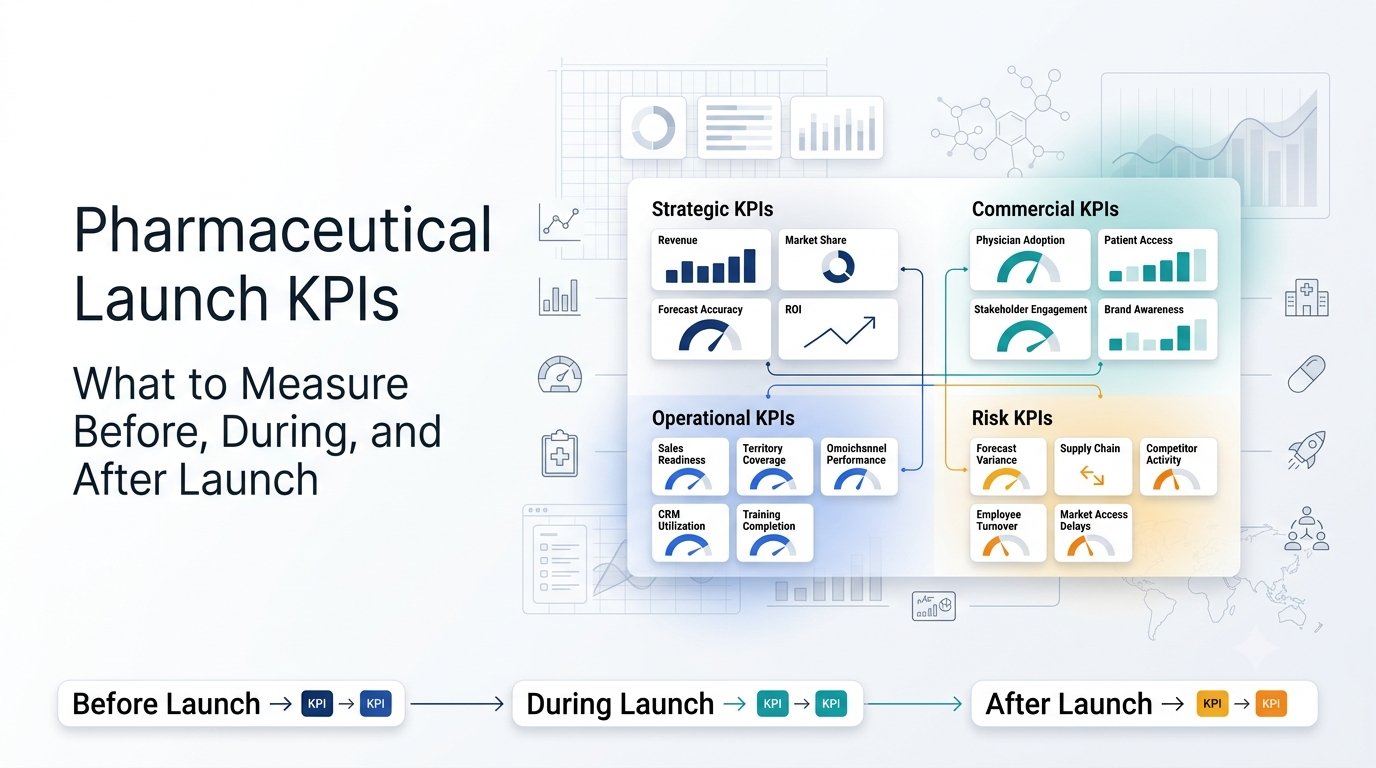
Rather than managing dozens of disconnected metrics, RxLauncher recommends organizing launch KPIs into four strategic categories.
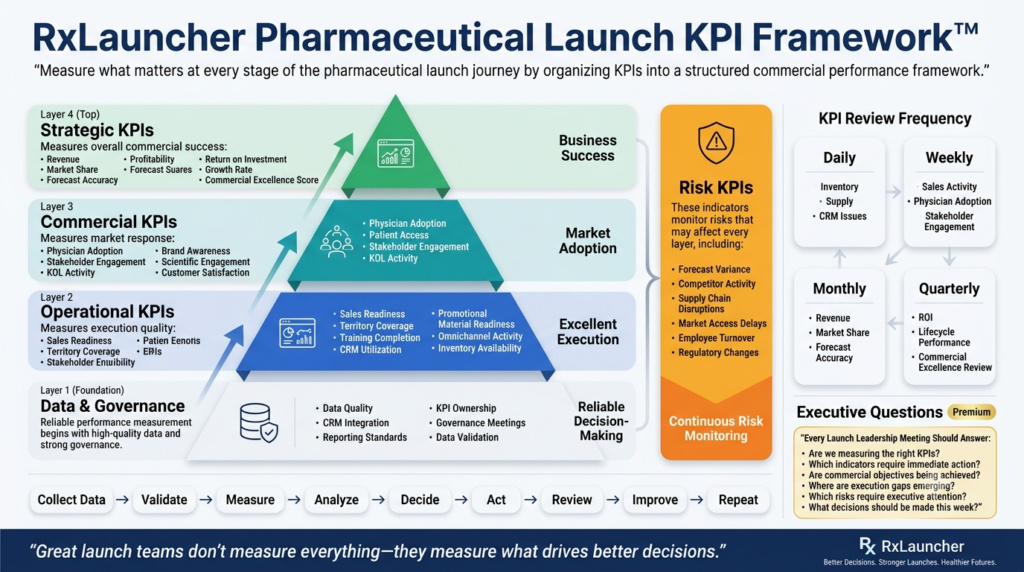
The framework consists of:
Strategic KPIs
Measure whether the launch is delivering the expected business outcomes.
Examples include:
- Revenue
- Market share
- Forecast accuracy
- Return on investment
Commercial KPIs
Evaluate how effectively the market is responding to the launch.
Examples include:
- Physician adoption
- Patient access
- Stakeholder engagement
- Brand awareness
Operational KPIs
Monitor execution quality across commercial functions.
Examples include:
- Sales readiness
- Territory coverage
- Promotional material availability
- CRM utilization
- Omnichannel engagement
Risk KPIs
Identify issues that could threaten launch performance.
Examples include:
- Forecast variance
- Supply chain disruptions
- Competitor activity
- Employee turnover
- Market access delays
Together, these four KPI groups provide leadership with a complete view of launch performance.
Phase One: Pre-Launch KPIs
Launch success begins long before the first product shipment reaches the market.
The weeks leading up to launch should focus on confirming organizational readiness rather than measuring sales performance.
Below are some of the most important pre-launch KPIs.
Commercial Readiness Score
Commercial readiness measures whether the organization is prepared to execute its launch plan.
Evaluation areas may include:
- Team alignment
- Governance
- Training completion
- Launch materials
- CRM readiness
- Cross-functional coordination
Organizations should resolve major readiness gaps before launch rather than during execution.
Sales Force Readiness
A prepared sales team is essential.
Monitor indicators such as:
- Product knowledge certification
- Scientific communication competency
- Objection handling capability
- Competitive knowledge
- Territory readiness
Training completion alone does not guarantee readiness.
Field simulations and competency assessments often provide more meaningful insights.
Marketing Asset Readiness
Commercial campaigns depend on high-quality promotional materials.
Monitor:
- Approval status
- Compliance review
- Digital asset availability
- Sales aid completion
- Launch content readiness
Delays in promotional assets often create unnecessary disruption during the first weeks of launch.
Forecast Readiness
Forecasting should not end when launch begins.
Leadership should validate:
- Commercial assumptions
- Demand scenarios
- Inventory projections
- Resource allocation
- Budget expectations
Organizations should document the assumptions supporting every major forecast to simplify future reviews.
Market Access Readiness
Commercial demand has little value if patients cannot access treatment.
Examples of market access KPIs include:
- Reimbursement milestone completion
- Pricing approval status
- Hospital formulary readiness
- Payer engagement
- Health economic evidence completion
Market access should be measured as rigorously as promotional readiness.
Stakeholder Engagement Progress
Early stakeholder relationships often influence launch momentum.
Monitor:
- Advisory board completion
- KOL engagement
- Medical education activities
- Congress participation
- Scientific communication milestones
Strong stakeholder engagement before launch frequently accelerates adoption afterward.
Phase Two: Launch KPIs
Once commercialization begins, measurement priorities change.
Leadership should focus on indicators that demonstrate market response, execution quality, and customer engagement.
Physician Adoption
One of the earliest indicators of launch success is physician adoption.
Measure:
- New prescribers
- Prescribing frequency
- Repeat prescribing
- Adoption by specialty
- Geographic adoption
These metrics often provide earlier insights than revenue alone.
Patient Access
Monitor whether eligible patients are actually receiving treatment.
Examples include:
- Covered patient population
- Reimbursement approvals
- Hospital adoption
- Time to treatment initiation
- Access restrictions
Improving patient access frequently has a greater long-term impact than increasing promotional activity.
Sales Force Effectiveness
Instead of counting activities, evaluate quality.
Useful KPIs include:
- Call quality
- Customer coverage
- Scientific discussion quality
- Territory performance
- Follow-up effectiveness
Commercial excellence is driven by meaningful customer engagement rather than simply increasing activity volumes.
Omnichannel Engagement
Modern pharmaceutical launches require coordinated customer experiences.
Monitor:
- Webinar participation
- Email engagement
- Website activity
- Digital content utilization
- Customer journey completion
- Preferred communication channels
The objective is consistent engagement rather than channel-specific performance.
Brand Awareness
During the early launch period, awareness indicators may include:
- Congress visibility
- Scientific publication engagement
- Website traffic
- Brand recall studies
- Share of voice
Awareness should eventually translate into customer action, making it an important leading indicator rather than a final outcome.
Phase Three: Post-Launch KPIs
As the launch progresses beyond the initial weeks, leadership should shift attention from early execution metrics to long-term commercial performance.
The objective is no longer to confirm that launch activities are happening.
The objective is to determine whether those activities are creating sustainable business results.
Post-launch KPIs help organizations evaluate commercial performance, identify optimization opportunities, and support lifecycle planning.
Revenue Performance
Revenue remains one of the most important indicators of commercial success, but it should always be interpreted within the context of the original launch assumptions.
Monitor indicators such as:
- Revenue versus forecast
- Revenue growth by month
- Revenue by customer segment
- Revenue by territory
- Product mix performance
Rather than focusing on absolute sales alone, compare actual performance against expected milestones to identify emerging trends early.
Market Share
Revenue can increase while market share remains unchanged if the overall market is expanding.
Market share provides a clearer indication of competitive performance.
Examples include:
- Total market share
- Segment-specific market share
- Geographic market share
- New prescription share
- Share versus key competitors
Consistent market share growth often indicates successful brand adoption and competitive positioning.
Forecast Accuracy
Forecasting is not complete once launch begins.
Organizations should continuously compare projected performance with actual results to improve future decision-making.
Evaluate:
- Demand forecast accuracy
- Sales forecast variance
- Inventory forecast accuracy
- Budget variance
- Resource utilization
Improving forecast accuracy strengthens future launch planning and resource allocation.
Return on Commercial Investment
Commercial activities require significant investment across marketing, sales, medical affairs, digital channels, and market access.
Leadership should regularly evaluate whether these investments generate measurable business value.
Examples include:
- Campaign return on investment
- Cost per new prescriber
- Promotional effectiveness
- Customer acquisition cost
- Commercial productivity
The objective is to maximize business impact rather than simply increase commercial activity.
Customer Satisfaction and Experience
Long-term success depends on delivering value beyond the initial launch period.
Although customer satisfaction is often associated with consumer industries, it also plays an important role in pharmaceutical commercialization.
Examples include:
- Healthcare professional satisfaction
- Medical information quality
- Scientific support responsiveness
- Educational program feedback
- Digital experience ratings
Positive customer experiences contribute to stronger relationships and sustainable brand growth.
Build an Executive Launch Dashboard
Collecting KPIs is only the first step.
Leadership teams require a structured dashboard that transforms data into meaningful decisions.
An effective pharmaceutical launch dashboard should provide a balanced view of commercial performance rather than focusing on one department.
RxLauncher recommends organizing dashboards into four executive sections:
- Strategic Performance
- Commercial Performance
- Operational Excellence
- Risk Monitoring
Each section should contain only the KPIs required to support management decisions.
An executive dashboard should answer three questions within minutes:
- Are we achieving our launch objectives?
- Where are performance gaps emerging?
- What actions should leadership take next?
Simple dashboards often produce better decisions than highly complex reports.
Review KPIs at the Right Frequency
Not every KPI requires daily review.
Establishing a structured review cadence helps leadership focus attention where it is needed most.
| Review Frequency | Typical KPIs |
|---|---|
| Daily | Inventory availability, supply issues, CRM performance, urgent operational risks |
| Weekly | Physician adoption, stakeholder engagement, sales force activity, market access progress |
| Monthly | Revenue, market share, forecast accuracy, campaign effectiveness |
| Quarterly | Return on investment, commercial excellence, lifecycle performance, strategic objectives |
Regular review meetings create accountability while preventing leadership from becoming overwhelmed by excessive reporting.
Common KPI Mistakes
Many launch teams collect impressive amounts of data but struggle to translate information into action.
Avoid these common mistakes.
Measuring Too Many KPIs
When every metric is considered important, none receives the attention it deserves.
Prioritize the indicators that directly influence commercial decisions.
Measuring Activity Instead of Outcomes
High activity levels do not necessarily produce commercial success.
For example:
- More sales calls do not always improve physician adoption.
- More emails do not always increase engagement.
- More webinars do not always change prescribing behavior.
Focus on outcomes rather than activity alone.
Reviewing KPIs Too Late
Waiting until the end of the quarter may delay important decisions.
Early performance reviews allow organizations to adjust execution before small issues become major challenges.
Ignoring Leading Indicators
Revenue is a lagging indicator.
Metrics such as physician adoption, market access progress, stakeholder engagement, and sales readiness often predict future commercial performance.
Leadership should monitor both leading and lagging indicators.
No KPI Ownership
Every KPI should have a clearly assigned owner.
When responsibility is unclear, corrective actions are often delayed.
Assign ownership, review performance regularly, and define escalation pathways before launch.
Leadership Perspective
The strongest pharmaceutical launch organizations do not measure performance simply to produce reports.
They measure performance to improve decisions.
Effective KPIs create alignment across Marketing, Medical Affairs, Market Access, Commercial Excellence, Sales, Finance, and Executive Leadership.
They encourage constructive conversations, identify opportunities earlier, and support continuous improvement throughout the product lifecycle.
Ultimately, the purpose of a launch dashboard is not to describe yesterday’s performance.
It is to help leadership make better decisions tomorrow.
Action Checklist
Before finalizing your launch measurement framework, ensure that your organization has completed the following activities.
| Action | Primary Owner | Expected Deliverable |
|---|---|---|
| Define strategic launch objectives | Executive Leadership | Launch Success Framework |
| Select core launch KPIs | Commercial Excellence | KPI Catalogue |
| Assign KPI ownership | Department Heads | Responsibility Matrix |
| Build executive dashboard | Commercial Excellence | Launch Performance Dashboard |
| Establish review cadence | PMO / Leadership | KPI Review Calendar |
| Define corrective action process | Executive Leadership | Performance Governance Plan |
Recommended RxLauncher Tool
Excel Chart Builder
A well-designed dashboard makes launch performance easier to understand and communicate.
Use the RxLauncher Excel Chart Builder to transform pharmaceutical launch data into executive-ready charts, KPI dashboards, and commercial performance reports.
Whether you’re tracking physician adoption, market access progress, forecast accuracy, or revenue trends, professional visualizations help leadership identify patterns faster and support more confident decision-making.
Final Thoughts
Successful pharmaceutical launches are not measured by one number.
They are evaluated through a balanced system of strategic, commercial, operational, and risk indicators that evolve throughout the launch journey.
Organizations that monitor the right KPIs at the right time are better equipped to respond to market changes, optimize commercial execution, and sustain long-term growth.
The goal is not to collect more data.
The goal is to generate better insights—and turn those insights into better decisions.
Continue Learning
Expand your pharmaceutical launch knowledge with these related resources from the RxLauncher Knowledge Hub:
- The Complete Guide to Pharmaceutical Product Launch
- Marketing Plan vs. Product Launch Plan: Why You Need Both
- How to Forecast a Pharma Launch Accurately
- How to Build a Pharma Dashboard for Decision-Making
- Pharma Commercial Excellence Framework
- Pharma Sales Force Effectiveness Framework
- Pharma Resource Allocation Strategy
These guides explore the planning, execution, measurement, and optimization practices that help pharmaceutical organizations build stronger launches and achieve sustainable commercial success.