
Table of Contents
How Do You Build a Brand Positioning Strategy in Pharma?
The strategy of brand positioning in pharma defines how a product is perceived relative to alternatives in the minds of stakeholders.
Strong positioning creates differentiation, improves adoption, and strengthens commercial performance.
Weak positioning makes products difficult to remember and harder to recommend.
The most successful pharma brands are rarely the ones with the most information. They are often the ones with the clearest position.
What is brand positioning in pharma?
Brand positioning in pharma is the process of defining:
- What your brand stands for
- Why it matters
- Who it serves best
- How it differs from competitors
Positioning answers four critical questions:
- Why this product?
- Why this patient?
- Why now?
- Why instead of alternatives?
Important reality:
Positioning is not a slogan.
It is a strategic decision.
Strong positioning influences:
- Adoption
- Recall
- Engagement
- Loyalty
Why is positioning important in pharma?
Healthcare professionals face:
- Multiple products
- Similar claims
- Information overload
- Competitive noise
Without clear positioning:
Products become interchangeable.
Strong positioning helps stakeholders:
- Understand value quickly
- Remember differentiation
- Make decisions confidently
Important principle:
If your positioning sounds like every competitor, it is not positioning.
👉 As discussed in
🔗 Related Post: How Do You Build a Pharma Go-To-Market Strategy Step by Step?
Positioning influences every commercial decision.
Why do pharma positioning strategies fail?
Most failures occur because positioning is built internally instead of externally.
Common mistakes:
- Product-focused thinking
- Generic claims
- No stakeholder relevance
- Weak differentiation
- Poor consistency
Example weak positioning:
“Effective and safe”
Problem:
Most competitors can say the same thing.
Strong positioning creates distinction.
👉 As discussed in
🔗 Related Post: Why Pharma Launches Fail: 9 Critical Mistakes
Weak differentiation is a major launch risk.
What are the 7 principles of effective brand positioning in pharma?
1. Start with unmet need
Positioning should begin with the problem.
Ask:
- What challenge exists today?
- What remains unsolved?
- What frustrates stakeholders?
Important:
Customers do not buy products.
They seek solutions.
Strong positioning starts with patient and stakeholder needs.
2. Define your unique value proposition
Every strong position requires a clear value proposition.
It should explain:
- Clinical value
- Practical value
- Economic value
- Patient impact
Structure:
Problem
↓
Solution
↓
Evidence
↓
Outcome
Important:
Value propositions should be simple enough to remember.
3. Identify meaningful differentiation
Differentiation creates competitive advantage.
Sources of differentiation may include:
- Efficacy
- Safety
- Convenience
- Access
- Cost-effectiveness
- Evidence strength
Common mistake:
Trying to differentiate on everything.
Better approach:
Own one meaningful position.
👉 As discussed in
🔗 Related Post: Scientific Messaging Framework in Pharma
Focused communication improves understanding.
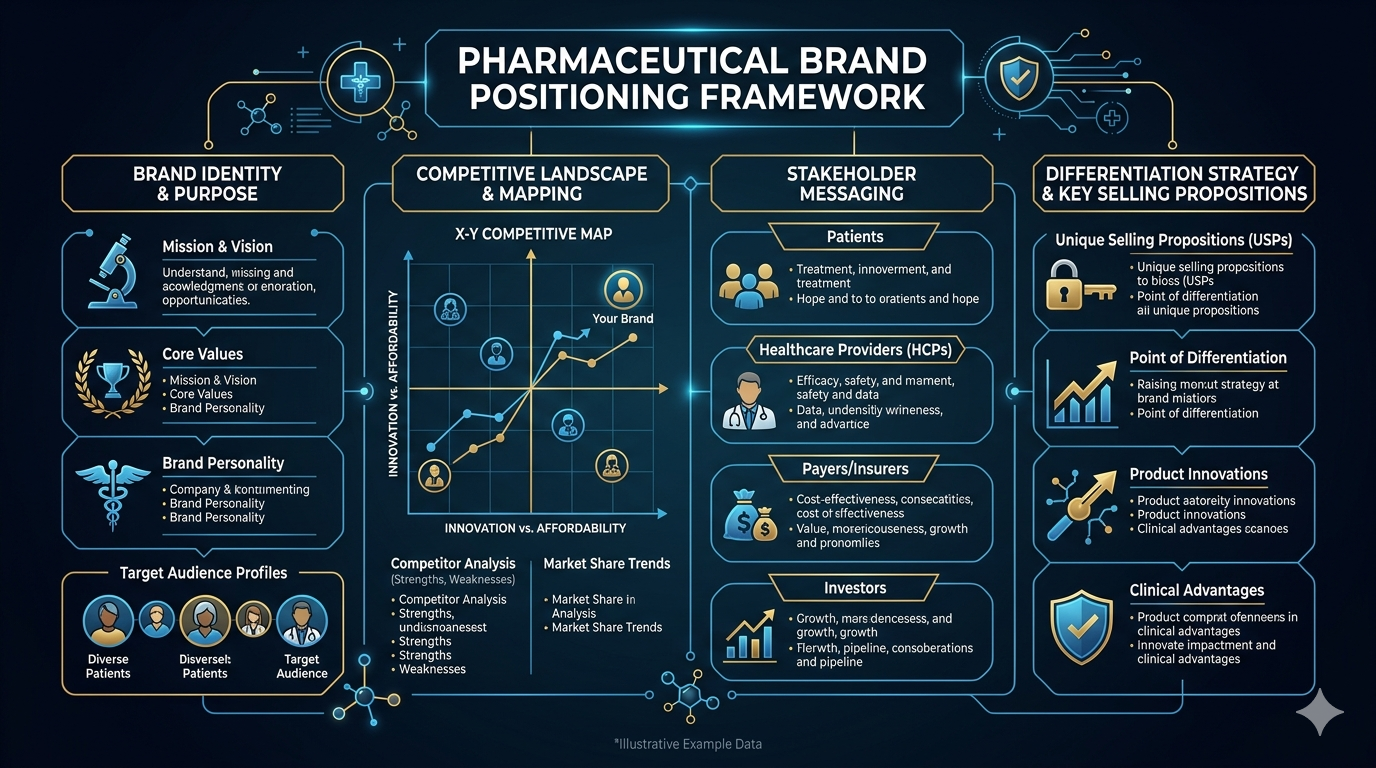
4. Align positioning with stakeholder priorities
Different stakeholders evaluate value differently.
Physicians focus on:
- Outcomes
- Safety
- Clinical relevance
Payers focus on:
- Cost
- Budget impact
- Value
Institutions focus on:
- Implementation
- Protocol fit
- Operational impact
Research consistently highlights the growing influence of multiple stakeholder groups on commercial success.
Important:
Brand positioning in pharma should remain consistent while supporting stakeholder-specific relevance.
5. Support positioning with evidence
Claims require proof.
Evidence may include:
- Clinical trials
- Real-world evidence
- Guidelines
- Comparative studies
- Outcomes research
Strong positioning combines:
Differentiation + Evidence
Weak positioning relies on assertions.
👉 As discussed in
🔗 Related Post: Pharma KOL Engagement: 7 Proven Strategy Principles
Scientific credibility drives trust.
6. Ensure organizational alignment
Positioning should guide every interaction.
Alignment should exist across:
- Marketing
- Medical Affairs
- Sales
- Market Access
Inconsistency creates:
- Confusion
- Reduced trust
- Lower effectiveness
Strong organizations communicate one strategic story.
👉 As discussed in
🔗 Related Post: Pharma Commercial Excellence: 8 Proven Framework Pillars
Alignment improves execution quality.
7. Reinforce positioning continuously
Positioning is not a launch activity.
Reinforce through:
- Sales interactions
- CME programs
- Scientific communication
- Omnichannel engagement
- KOL activities
Important:
Positioning becomes powerful through repetition.
Consistency builds memory.
How does positioning support launches?
Launches introduce uncertainty.
Strong positioning helps:
- Accelerate awareness
- Improve recall
- Support adoption
- Guide communication
During launch:
Positioning acts as the foundation for all messaging.
👉 As discussed in
🔗 Related Post: How to Build a Pharma Launch Plan: 7 Proven Steps
Positioning should be established before execution begins.
How does positioning support switching strategies?
Switching requires a reason.
Positioning provides:
- Differentiation
- Relevance
- Competitive advantage
Without positioning:
Switching becomes difficult.
👉 As discussed in
🔗 Related Post: Pharma Switching Strategy: 6 Proven Ways to Win
Behavior change requires meaningful differentiation.
How does positioning support omnichannel engagement?
Omnichannel effectiveness depends on consistency.
Strong positioning ensures:
- Consistent messaging
- Better recall
- Better stakeholder experience
Across channels:
The core story should remain the same.
👉 As discussed in
🔗 Related Post: Omnichannel Strategy in Pharma Marketing
Consistency strengthens engagement.
How can tools support positioning strategy?
1. Marketing Plan Generator
Use it to:
- Define positioning frameworks
- Align strategic objectives
- Structure launch planning
2. Excel Chart Builder
Use it to:
- Visualize competitive positioning
- Compare stakeholder priorities
- Support strategic analysis
3. Manager Effectiveness Heatmap
Use it to:
- Assess communication consistency
- Improve coaching quality
4. Turnover Index
Use it to:
- Protect execution continuity
- Maintain positioning consistency
👉 Strong positioning requires consistent execution.
What are the biggest positioning mistakes?
1. Generic claims
Creates weak differentiation.
2. Too many messages
Reduces recall.
3. Internal thinking
Ignores stakeholder needs.
4. Weak evidence support
Reduces credibility.
5. Inconsistent execution
Damages trust.
Final Insight
Positioning is not what you say about your product.
It is what stakeholders remember about it.
The strongest pharma brands are not necessarily the most innovative.
They are often the easiest to understand.
In pharma:
👉 Differentiation creates attention
👉 Evidence creates trust
👉 Positioning creates preference
Organizations that position effectively usually:
- Launch faster
- Compete more effectively
- Communicate more clearly
- Build stronger stakeholder relationships
Related Guides You Should Review Next
🔗 Related Post: Scientific Messaging Framework in Pharma
🔗 Related Post: How Do You Build a Pharma Go-To-Market Strategy Step by Step?
🔗 Related Post: How to Build a Pharma Launch Plan: 7 Proven Steps
🔗 Related Post: Pharma KOL Engagement: 7 Proven Strategy Principles
🔗 Related Post: Omnichannel Strategy in Pharma Marketing
🔗 Related Post: Pharma Commercial Excellence: 8 Proven Framework Pillars