
Table of Contents
How Do You Build a Pharma Stakeholder Mapping Framework?
A pharma stakeholder mapping framework identifies, prioritizes, and manages the people and organizations that influence adoption, access, prescribing behavior, and commercial success.
Modern pharma success depends on understanding influence networks rather than focusing only on physicians.
Strong stakeholder mapping improves execution, resource allocation, and launch performance.
Without structured mapping, engagement becomes inefficient and reactive.
What is stakeholder mapping in pharma?
Stakeholder mapping is the process of identifying:
- Who influences decisions
- How influence works
- Which stakeholders matter most
- How engagement should be prioritized
Pharma stakeholder mapping answers:
- Who influences adoption?
- Who controls access?
- Who drives prescribing behavior?
- Who affects commercial success?
Important reality:
Prescribers are only one part of the system.
Why is stakeholder mapping critical in pharma?
Healthcare systems have become increasingly complex.
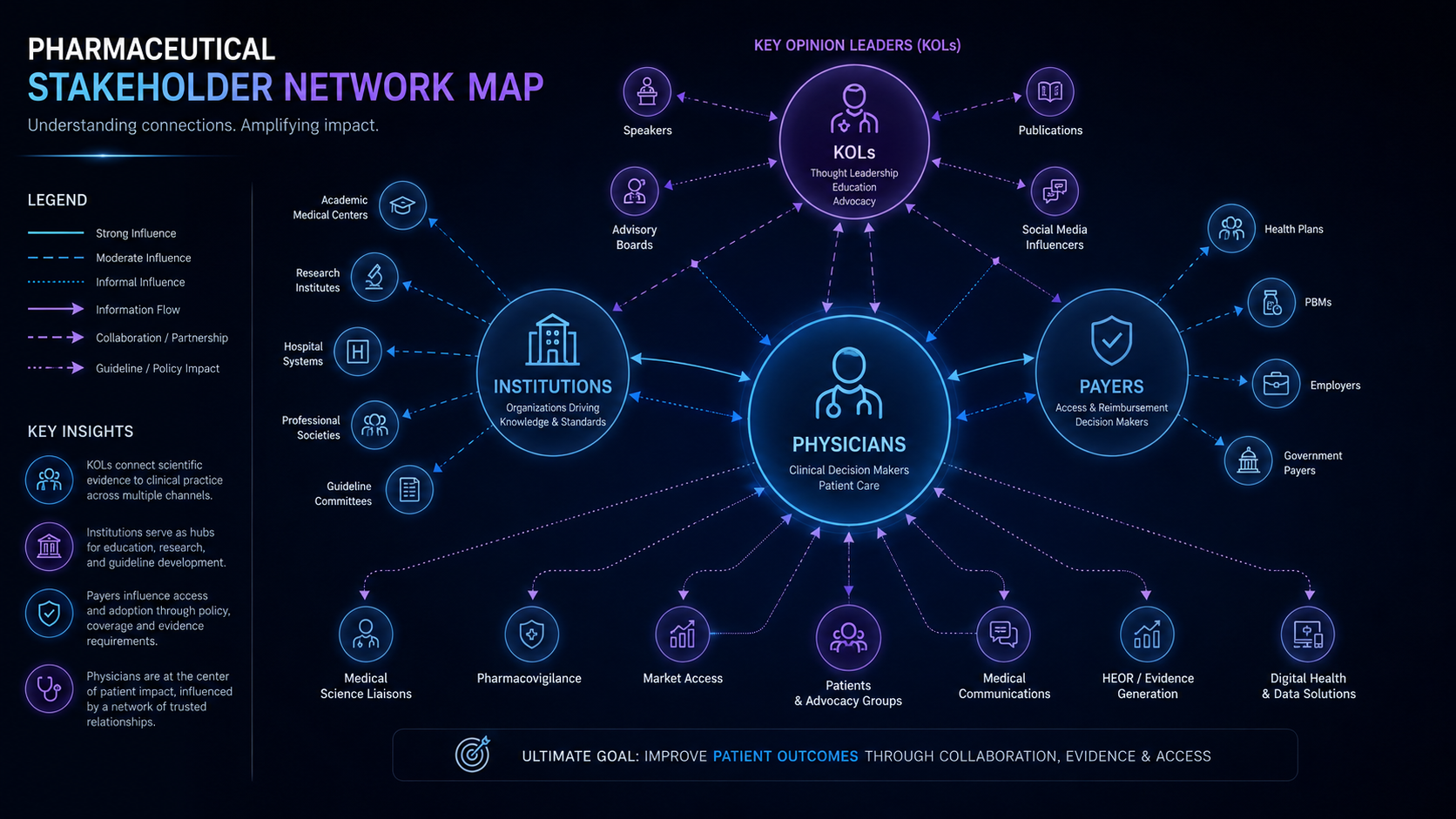
Modern treatment decisions are influenced by:
- Physicians
- KOLs
- Payers
- Institutions
- Committees
- Pharmacists
- Patient groups
Research increasingly shows multiple stakeholder groups influence commercial outcomes and launch success rather than individual prescribers alone
This means:
Commercial strategy requires:
- Broader visibility
- Better prioritization
- Stronger coordination
Why do pharma stakeholder mapping exercises fail?
Most organizations create lists instead of systems.
Common mistakes:
- Mapping only physicians
- Treating all stakeholders equally
- No prioritization logic
- Static stakeholder lists
- Weak cross-functional alignment
Result:
- Resource waste
- Weak engagement
- Poor execution
👉 As discussed in
🔗 Related Post: Pharma Commercial Excellence: 8 Proven Framework Pillars
Fragmented systems reduce execution quality.
What are the 7 steps to build a pharma stakeholder mapping framework?
Step 1: Identify all stakeholder groups
Start broad.
Typical stakeholder categories:
Clinical stakeholders
- Physicians
- Specialists
- KOLs
- Guideline experts
Access stakeholders
- Payers
- Insurance decision-makers
- Institutional committees
Commercial stakeholders
- Sales leadership
- Distribution partners
- Procurement teams
External stakeholders
- Patient groups
- Scientific societies
- Academic institutions
Important:
Map systems, not individuals only.
Step 2: Understand influence pathways
Influence rarely works directly.
Questions to ask:
- Who influences whom?
- Where are decisions made?
- Which relationships matter most?
Example:
A payer may influence:
- Institutional adoption
- Physician prescribing
- Patient access
Important principle:
Influence networks matter more than titles.
Step 3: Measure stakeholder importance
Not all stakeholders deserve equal attention.
Evaluate stakeholders using:
- Influence level
- Access impact
- Commercial importance
- Scientific credibility
- Network reach
Simple prioritization model:
High Influence + High Impact
→ Highest priority
High Influence + Low Impact
→ Selective engagement
Low Influence + Low Impact
→ Maintenance only
Step 4: Segment stakeholders strategically
Segmentation improves execution.
Examples:
KOL Segment
- Scientific influence
- Education activities
- Evidence discussions
Access Segment
- Reimbursement focus
- Economic value messaging
High Prescriber Segment
- Clinical adoption focus
Why segmentation matters:
Different stakeholders require different engagement.
Step 5: Define engagement strategies
Mapping alone creates no value.
Build tailored engagement plans:
KOLs
- Advisory boards
- Scientific activities
- Educational programs
Payers
- Economic evidence
- Value discussions
- Budget impact analysis
Institutions
- Protocol discussions
- Access planning
Important:
Engagement should match stakeholder needs.
👉 As discussed in
🔗 Related Post: Pharma KOL Engagement: 7 Proven Strategy Principles
Relationships require long-term strategic thinking.
Step 6: Align stakeholders with launch objectives
Stakeholder planning should connect directly to business goals.
Example objectives:
- Faster adoption
- Better access
- Increased switching
- Stronger awareness
Important principle:
Stakeholder activities without objectives create noise.
Research highlights the importance of integrating stakeholder planning earlier in commercialization activities to improve launch performance
Step 7: Continuously update stakeholder maps
Stakeholder systems evolve constantly.
Changes may include:
- New competitors
- New policies
- Organizational changes
- Emerging influencers
Best practice:
Review stakeholder maps regularly.
Because:
Static maps quickly become outdated.
How does stakeholder mapping improve launches?
Launch success depends heavily on coordination.
Stakeholder mapping improves:
- Resource allocation
- Engagement efficiency
- Execution quality
- Adoption speed
👉 As explained in
🔗 Related Post: How to Build a Pharma Launch Plan: 7 Proven Steps
Launch success requires coordinated stakeholder alignment.
How does stakeholder mapping support market access?
Access decisions depend heavily on stakeholder influence.
Mapping helps identify:
- Decision-makers
- Influencers
- Institutional barriers
- Approval pathways
👉 As discussed in
🔗 Related Post: Pharma Market Access Strategy: 7 Proven Success Steps
Access strategy is fundamentally stakeholder-driven.
How does stakeholder mapping support territory strategy?
Stakeholder concentration differs across territories.
Mapping helps:
- Prioritize regions
- Optimize field force deployment
- Improve targeting
👉 As discussed in
🔗 Related Post: Pharma Territory Targeting: 7 Proven Strategy Steps
Geography alone does not define opportunity.
How can tools improve stakeholder mapping?
1. Marketing Plan Generator
Use it to:
- Structure stakeholder plans
- Align objectives
- Define execution activities
2. Excel Chart Builder
Use it to:
- Visualize stakeholder influence networks
- Build prioritization matrices
- Compare stakeholder segments
3. Manager Effectiveness Heatmap
Use it to:
- Improve cross-functional coordination
- Detect execution gaps
4. Turnover Index
Use it to:
- Protect relationship continuity
- Reduce disruption risk
👉 Stakeholder management depends heavily on organizational stability.
What are the biggest stakeholder mapping mistakes?
1. Physician-only thinking
Modern pharma is multi-stakeholder.
2. Equal prioritization
Resources become diluted.
3. Static maps
Markets evolve rapidly.
4. No engagement strategy
Mapping without action creates no value.
5. Weak cross-functional ownership
Creates fragmented execution.
Final Insight
Stakeholder mapping is not an exercise.
It is a commercial capability.
The strongest pharma organizations understand:
- Influence networks
- Decision pathways
- Stakeholder priorities
In pharma:
👉 Products rarely compete alone
👉 Ecosystems compete
The organizations that win usually:
- Understand influence deeply
- Prioritize strategically
- Engage systematically
Related Guides You Should Review Next
🔗 Related Post: Pharma KOL Engagement: 7 Proven Strategy Principles
🔗 Related Post: Pharma Market Access Strategy: 7 Proven Success Steps
🔗 Related Post: How to Build a Pharma Launch Plan: 7 Proven Steps
🔗 Related Post: Pharma Territory Targeting: 7 Proven Strategy Steps
🔗 Related Post: Pharma Commercial Excellence: 8 Proven Framework Pillars