
Table of Contents
The Complete Guide to Pharmaceutical Product Launch
Launching a pharmaceutical product is one of the most important—and demanding—commercial initiatives a healthcare company will undertake. Years of scientific research, clinical development, regulatory preparation, manufacturing, and investment culminate in a launch that may determine the long-term success of a brand.
Despite this level of preparation, many launches fail to achieve their commercial objectives.
The reasons are rarely limited to the product itself. In many cases, the clinical evidence is compelling, regulatory approval has been secured, and manufacturing is ready. Yet adoption is slower than expected, forecasts prove inaccurate, market access takes longer than planned, or competitors establish a stronger market position.
These outcomes are often the result of fragmented planning rather than poor science.
Successful launches are built on alignment. Marketing, Medical Affairs, Market Access, Sales, Supply Chain, Finance, and Leadership must work toward the same commercial objectives while responding to the needs of physicians, payers, healthcare institutions, and patients. When these functions operate independently, execution becomes inconsistent and opportunities are lost.
This guide presents a practical framework for planning and executing pharmaceutical launches. Rather than treating forecasting, positioning, stakeholder engagement, market access, commercial readiness, and performance measurement as separate activities, it explains how they work together as one integrated commercial system.
The framework presented throughout this guide has been developed to help pharmaceutical professionals make more informed commercial decisions, identify risks earlier, and improve launch execution. Each chapter focuses on a critical stage of the launch journey and links to more detailed resources available within the RxLauncher Knowledge Hub.
Whether you are preparing for your first product launch, expanding an existing brand into a new indication, or leading a mature portfolio, the principles in this playbook are designed to support practical decision-making rather than theoretical discussion.
The objective is simple:
Help launch teams build brands that are not only approved—but successfully adopted, commercially sustainable, and positioned for long-term growth.
Chapter 1: Is This Product Worth Launching?
Every pharmaceutical launch begins with optimism.
Clinical trials have demonstrated positive results. Regulatory approval is approaching—or has already been secured. Internal teams are eager to move forward, and expectations for commercial success are high.
At this stage, many organizations ask the wrong question:
How do we launch this product?
The better question is:
Should we launch this product in this market, at this time, with this strategy?
These questions are not the same.
Regulatory approval confirms that a product can be marketed. It does not guarantee that the market is ready to adopt it, that payers will reimburse it, or that healthcare professionals will change their prescribing behavior.
Commercial success depends on a much broader set of factors than scientific evidence alone.
Before forecasting sales, planning promotional activities, or deploying a sales force, launch teams should complete a structured opportunity assessment.
This process helps validate whether the commercial opportunity justifies the planned investment and identifies the areas that require additional preparation before launch.
Looking Beyond the Product
One of the most common launch mistakes is evaluating the product in isolation.
Strong products can fail commercially.
Average products can outperform expectations.
The difference often lies in the surrounding environment.
A successful launch depends on the interaction between four critical dimensions:
- The market opportunity.
- The competitive environment.
- Organizational readiness.
- Long-term growth potential.
Ignoring any one of these dimensions increases commercial risk.
For example, a therapy with excellent clinical outcomes may struggle if reimbursement is limited or if competitors have already established strong relationships with key stakeholders.
Similarly, an attractive market may still produce disappointing results if internal teams are not aligned or commercial capabilities are underdeveloped.
Launch decisions should therefore be based on the overall opportunity—not on product enthusiasm alone.
The Four Questions Every Launch Team Should Answer
Before approving a commercial launch, leadership teams should reach a clear answer to four strategic questions.
1. Is there a meaningful unmet medical need?
The first objective is to understand whether the product addresses a genuine clinical problem.
Consider questions such as:
- Does the product improve patient outcomes?
- Does it solve an important limitation of existing therapies?
- Will healthcare professionals recognize this value?
Products that address significant unmet needs generally have stronger adoption potential than products offering only incremental improvements.
2. Can we create meaningful differentiation?
Even highly effective products require a clear competitive position.
Evaluate:
- Clinical advantages
- Safety profile
- Convenience
- Administration
- Economic value
- Real-world evidence
The goal is not to claim superiority in every area, but to establish a clear and credible reason for healthcare professionals to consider the product.
3. Is our organization ready to execute?
Commercial opportunity alone is not enough.
Launch readiness should be evaluated across:
- Marketing
- Medical Affairs
- Market Access
- Sales
- Supply Chain
- Leadership
- Analytics
Weak execution can undermine even the strongest commercial opportunity.
4. Can this brand support sustainable growth?
The final question extends beyond the first year of launch.
Evaluate opportunities such as:
- Indication expansion
- New customer segments
- Geographic expansion
- Portfolio contribution
- Lifecycle management
Organizations should avoid investing heavily in opportunities with limited long-term potential unless there is a compelling strategic reason.
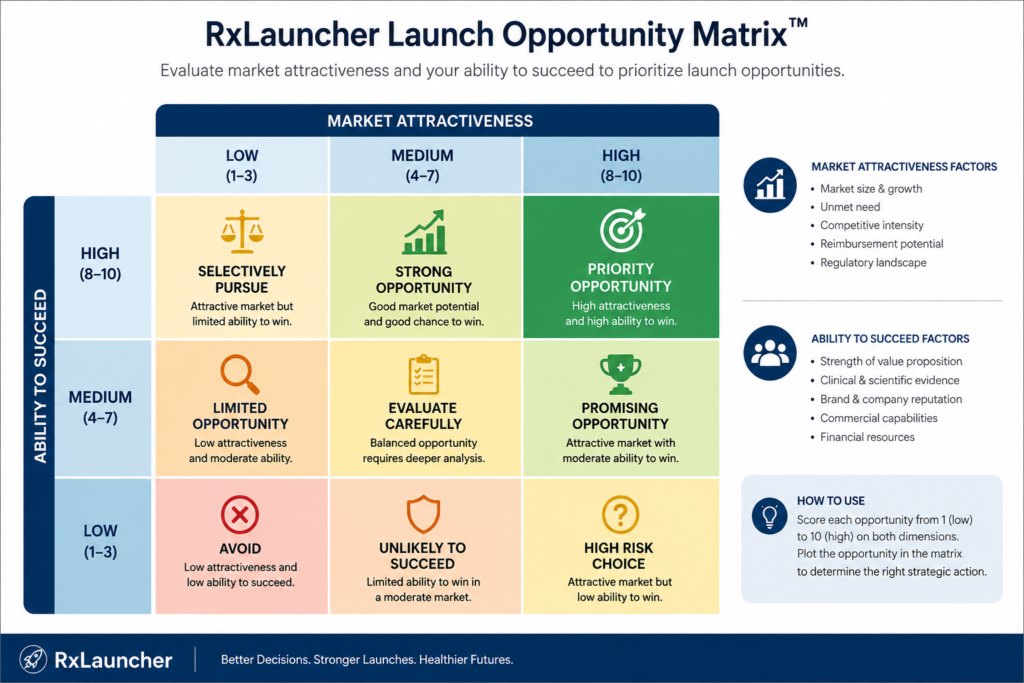
Introducing the RxLauncher Launch Opportunity Matrix™
To simplify opportunity assessment, RxLauncher uses a practical decision framework based on two dimensions:
- Commercial Attractiveness
- Organizational Readiness
Products with strong scores in both dimensions are positioned for launch.
Products with attractive markets but limited readiness may require additional preparation before commercial investment.
Likewise, organizations with excellent capabilities should still challenge whether the market opportunity justifies the investment.
The objective is not simply to launch quickly.
The objective is to launch successfully.
Key Takeaways
Before investing in a pharmaceutical launch:
- Validate the commercial opportunity, not only the scientific evidence.
- Assess the competitive landscape objectively.
- Confirm organizational readiness across all commercial functions.
- Consider the long-term growth potential of the brand.
- Use structured frameworks to reduce bias and improve decision-making.
A disciplined opportunity assessment creates a stronger foundation for every stage that follows—from forecasting and positioning to market access and launch execution.
Executive Pitfalls
Even experienced launch teams can overestimate a product’s commercial potential. Before moving to forecasting and execution, make sure you avoid these common pitfalls during the opportunity assessment stage.
Confusing Regulatory Approval with Commercial Readiness
Regulatory approval confirms that a product can be marketed. It does not guarantee physician adoption, reimbursement, or commercial success.
Building Forecasts Before Validating the Opportunity
Forecasts built on optimistic assumptions rather than objective market analysis often create unrealistic expectations and poor investment decisions.
Underestimating Competitor Response
Competitors rarely remain passive during a new product launch. Their positioning, scientific activities, stakeholder relationships, and pricing strategies should all be considered before finalizing launch plans.
Ignoring Market Access Barriers
A clinically differentiated product may still struggle if reimbursement pathways, pricing expectations, or institutional barriers are not addressed early.
Starting Commercial Execution Too Soon
Sales training, promotional campaigns, and field deployment should follow a validated commercial opportunity—not replace it.
Leadership Perspective
The quality of a pharmaceutical launch is usually determined long before the first customer interaction.
Organizations that invest time validating commercial opportunity, challenging assumptions, and aligning cross-functional teams consistently make better strategic decisions. They forecast more accurately, allocate resources more effectively, and adapt more quickly when market conditions change.
The objective is not to launch as early as possible.
The objective is to launch with confidence.
Action Plan
Complete the following activities before progressing to commercial forecasting.
| Action | Primary Owner | Expected Deliverable |
|---|---|---|
| Assess unmet medical need | Marketing & Medical Affairs | Market Opportunity Assessment |
| Analyze the competitive landscape | Marketing | Competitive Intelligence Summary |
| Evaluate reimbursement potential | Market Access | Market Access Assessment |
| Assess organizational readiness | Commercial Leadership | Launch Readiness Review |
| Validate commercial assumptions | Cross-Functional Launch Team | Opportunity Validation Report |
| Define launch objectives | Marketing | Draft Commercial Launch Plan |
Recommended RxLauncher Tool
Marketing Plan Generator
Once the commercial opportunity has been validated, organize your launch strategy into a structured commercial plan.
The Marketing Plan Generator helps you define:
- Business objectives
- Customer segments
- Strategic initiatives
- KPIs
- Activity plans
- Timelines
- Budget assumptions
Building a structured marketing plan at this stage creates a stronger foundation for forecasting and execution.
Deep Dive Resources
Continue building your launch strategy with these related resources from the RxLauncher Knowledge Hub.
- Pharma Competitive Intelligence Framework
- Pharma Market Development Strategy
- How to Forecast a Pharma Launch Accurately
- Brand Positioning Strategy in Pharma
These articles provide practical frameworks that expand on the concepts introduced in this chapter.
Continue the Playbook →
Chapter 2
How Big Is the Commercial Opportunity?
With the commercial opportunity validated, the next step is estimating its potential.
In the next chapter, you’ll learn how to build evidence-based commercial forecasts, develop realistic assumptions, evaluate multiple launch scenarios, and create projections that support better investment and resource allocation decisions.
Chapter 2: How Big Is the Commercial Opportunity?
Once a launch opportunity has been validated, the next challenge is determining its commercial potential.
This is where forecasting becomes one of the most valuable decision-making tools available to launch teams.
Unfortunately, forecasting is often misunderstood.
Some organizations treat it as a financial exercise.
Others see it as a sales target.
In reality, commercial forecasting is neither.
A high-quality forecast is a structured estimate built from evidence, assumptions, and market understanding. Its purpose is not to predict the future with perfect accuracy. Its purpose is to support better commercial decisions before significant investments are made.
Good forecasts reduce uncertainty.
Poor forecasts create false confidence.
Forecasting Begins with Questions, Not Numbers
Many teams immediately start building spreadsheets.
Instead, begin by asking strategic questions.
- How many eligible patients exist?
- How many physicians are likely to prescribe?
- What barriers could delay adoption?
- How quickly will reimbursement expand?
- How might competitors respond?
- What assumptions have the greatest impact on launch performance?
Every forecast is built on assumptions.
The quality of those assumptions determines the quality of the forecast.
The Five Building Blocks of Commercial Forecasting
Rather than thinking about forecasting as a mathematical model, think of it as a sequence of commercial decisions.
Market Potential
Estimate the size of the opportunity.
Consider:
- Disease prevalence
- Incidence
- Eligible patient population
- Geographic differences
- Treatment pathways
Adoption Rate
Determine how quickly the market is likely to adopt the product.
Factors include:
- Clinical differentiation
- Physician confidence
- Scientific evidence
- KOL support
- Market education
Market Access
Commercial potential depends heavily on access.
Evaluate:
- Reimbursement timing
- Pricing expectations
- Institutional adoption
- Healthcare system constraints
Strong products often underperform because access assumptions were overly optimistic.
Competitive Environment
Competitors influence every forecast.
Consider:
- Existing market leaders
- Pipeline products
- Generic competition
- Pricing strategies
- Promotional intensity
Forecasting without competitive assumptions creates incomplete projections.
Execution Capability
Even attractive opportunities require strong execution.
Forecast assumptions should reflect:
- Sales force capacity
- Marketing investment
- Medical engagement
- Supply readiness
- Commercial alignment
Forecasts should represent what the organization can realistically execute—not simply what it hopes to achieve.
Introducing the RxLauncher Forecast Confidence Pyramid™
Not all forecasts carry the same level of confidence.
RxLauncher evaluates forecast quality according to the strength of supporting evidence.
At the base are market assumptions.
As additional information becomes available through epidemiology, stakeholder research, market validation, and real-world evidence, confidence in the forecast increases.
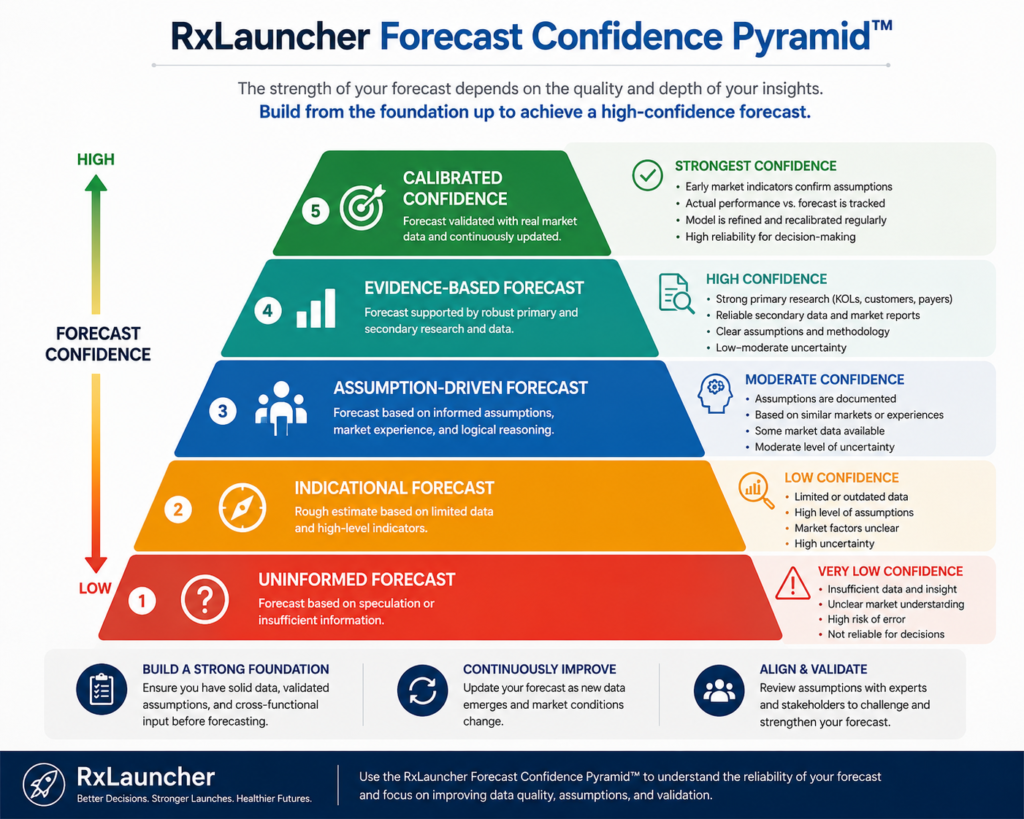
The objective is not simply to produce a number.
The objective is to understand how much confidence leadership should place in that number.
From Forecast to Decision
A commercial forecast should influence far more than expected sales.
It should support decisions about:
- Resource allocation
- Sales force size
- Marketing investment
- Market access priorities
- Supply planning
- Launch timing
Forecasting is therefore a management tool—not simply a financial exercise.
Organizations that review forecasts regularly and update assumptions as new information becomes available generally make faster and more effective commercial decisions.
Decision Point
Before investing in launch execution, pause and evaluate your forecast.
Ask your launch team the following questions:
- Have we clearly documented every major forecasting assumption?
- Are our patient population estimates supported by reliable data?
- Have we considered the impact of reimbursement timing on product adoption?
- Have we evaluated likely competitive responses?
- Have we developed optimistic, base-case, and conservative scenarios?
- Would we still make the same investment decision if our forecast were 20% lower than expected?
If the answer to any of these questions is “No”, revisit your assumptions before progressing to the next stage of launch planning.
Remember:
A forecast is not a commitment.
It is a decision-making tool that should evolve as market knowledge improves.
Executive Pitfalls
Forecasting errors rarely occur because teams cannot build spreadsheets.
They occur because assumptions are weak.
Avoid these common forecasting mistakes.
Building Forecasts Around Optimism
Commercial forecasts should be evidence-based, not aspiration-based.
Optimistic assumptions may satisfy short-term expectations but often create unrealistic commercial targets.
Ignoring Market Access Timing
Physician demand does not automatically translate into market uptake.
Delays in reimbursement, hospital listing, or payer approval can significantly influence launch performance.
Assuming Competitors Will Not Respond
Competitors often increase promotional activity, publish additional evidence, strengthen KOL engagement, or introduce pricing initiatives before and during a launch.
Every commercial forecast should consider competitive scenarios.
Creating Only One Forecast
No forecast is certain.
Develop at least three scenarios:
- Conservative
- Base Case
- Optimistic
Scenario planning improves preparedness and supports better investment decisions.
Failing to Update Forecasts
A forecast created six months before launch should not remain unchanged.
Update assumptions regularly as new commercial evidence becomes available.
Leadership Perspective
Forecasts should never become static documents.
The strongest commercial organizations continuously review market assumptions, compare forecasts with actual performance, and refine future projections using new evidence.
Forecast accuracy is not achieved by predicting the future perfectly.
It is achieved through continuous learning and disciplined decision-making.
Action Plan
Before moving to brand positioning, complete the following forecasting activities.
| Action | Primary Owner | Expected Deliverable |
|---|---|---|
| Estimate addressable patient population | Marketing | Market Size Estimate |
| Validate commercial assumptions | Cross-Functional Launch Team | Forecast Assumptions Document |
| Analyze competitor impact | Marketing | Competitive Scenario Review |
| Develop three commercial scenarios | Marketing & Finance | Scenario Forecast Model |
| Review forecast with leadership | Commercial Leadership | Forecast Approval |
| Schedule quarterly forecast reviews | Commercial Excellence | Forecast Review Calendar |
Recommended RxLauncher Tool
Marketing Plan Generator
Commercial forecasts should support strategic decisions—not exist as standalone spreadsheets.
Use the Marketing Plan Generator to organize your objectives, strategic initiatives, KPIs, timelines, and commercial assumptions into one structured launch plan.
Combining forecasting with structured planning improves alignment across Marketing, Medical Affairs, Sales, and Leadership.
Deep Dive Resources
Expand your forecasting knowledge with these practical resources from the RxLauncher Knowledge Hub.
- How to Forecast a Pharma Launch Accurately
- Pharma Scenario Planning Framework
- Pharma Resource Allocation Strategy
- Pharma Competitive Intelligence Framework
Each guide explores one element of commercial forecasting in greater detail.
Continue the Playbook →
Chapter 3
How Should We Position the Brand?
A successful launch is not determined only by the quality of the product.
It depends on whether healthcare professionals immediately understand why the brand deserves a place in clinical practice.
In the next chapter, you’ll learn how to build a clear pharmaceutical brand positioning strategy, define a compelling value proposition, and differentiate your product in competitive markets.
Chapter 3: How Should We Position the Brand?
A successful pharmaceutical launch depends on more than clinical evidence.
Healthcare professionals are exposed to thousands of scientific publications, promotional messages, congress presentations, and sales interactions every year. To stand out in this environment, a brand must communicate a clear, credible, and differentiated value proposition.
This is the purpose of brand positioning.
Positioning is not a slogan.
It is not a visual identity.
It is not a promotional campaign.
Brand positioning is the strategic decision that defines how your product should be perceived in comparison with available alternatives.
Every commercial activity—from scientific messaging and sales conversations to digital campaigns and market access discussions—should reinforce that positioning.
Without a clear positioning strategy, even clinically strong products risk becoming interchangeable with competitors.
Positioning Begins with Customer Understanding
Many organizations develop positioning by focusing exclusively on the product.
The most successful launch teams begin somewhere else.
They begin with the customer.
Ask questions such as:
- What clinical challenge is the customer trying to solve?
- Which outcomes matter most?
- What frustrations exist with current therapies?
- Which barriers prevent optimal treatment?
Customers rarely choose products because of features alone.
They choose solutions that address meaningful problems.
Understanding these problems is the foundation of effective positioning.
Build Positioning Around Value, Not Features
Clinical evidence is essential.
However, evidence alone rarely changes behavior.
Healthcare professionals interpret evidence through the lens of clinical practice.
Ask yourself:
- What difference does this product make?
- Why should prescribing behavior change?
- Which patients benefit most?
- How does this improve treatment decisions?
Features describe the product.
Value explains why the product matters.
Strong positioning translates scientific evidence into meaningful clinical value.
The Four Components of Strong Brand Positioning
Effective pharmaceutical positioning usually answers four questions.
Who is the product for?
Define the primary customer and patient population.
Avoid trying to appeal to everyone.
What problem does it solve?
Clearly define the unmet medical need.
Positioning should focus on solving important clinical challenges rather than listing product characteristics.
Why is it different?
Identify meaningful differentiation.
This may include:
- Clinical efficacy
- Safety profile
- Convenience
- Administration
- Patient adherence
- Real-world evidence
- Economic value
Differentiation should be relevant—not simply unique.
Why should customers believe it?
Every positioning statement requires supporting evidence.
Evidence may include:
- Clinical trials
- Real-world studies
- Treatment guidelines
- Expert recommendations
- Health economic data
Credibility is what transforms positioning into trust.
Introducing the RxLauncher Brand Positioning Canvas™
To create consistent positioning across commercial functions, RxLauncher recommends organizing positioning into six connected elements.
- Target Customer
- Unmet Medical Need
- Brand Promise
- Clinical Proof
- Supporting Messages
- Desired Market Perception
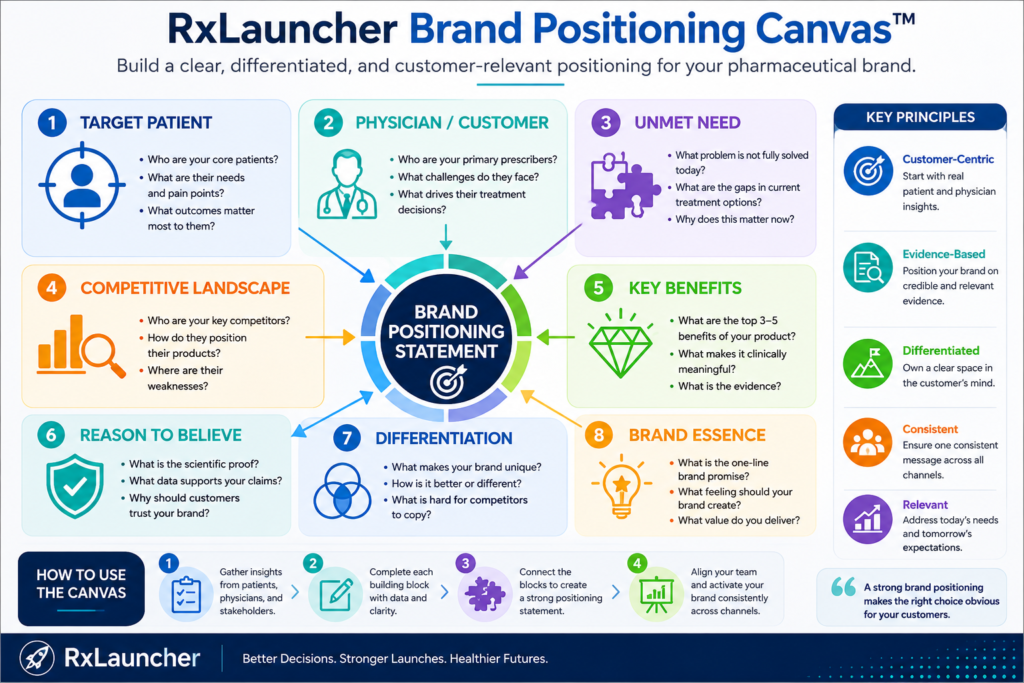
This framework helps ensure that Marketing, Medical Affairs, Sales, and Leadership communicate the same strategic message throughout the launch journey.
Positioning Is a Long-Term Strategy
Brand positioning should remain consistent.
Individual promotional messages may evolve.
New evidence may emerge.
New indications may be approved.
Competitors may enter the market.
However, the core positioning should provide a stable strategic direction throughout the brand lifecycle.
Organizations that frequently change positioning risk confusing customers and weakening long-term brand equity.
Decision Point
Before developing promotional materials or training the sales force, ask your team:
- Is our positioning built around customer needs rather than product features?
- Can every team member explain the brand promise in one or two sentences?
- Is our differentiation meaningful to healthcare professionals?
- Does every supporting message reinforce the same positioning?
- Can our positioning be supported by credible scientific evidence?
If these questions cannot be answered consistently, revisit your positioning before moving to launch execution.
Executive Pitfalls
Strong brands are rarely created by strong products alone.
Avoid these positioning mistakes.
Focusing on Features Instead of Value
Healthcare professionals care less about product features than about the clinical value those features create.
Trying to Appeal to Everyone
Positioning becomes weaker as the target audience becomes broader.
Prioritize the customers who matter most.
Changing Positioning Too Frequently
Consistency builds recognition and trust.
Adjust tactical messages when needed, but avoid changing the core positioning without a compelling strategic reason.
Ignoring Competitive Positioning
Differentiation requires understanding how competitors position themselves.
Positioning should be developed in the context of the market—not in isolation.
Weak Scientific Support
Every positioning claim should be supported by credible evidence.
Scientific credibility remains the foundation of pharmaceutical marketing.
Leadership Perspective
Positioning is one of the few strategic decisions that influences every commercial function.
When Marketing, Medical Affairs, Sales, and Market Access communicate the same core value proposition, customers experience a consistent brand.
That consistency builds confidence, strengthens adoption, and supports long-term commercial success.
Action Plan
Complete the following activities before developing launch materials.
| Action | Primary Owner | Expected Deliverable |
|---|---|---|
| Define target customer | Marketing | Customer Definition |
| Document unmet medical need | Marketing & Medical Affairs | Customer Insight Summary |
| Define brand promise | Marketing | Positioning Statement |
| Validate scientific support | Medical Affairs | Evidence Summary |
| Review competitive positioning | Marketing | Positioning Comparison |
| Approve final positioning | Cross-Functional Launch Team | Brand Positioning Framework |
Recommended RxLauncher Tool
Marketing Plan Generator
Positioning should influence every element of the commercial strategy.
Use the Marketing Plan Generator to align customer segments, objectives, messaging priorities, promotional activities, and KPIs with your approved positioning strategy.
Deep Dive Resources
Continue strengthening your launch strategy with these related resources.
- Brand Positioning Strategy in Pharma
- Scientific Messaging Framework
- Customer Segmentation Strategy
- KOL Engagement Strategy
Continue the Playbook →
Chapter 4
Who Must We Win Before Launch?
A successful launch depends on more than physicians alone.
In the next chapter, you’ll learn how to identify key stakeholders, prioritize engagement efforts, build KOL relationships, and develop an integrated stakeholder strategy that supports successful market adoption.
Chapter 4: Who Must We Win Before Launch?
Building a Stakeholder Strategy That Accelerates Market Adoption
A pharmaceutical product is rarely adopted because of one successful sales call or one compelling clinical study.
Successful launches are the result of trust built across a network of stakeholders who influence prescribing behavior, reimbursement decisions, treatment guidelines, and patient access.
One of the most common launch mistakes is assuming that physicians are the only audience that matters.
In reality, healthcare decisions are shaped by a much broader ecosystem. Medical societies publish treatment recommendations. Key Opinion Leaders influence clinical practice. Hospital committees evaluate formulary inclusion. Payers determine reimbursement policies. Pharmacists support implementation. Patients increasingly participate in treatment decisions.
Each stakeholder has different priorities, different concerns, and different definitions of value.
An effective launch strategy recognizes these differences and develops a structured engagement plan long before commercial execution begins.
Understanding the Healthcare Decision Ecosystem
Before planning engagement activities, launch teams should identify everyone who can influence the success of the brand.
Typical stakeholder groups include:
- Physicians
- Key Opinion Leaders (KOLs)
- Medical Societies
- Hospital Committees
- Pharmacy & Therapeutics Committees
- Payers and Insurance Organizations
- Hospital Pharmacists
- Clinical Pharmacists
- Nurses
- Patient Advocacy Groups
- Healthcare Authorities
- Internal Commercial Teams
Not every stakeholder has the same influence.
Not every stakeholder requires the same communication strategy.
The objective is to focus effort where it creates the greatest commercial impact.
Start with Influence, Not Accessibility
Many organizations prioritize stakeholders who are easiest to reach.
Successful launch teams prioritize stakeholders who have the greatest ability to influence adoption.
A respected KOL may influence hundreds of physicians.
A reimbursement committee may determine whether thousands of patients gain access to treatment.
A national medical society may update treatment recommendations that affect prescribing behavior across an entire country.
The question is not:
Who can we contact?
The better question is:
Who can influence the market?
Align Stakeholder Priorities with Brand Value
Every stakeholder evaluates your product differently.
For example:
A physician may ask:
- Does this improve patient outcomes?
- Is it supported by strong evidence?
A payer may ask:
- Does the clinical value justify the cost?
- What is the budget impact?
A hospital committee may ask:
- Does this align with current treatment protocols?
- What operational changes are required?
Patient organizations may ask:
- Will this improve quality of life?
- Does it improve access to treatment?
Although the product remains the same, the conversation should reflect the priorities of each audience.
Successful engagement adapts the message without changing the core brand positioning.
Introducing the RxLauncher Stakeholder Influence Matrix™
RxLauncher recommends evaluating stakeholders using two dimensions:
- Level of Influence
- Level of Engagement Required
This creates four practical engagement strategies.
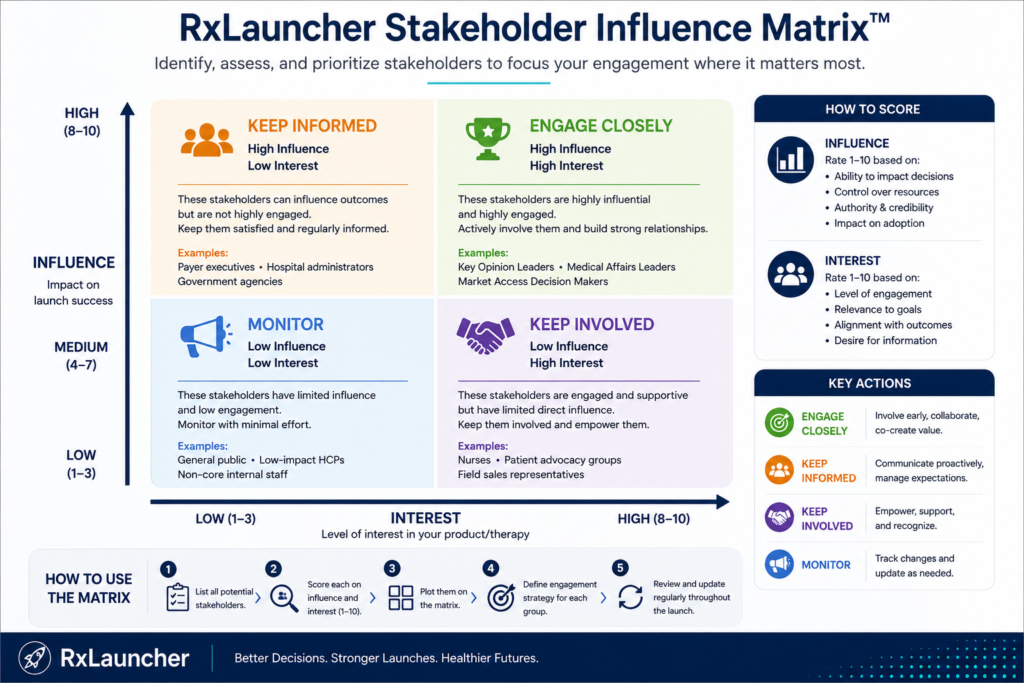
High Influence / High Engagement
These stakeholders should receive the highest priority.
Examples include:
- National KOLs
- Medical Society Leaders
- Major Hospital Decision Makers
- Key Payers
High Influence / Lower Engagement
Maintain regular communication and monitor changes.
Examples include:
- Regulatory Authorities
- Professional Associations
Lower Influence / High Engagement
Support implementation and education.
Examples include:
- Hospital Pharmacists
- Nurses
- Local Clinical Champions
Lower Influence / Lower Engagement
Monitor periodically and provide appropriate educational resources.
Build Cross-Functional Stakeholder Plans
Stakeholder engagement should never be owned by one department alone.
Marketing, Medical Affairs, Market Access, Sales, and Leadership should coordinate activities using a shared engagement strategy.
For example:
Medical Affairs may lead scientific discussions.
Marketing develops educational content.
Market Access engages reimbursement stakeholders.
Sales reinforces approved commercial messages.
When each function works independently, stakeholders receive inconsistent experiences.
Alignment builds trust.
Engagement Should Begin Before Launch
One of the biggest misconceptions is that stakeholder engagement starts after launch.
In reality, many relationships should begin months—or even years—before commercialization.
Early engagement helps organizations:
- Understand market expectations.
- Identify evidence gaps.
- Improve scientific communication.
- Anticipate market access challenges.
- Build credibility before commercial promotion begins.
Waiting until launch often means competing against organizations that have already established trusted relationships.
Measure Stakeholder Success
Stakeholder engagement should be managed with clear objectives.
Examples include:
- Number of scientific interactions.
- Advisory board outcomes.
- KOL advocacy.
- Educational program participation.
- Guideline inclusion.
- Market access progress.
- Stakeholder satisfaction.
Activities alone should not define success.
The objective is meaningful influence that supports better patient outcomes and sustainable commercial growth.
Stakeholder Engagement Is a Continuous Process
Stakeholder relationships continue throughout the product lifecycle.
As new evidence emerges, competitors enter the market, or treatment guidelines change, engagement strategies should evolve accordingly.
Organizations that continuously strengthen stakeholder relationships are better positioned to sustain brand performance long after launch.
Decision Point
Before finalizing your launch plan, ask the following questions:
- Have we identified every stakeholder who can influence product adoption?
- Do we understand what each stakeholder values most?
- Have we prioritized stakeholders according to influence rather than convenience?
- Are Marketing, Medical Affairs, Sales, and Market Access working from one engagement strategy?
- Have we defined measurable objectives for stakeholder engagement?
If these questions cannot be answered confidently, strengthen your stakeholder strategy before moving into commercial execution.
Executive Pitfalls
Strong stakeholder engagement requires discipline and coordination.
Avoid these common mistakes.
Treating Every Stakeholder the Same
Different stakeholders require different messages, communication channels, and engagement objectives.
Focusing Only on Physicians
Commercial success depends on an ecosystem of influencers, decision-makers, and healthcare organizations.
Waiting Until Launch
Relationships built after launch often take longer to influence adoption.
Early engagement creates credibility and trust.
Inconsistent Cross-Functional Communication
Stakeholders should experience one coordinated brand—not separate conversations from different departments.
Measuring Activity Instead of Impact
The number of meetings is less important than the quality of relationships and the decisions those relationships influence.
Leadership Perspective
Stakeholder engagement is not about increasing the number of interactions.
It is about increasing the quality of influence.
Organizations that consistently understand stakeholder priorities, coordinate communication across functions, and build trusted long-term relationships typically achieve stronger adoption, better market access, and more sustainable commercial performance.
Action Plan
Complete these activities before beginning commercial execution.
| Action | Primary Owner | Expected Deliverable |
|---|---|---|
| Identify all stakeholder groups | Marketing | Stakeholder Map |
| Prioritize stakeholders by influence | Cross-Functional Launch Team | Stakeholder Prioritization Matrix |
| Define engagement objectives | Marketing & Medical Affairs | Stakeholder Engagement Plan |
| Align communication across functions | Commercial Leadership | Cross-Functional Communication Framework |
| Establish stakeholder KPIs | Commercial Excellence | Stakeholder Performance Dashboard |
Recommended RxLauncher Tool
Marketing Plan Generator
An effective stakeholder strategy should be integrated into the overall commercial plan.
Use the Marketing Plan Generator to align stakeholder objectives, communication activities, timelines, responsibilities, and KPIs within one structured launch plan.
Deep Dive Resources
Continue expanding your stakeholder strategy with these related resources from the RxLauncher Knowledge Hub.
- Stakeholder Mapping Framework in Pharma
- KOL Engagement Strategy in Pharma
- Customer Segmentation Strategy
- Scientific Messaging Framework
- CME Strategy in Pharmaceutical Marketing
Continue the Playbook →
Chapter 5
Can Patients Actually Access the Product?
A successful product launch depends on more than physician interest.
In the next chapter, you’ll learn how market access, reimbursement, pricing, and payer engagement influence commercial success—and why access strategy should be developed long before launch.
Chapter 5: Can Patients Actually Access the Product?
Building a Market Access Strategy That Supports Commercial Success
A successful pharmaceutical launch is not measured by regulatory approval alone.
Commercial success begins when eligible patients can actually receive the treatment.
This depends on market access.
Many launch teams invest significant effort in brand positioning, forecasting, and sales readiness, only to discover that reimbursement delays, pricing challenges, or institutional approval processes slow adoption far more than expected.
Market access is therefore not a supporting activity.
It is a core commercial strategy.
Organizations that integrate market access into launch planning from the beginning are better positioned to accelerate adoption, reduce commercial uncertainty, and improve long-term brand performance.
Market Access Begins Before Launch
One of the most common misconceptions is that market access starts after approval.
In reality, market access planning should begin long before commercialization.
Early planning helps organizations:
- Understand payer expectations.
- Identify evidence requirements.
- Assess pricing opportunities.
- Anticipate reimbursement barriers.
- Build stronger value propositions.
The earlier these questions are addressed, the fewer surprises occur during launch.
Understanding the Market Access Ecosystem
Market access involves far more than reimbursement.
Successful launch teams understand the complete ecosystem.
This may include:
- Government authorities
- Public and private payers
- Hospital purchasing committees
- Pharmacy & Therapeutics Committees
- Health Technology Assessment (HTA) organizations
- Hospital pharmacists
- Procurement teams
Each stakeholder evaluates value differently.
Clinical evidence alone is rarely sufficient.
Organizations must also demonstrate economic value, budget impact, and long-term patient outcomes.
Build Value Beyond Clinical Efficacy
Clinical performance opens the conversation.
Value secures access.
Healthcare systems increasingly evaluate products based on questions such as:
- Does this therapy improve outcomes?
- Does it reduce healthcare costs?
- Does it decrease hospitalization?
- Does it improve quality of life?
- Is it economically sustainable?
Launch teams should prepare evidence that answers both clinical and economic questions.
Introducing the RxLauncher Market Access Readiness Framework™
RxLauncher recommends evaluating launch readiness across five key dimensions:
- Clinical Evidence
- Health Economic Evidence
- Pricing Strategy
- Reimbursement Readiness
- Stakeholder Engagement
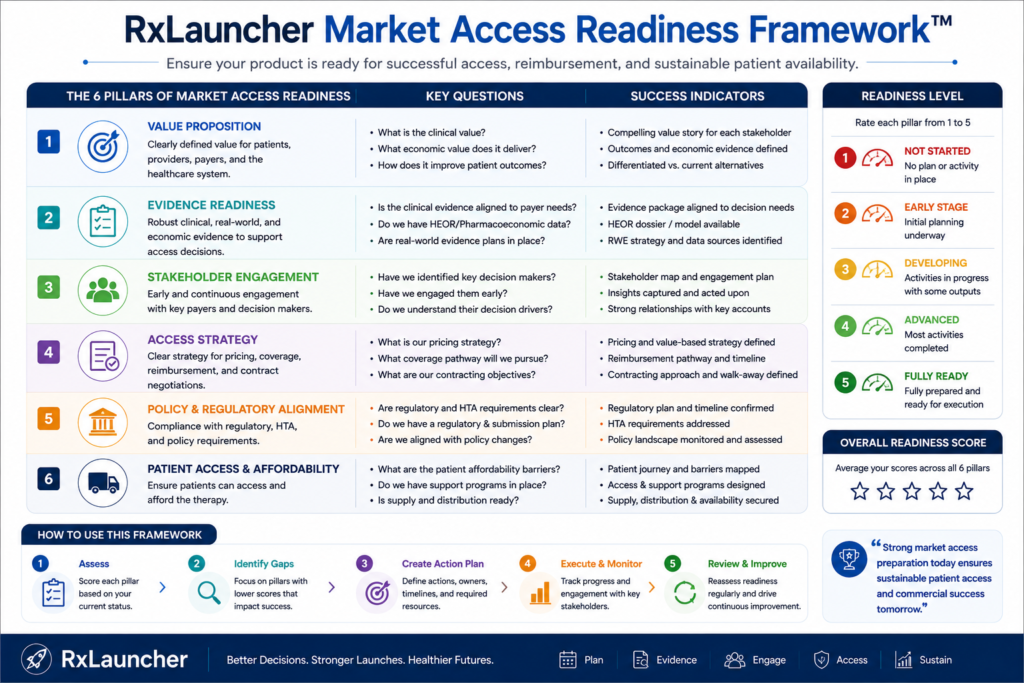
Weakness in any one area can delay patient access and reduce commercial performance.
Align Market Access with Commercial Strategy
Market Access should never operate independently from Marketing or Medical Affairs.
For example:
Marketing defines the brand strategy.
Medical Affairs develops scientific evidence.
Market Access translates value into reimbursement discussions.
Sales reinforces approved messages during customer interactions.
When these functions collaborate, the launch presents one consistent value proposition to every stakeholder.
Prepare for Multiple Access Scenarios
Access rarely follows a single predictable path.
Launch teams should prepare for different outcomes.
Examples include:
- Immediate reimbursement.
- Delayed reimbursement.
- Restricted patient populations.
- Hospital-only access.
- Regional differences.
- Pricing negotiations.
Scenario planning enables organizations to respond more quickly when market conditions change.
Measure Market Access Performance
Market access should be managed using meaningful performance indicators.
Examples include:
- Time to reimbursement.
- Percentage of covered patients.
- Hospital formulary inclusion.
- Pricing approval milestones.
- Geographic access.
- Budget impact outcomes.
Tracking these indicators provides an early signal of launch performance and helps identify barriers before they affect commercial results.
Market Access Is an Ongoing Process
Market access does not end at launch.
Pricing policies evolve.
Treatment guidelines change.
Competitors generate new evidence.
Healthcare priorities shift.
Organizations that continuously monitor access conditions are better positioned to protect and expand market opportunities throughout the product lifecycle.
Decision Point
Before finalizing launch plans, ask your cross-functional team:
- Have we identified all reimbursement requirements?
- Is our value proposition supported by both clinical and economic evidence?
- Have we prepared for multiple reimbursement scenarios?
- Are Market Access, Marketing, Medical Affairs, and Sales aligned?
- Have we established KPIs to monitor patient access after launch?
If these questions remain unanswered, strengthen your market access strategy before proceeding to commercial execution.
Executive Pitfalls
Market access challenges often become visible only after launch.
Avoid these common mistakes.
Treating Market Access as a Post-Launch Activity
Successful organizations begin access planning long before commercialization.
Focusing Only on Clinical Evidence
Clinical efficacy is essential, but economic value increasingly influences reimbursement decisions.
Ignoring Regional Differences
Pricing, reimbursement, and access pathways may vary significantly across markets.
Weak Cross-Functional Alignment
Inconsistent communication between Market Access, Marketing, Medical Affairs, and Sales creates confusion for external stakeholders.
Measuring Approval Instead of Patient Access
Regulatory approval represents one milestone.
The ultimate objective is ensuring that eligible patients can receive the treatment.
Leadership Perspective
The strongest pharmaceutical launches create value for every stakeholder—not only prescribers.
Organizations that integrate scientific evidence, economic value, and coordinated stakeholder engagement into one market access strategy consistently achieve faster adoption and stronger commercial performance.
Market access is not a barrier to commercialization.
It is one of its greatest enablers.
Action Plan
Complete these activities before launch.
| Action | Primary Owner | Expected Deliverable |
|---|---|---|
| Assess reimbursement requirements | Market Access | Access Assessment |
| Develop pricing strategy | Market Access & Finance | Pricing Strategy |
| Prepare health economic evidence | Medical Affairs | HEOR Evidence Package |
| Align cross-functional messaging | Marketing, Medical Affairs & Market Access | Integrated Value Proposition |
| Establish access KPIs | Commercial Excellence | Market Access Dashboard |
Recommended RxLauncher Tool
Marketing Plan Generator
Market access activities should be integrated into the overall launch strategy.
Use the Marketing Plan Generator to align market access objectives, timelines, stakeholder activities, and performance indicators with the broader commercial launch plan.
Deep Dive Resources
Expand your understanding of market access through these related resources.
- Market Access Strategy for Pharma Brands
- Pharma Competitive Intelligence Framework
- Pharma Resource Allocation Strategy
- Pharma Scenario Planning Framework
Continue the Playbook →
Chapter 6
Is the Organization Ready to Execute?
A strong strategy alone does not guarantee launch success.
In the next chapter, you’ll learn how to evaluate commercial readiness, align cross-functional teams, prepare the sales force, and ensure the organization is fully equipped to execute the launch successfully.
Chapter 6: Is the Organization Ready to Execute?
Building Commercial Readiness Before Launch Day
A successful launch is not created by strategy alone.
It is created by people who understand the strategy, believe in it, and execute it consistently.
Many pharmaceutical organizations invest months developing commercial plans, forecasting demand, and refining brand positioning. Yet when launch day arrives, teams are still waiting for approvals, sales representatives have inconsistent messages, dashboards are incomplete, and leadership lacks clear visibility into execution.
Commercial readiness closes the gap between planning and execution.
It ensures that every function understands its role, has the capabilities required to perform it, and works toward the same commercial objectives.
Commercial Readiness Is More Than Sales Training
Sales force preparation is only one component of launch readiness.
A launch-ready organization aligns multiple business functions before commercial activities begin.
These typically include:
- Marketing
- Medical Affairs
- Market Access
- Sales
- Supply Chain
- Regulatory Affairs
- Finance
- Commercial Excellence
- Executive Leadership
Every department contributes to launch success.
Weakness in one area often affects the entire organization.
Align Around Shared Commercial Objectives
Commercial readiness begins with alignment.
Every team should understand:
- What success looks like.
- Which KPIs matter most.
- Who owns each deliverable.
- How decisions will be made.
- When escalation is required.
Alignment reduces duplication, improves accountability, and enables faster decision-making during launch.
Build Capabilities Before They Are Needed
Launches expose capability gaps very quickly.
Examples include:
- Inconsistent scientific communication.
- Weak objection handling.
- Limited market access knowledge.
- Poor data interpretation.
- Unclear customer segmentation.
Organizations that invest in capability development before launch generally execute with greater confidence and consistency.
Training should extend beyond product knowledge to include customer engagement, competitive awareness, compliance, and cross-functional collaboration.
Introducing the RxLauncher Commercial Readiness Framework™
RxLauncher recommends evaluating organizational readiness across six key dimensions.
- Strategy Alignment
- Leadership Readiness
- Team Capabilities
- Operational Processes
- Performance Measurement
- Cross-Functional Collaboration
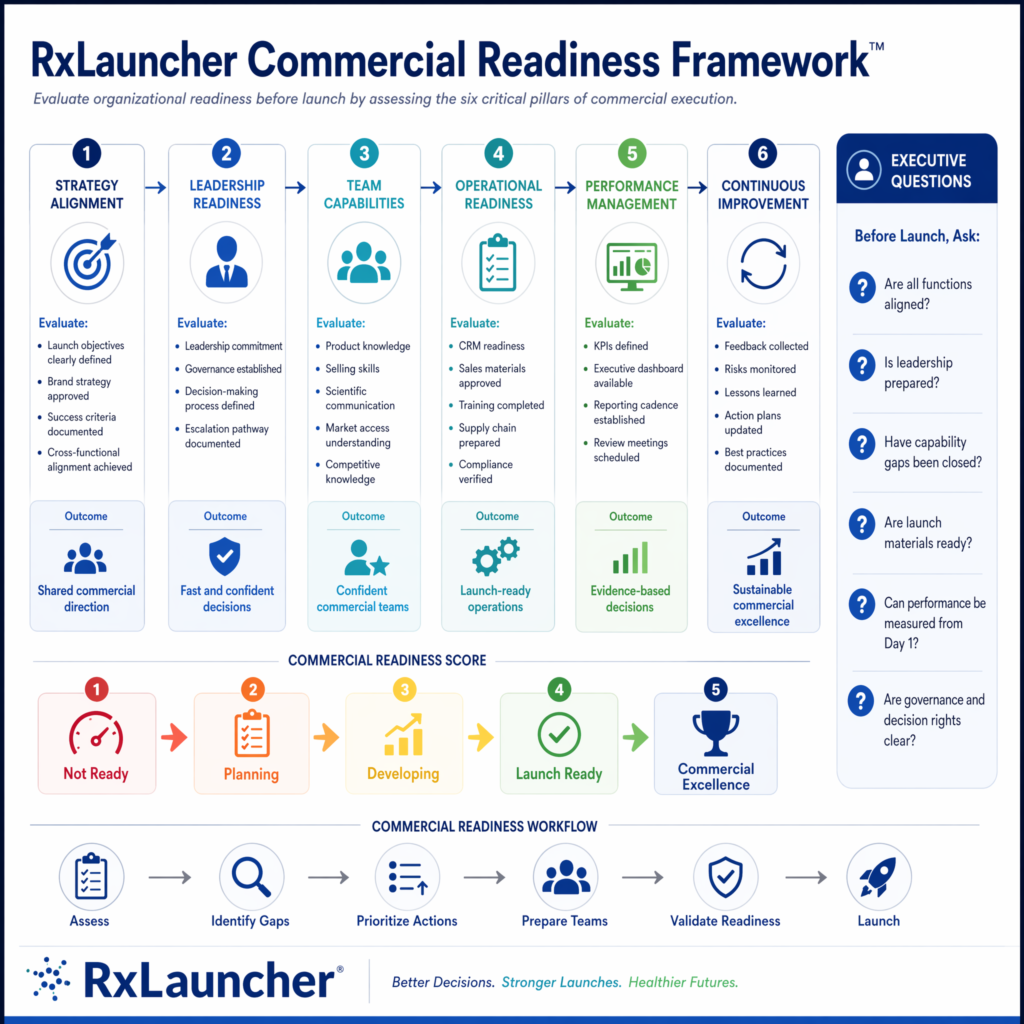
Each dimension should be reviewed before launch to identify capability gaps and prioritize corrective actions.
Governance Enables Better Decisions
Strong governance does not create bureaucracy.
It creates clarity.
Launch teams should define:
- Decision owners.
- Meeting cadence.
- Performance reviews.
- Escalation pathways.
- Risk management processes.
When governance is clear, organizations respond more quickly to changing market conditions.
Measure Readiness Before Measuring Performance
Many organizations wait until after launch to identify weaknesses.
Instead, assess readiness before execution begins.
Examples of readiness indicators include:
- Training completion rates.
- Launch material approvals.
- CRM readiness.
- Territory coverage.
- Stakeholder engagement plans.
- Dashboard availability.
- Cross-functional alignment.
Readiness metrics provide early warning signals that reduce launch risk.
Commercial Readiness Is a Continuous Capability
Readiness should not be viewed as a one-time milestone.
Markets evolve.
Teams change.
Competitors respond.
Commercial organizations should continuously strengthen capabilities, review governance, and update execution plans to maintain launch momentum throughout the product lifecycle.
Decision Point
Before approving commercial launch, ask your leadership team:
- Are all commercial functions aligned around the same launch objectives?
- Have critical capability gaps been identified and addressed?
- Does every team understand its responsibilities?
- Are governance and decision-making processes clearly defined?
- Do we have dashboards to monitor launch performance from day one?
If any answer is uncertain, strengthen organizational readiness before expanding commercial activities.
Executive Pitfalls
Commercial readiness is often underestimated because many organizations focus primarily on strategy.
Avoid these common mistakes.
Assuming Strategy Guarantees Execution
A well-designed strategy creates direction.
Execution creates results.
Limiting Readiness to Sales Training
Successful launches require coordinated preparation across every commercial function.
Weak Leadership Alignment
Inconsistent priorities among senior leaders quickly cascade throughout the organization.
Unclear Decision Ownership
Teams perform better when responsibilities and escalation pathways are clearly defined.
Measuring Results Before Readiness
Organizations should assess launch readiness before evaluating commercial performance.
Leadership Perspective
The strongest launch organizations do not simply prepare products for market.
They prepare people to execute consistently under changing market conditions.
Commercial readiness creates confidence, improves collaboration, and enables faster decision-making throughout the launch journey.
Execution excellence is rarely accidental.
It is intentionally built before launch begins.
Action Plan
Complete the following activities before launch approval.
| Action | Primary Owner | Expected Deliverable |
|---|---|---|
| Confirm cross-functional objectives | Executive Leadership | Launch Alignment Charter |
| Assess team capabilities | Commercial Excellence | Capability Assessment |
| Finalize governance structure | PMO / Leadership | Launch Governance Plan |
| Validate readiness metrics | Commercial Excellence | Readiness Dashboard |
| Complete launch simulation | Cross-Functional Launch Team | Launch Readiness Review |
Recommended RxLauncher Tools
Manager Effectiveness Heatmap
Evaluate leadership effectiveness, identify capability gaps, and strengthen management readiness before launch.
Marketing Plan Generator
Align commercial objectives, execution plans, KPIs, timelines, and ownership across the organization.
Turnover Index
Protect launch execution by identifying potential employee turnover risks within critical commercial teams.
Deep Dive Resources
Continue strengthening organizational execution with these related resources.
- Pharma Commercial Excellence Framework
- Pharma Sales Force Effectiveness Framework
- Pharma Resource Allocation Strategy
- Manager Effectiveness Heatmap
Continue the Playbook →
Chapter 7
How Should We Execute Across Channels?
A successful launch depends on delivering the right message through the right channel at the right time.
In the next chapter, you’ll learn how to design an integrated omnichannel strategy that creates consistent customer experiences across personal, digital, and scientific engagement channels.
Chapter 7: How Should We Execute Across Channels?
Creating an Omnichannel Engagement Strategy That Drives Adoption
Today’s pharmaceutical customers interact with brands through multiple channels before making clinical decisions.
A physician may first hear about a product during a scientific congress, later review published evidence, attend a webinar, receive a visit from a medical representative, and finally discuss the therapy with colleagues before prescribing it.
Each interaction contributes to the customer’s overall perception of the brand.
This is why successful launches no longer rely on isolated promotional activities.
They rely on coordinated customer experiences.
An omnichannel strategy ensures that every interaction—whether personal or digital—supports the same commercial objectives and reinforces the same brand promise.
Omnichannel Is More Than Multiple Channels
Many organizations confuse multichannel communication with omnichannel engagement.
Multichannel means using several communication channels.
Omnichannel means connecting those channels into one consistent customer experience.
Customers should experience:
- Consistent messaging.
- Relevant content.
- Appropriate timing.
- Seamless transitions between channels.
The objective is not to increase communication.
The objective is to improve engagement.
Start with Customer Behavior
Effective omnichannel strategies begin with understanding how customers prefer to learn and interact.
Different stakeholders consume information differently.
Examples include:
- Face-to-face discussions.
- Scientific publications.
- Medical webinars.
- Email updates.
- Professional social platforms.
- Medical education programs.
- Congresses and conferences.
Rather than forcing customers into preferred company channels, successful organizations adapt engagement to customer preferences.
Match Channels to Customer Objectives
Every communication channel has strengths.
Face-to-face meetings build trust.
Scientific webinars explain complex evidence.
Email supports ongoing education.
Medical congresses create awareness.
Digital platforms reinforce learning between personal interactions.
Launch teams should define the purpose of each channel before selecting activities.
More channels do not automatically create better engagement.
Better coordination does.
Introducing the RxLauncher Omnichannel Engagement Framework™
RxLauncher recommends building omnichannel strategies around five connected elements:
- Customer Insight
- Channel Selection
- Content Strategy
- Customer Interaction
- Performance Optimization
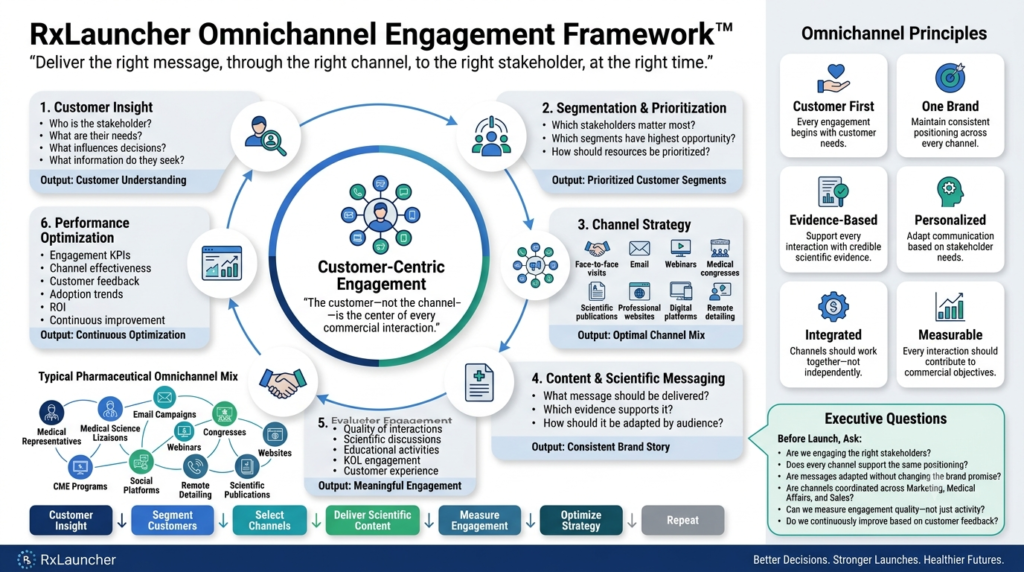
Each element should support the next to create a consistent customer experience throughout the launch journey.
Align Content Across Every Touchpoint
Every stakeholder interaction should reinforce the same positioning.
Marketing campaigns.
Medical education.
Sales conversations.
Scientific presentations.
Digital content.
Each should communicate one consistent brand promise while adapting supporting messages to the audience and communication channel.
Consistency builds confidence.
Inconsistency creates confusion.
Measure Customer Engagement
Omnichannel success should be evaluated using meaningful performance indicators.
Examples include:
- Email engagement.
- Webinar participation.
- Website activity.
- Representative interactions.
- Scientific meeting attendance.
- Customer satisfaction.
- Channel preference.
The objective is to understand how customers engage—not simply how many activities were completed.
Continuously Improve the Customer Experience
Customer preferences evolve.
Digital channels change.
Scientific evidence expands.
Competitors introduce new engagement approaches.
Organizations should continuously review customer feedback, channel performance, and engagement data to refine their omnichannel strategy throughout the product lifecycle.
Decision Point
Before launching commercial activities, ask your team:
- Do we understand how each stakeholder prefers to receive information?
- Are all communication channels aligned around one brand positioning strategy?
- Does every channel have a clearly defined objective?
- Can customers move naturally between personal and digital interactions?
- Have we defined KPIs to evaluate customer engagement?
If the answer to any of these questions is “No”, refine your omnichannel strategy before launch.
Executive Pitfalls
Successful omnichannel engagement requires planning—not simply more communication.
Avoid these common mistakes.
Using Every Available Channel
More channels do not necessarily improve customer experience.
Select channels that create value for the intended audience.
Delivering Inconsistent Messages
Customers should hear the same core value proposition regardless of channel.
Ignoring Customer Preferences
Organizations should adapt communication strategies to customer behavior—not internal preferences.
Measuring Activity Instead of Engagement
The number of emails or meetings is less important than meaningful customer interaction.
Failing to Optimize
Customer engagement strategies should evolve continuously using performance data and feedback.
Leadership Perspective
Omnichannel excellence is achieved when customers experience one coordinated brand rather than multiple disconnected communication activities.
Organizations that align customer insights, content strategy, and channel execution typically build stronger relationships, improve engagement, and accelerate product adoption.
Action Plan
Complete these activities before launch.
| Action | Primary Owner | Expected Deliverable |
|---|---|---|
| Map customer journeys | Marketing | Customer Journey Map |
| Define channel objectives | Marketing | Omnichannel Strategy |
| Align messaging across channels | Marketing & Medical Affairs | Content Framework |
| Prepare launch content | Marketing | Channel Content Library |
| Define engagement KPIs | Commercial Excellence | Omnichannel Dashboard |
Recommended RxLauncher Tool
Marketing Plan Generator
An omnichannel strategy should be integrated into the overall commercial launch plan.
Use the Marketing Plan Generator to organize communication channels, stakeholder activities, campaign timelines, responsibilities, and performance indicators in one structured execution plan.
Deep Dive Resources
Continue developing your omnichannel strategy with these related resources.
- Omnichannel Strategy in Pharma Marketing
- Scientific Messaging Framework
- Customer Segmentation Strategy
- KOL Engagement Strategy
- CME Strategy in Pharmaceutical Marketing
Continue the Playbook →
Chapter 8
How Will We Measure Success?
A successful launch requires more than execution.
In the next chapter, you’ll learn how to build launch dashboards, define meaningful KPIs, monitor commercial performance, and make faster, evidence-based decisions throughout the launch journey.
Chapter 8: How Will We Measure Success?
Building Launch Dashboards That Drive Better Decisions
A successful launch generates data from the first day of execution.
Sales figures, physician adoption, stakeholder engagement, reimbursement progress, marketing activities, and customer interactions all provide valuable information.
The challenge is not collecting data.
The challenge is identifying which information should influence decisions.
Many organizations build dashboards filled with metrics that are interesting but not actionable.
Effective launch dashboards help leadership answer three critical questions:
- Are we achieving our launch objectives?
- Where are performance gaps emerging?
- What actions should we take next?
A dashboard should support decisions—not simply report results.
Start with Business Objectives
Before selecting KPIs, define what success looks like.
Examples include:
- Achieving target market share.
- Accelerating physician adoption.
- Expanding patient access.
- Increasing stakeholder engagement.
- Improving commercial execution.
Every KPI should support one strategic objective.
If a metric cannot influence a decision, it probably does not belong on an executive dashboard.
Build KPI Layers
Not every stakeholder requires the same information.
Executive leaders need strategic indicators.
Commercial managers require operational visibility.
Field managers need execution metrics.
RxLauncher recommends organizing launch KPIs into four levels:
Strategic KPIs
Measure overall business performance.
Examples:
- Revenue
- Market share
- Forecast accuracy
- Patient access
Commercial KPIs
Evaluate execution quality.
Examples:
- Physician adoption
- Stakeholder engagement
- Sales force effectiveness
- Omnichannel performance
Operational KPIs
Track day-to-day execution.
Examples:
- Customer calls
- Webinar attendance
- Email engagement
- Territory coverage
Improvement KPIs
Identify opportunities for optimization.
Examples:
- Response time
- Content utilization
- Training completion
- CRM adoption
Each KPI level supports different management decisions.
Introducing the RxLauncher Launch Performance Dashboard™
RxLauncher recommends monitoring launch performance through six dashboard sections.
- Commercial Performance
- Market Access
- Stakeholder Engagement
- Sales Execution
- Marketing Performance
- Risk Indicators
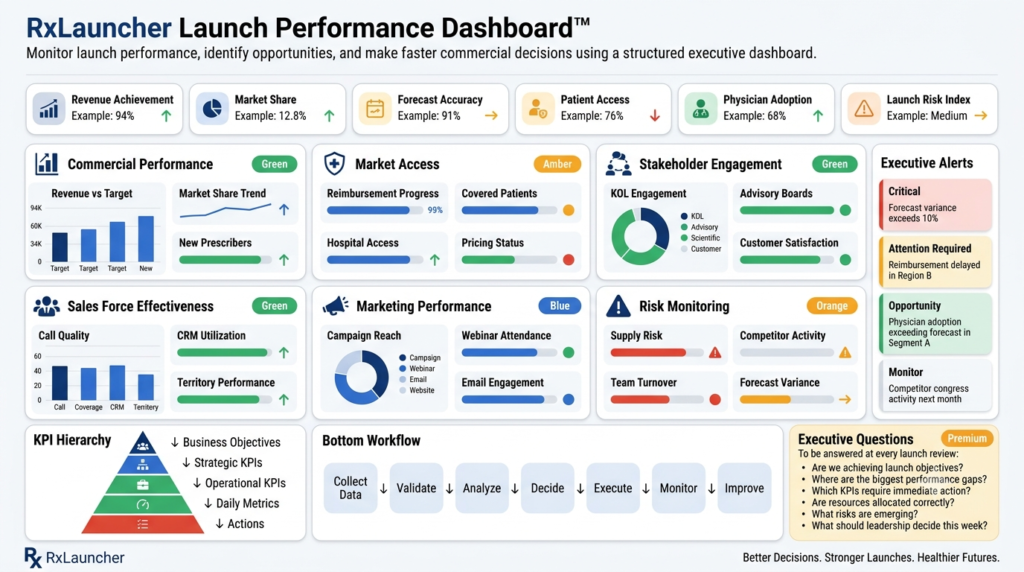
This structure provides leadership with a balanced view of launch progress without overwhelming decision-makers with unnecessary detail.
Measure Trends, Not Individual Numbers
One month of data rarely tells the full story.
Leadership should focus on trends.
Examples include:
- Is physician adoption accelerating?
- Is forecast accuracy improving?
- Is market access expanding?
- Are engagement activities producing better outcomes?
Trend analysis enables proactive decision-making.
Review Dashboards Regularly
Dashboards should become part of launch governance.
Establish a regular review cadence.
Examples include:
- Weekly launch meetings.
- Monthly executive reviews.
- Quarterly strategic assessments.
Consistent review enables faster responses to emerging risks and opportunities.
Data Should Lead to Action
Every KPI should trigger one of three decisions.
- Continue.
- Adjust.
- Escalate.
If dashboards do not influence actions, they become reporting tools rather than management tools.
Launch performance improves when data supports timely decision-making across the organization.
Decision Point
Before finalizing your launch dashboard, ask your team:
- Does every KPI support a business objective?
- Can leadership understand launch performance within five minutes?
- Are dashboard metrics updated regularly?
- Have decision owners been assigned for every major KPI?
- Does every KPI lead to a specific management action?
If not, simplify the dashboard before launch.
The most effective dashboards focus on clarity rather than quantity.
Executive Pitfalls
Strong dashboards improve decisions.
Weak dashboards create confusion.
Avoid these common mistakes.
Measuring Everything
More metrics do not create better decisions.
Focus on indicators that influence action.
Reporting Without Analysis
Dashboards should explain performance—not simply display numbers.
Ignoring Trends
Short-term fluctuations rarely require strategic changes.
Focus on patterns over time.
Delayed Reporting
Outdated information limits leadership’s ability to respond quickly.
No Accountability
Every KPI should have a clearly defined owner responsible for reviewing performance and initiating corrective actions.
Leadership Perspective
High-performing launch organizations do not wait until the end of the quarter to evaluate performance.
They monitor meaningful indicators continuously, identify issues early, and make evidence-based decisions before small problems become major commercial risks.
A dashboard is not a reporting document.
It is a leadership tool.
Action Plan
Before launch, complete the following activities.
| Action | Primary Owner | Expected Deliverable |
|---|---|---|
| Define strategic KPIs | Executive Leadership | KPI Framework |
| Build executive dashboard | Commercial Excellence | Launch Dashboard |
| Assign KPI ownership | Department Heads | KPI Responsibility Matrix |
| Establish review cadence | PMO / Leadership | Dashboard Review Calendar |
| Define corrective action process | Commercial Leadership | Performance Governance Plan |
Recommended RxLauncher Tool
Excel Chart Builder
Transform launch data into professional dashboards and executive reports.
Use the Excel Chart Builder to create clear visualizations of launch KPIs, forecast performance, market access progress, sales execution, and stakeholder engagement.
Well-designed dashboards help leadership identify trends quickly and make better commercial decisions.
Deep Dive Resources
Continue improving launch measurement with these related resources.
- How to Build a Pharma Dashboard for Decision-Making
- Pharma Commercial Excellence Framework
- Pharma Sales Force Effectiveness Framework
- Pharma Resource Allocation Strategy
Continue the Playbook →
Chapter 9
What Could Go Wrong?
Every launch involves uncertainty.
In the next chapter, you’ll learn how to identify commercial risks, prepare multiple launch scenarios, strengthen organizational resilience, and respond effectively when market conditions change.
Chapter 9: What Could Go Wrong?
Building a Risk Management and Scenario Planning Framework for Successful Pharmaceutical Launches
No pharmaceutical launch unfolds exactly as planned.
Unexpected competitor activity, reimbursement delays, supply disruptions, regulatory changes, slower physician adoption, or internal capability challenges can all influence commercial performance.
The objective of risk management is not to eliminate uncertainty.
It is to prepare the organization to respond quickly, confidently, and effectively when uncertainty becomes reality.
Organizations that identify risks early and develop structured contingency plans are more likely to maintain launch momentum and protect long-term commercial performance.
Every Launch Carries Risk
Commercial risk exists throughout the launch journey.
Examples include:
- Forecast assumptions proving inaccurate.
- Delayed reimbursement decisions.
- New competitive evidence.
- Supply chain interruptions.
- Leadership changes.
- Sales force turnover.
- Lower-than-expected physician adoption.
- Budget constraints.
- Regulatory updates.
The presence of risk should not prevent launch.
Ignoring risk is the greater danger.
Identify Risks Across the Entire Organization
Launch risks should not be evaluated only by Marketing.
Cross-functional workshops often reveal risks that individual departments may overlook.
Include representatives from:
- Marketing
- Medical Affairs
- Market Access
- Sales
- Supply Chain
- Regulatory Affairs
- Finance
- Commercial Excellence
- Executive Leadership
Each function contributes a different perspective that strengthens risk planning.
Introducing the RxLauncher Launch Risk Matrix™
RxLauncher recommends evaluating every identified risk using two dimensions:
- Probability
- Business Impact
This creates four practical response strategies:
- Monitor
- Mitigate
- Prepare
- Accept
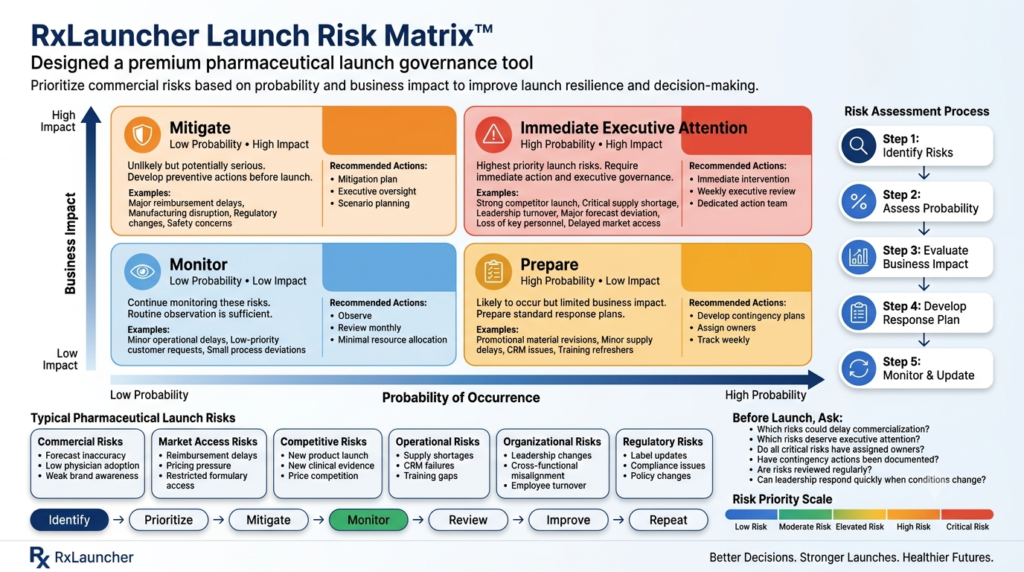
This framework helps leadership focus attention and resources on the risks most likely to influence launch success.
Build Multiple Launch Scenarios
Forecasting should never rely on a single outcome.
Every launch plan should include:
Base Case
The most realistic commercial expectation based on current evidence.
Optimistic Case
Assumes stronger adoption, faster reimbursement, or more favorable market conditions.
Conservative Case
Assumes slower adoption, competitive pressure, or operational challenges.
Each scenario should include predefined management actions so the organization can respond without unnecessary delays.
Develop Contingency Plans
Every major launch risk should have an agreed response.
Examples include:
- Additional scientific education if physician adoption is slower than expected.
- Alternative supply arrangements if manufacturing disruptions occur.
- Revised promotional priorities if reimbursement is delayed.
- Resource reallocation if competitor activity increases.
Planning responses before launch reduces reaction time during execution.
Monitor Risks Continuously
Risk management should continue throughout the launch lifecycle.
Leadership should review:
- Commercial KPIs.
- Market feedback.
- Competitive developments.
- Stakeholder insights.
- Internal capability indicators.
Risk monitoring should become part of the regular launch governance process rather than a one-time planning exercise.
Resilient Organizations Learn Faster
Unexpected events create opportunities to improve.
High-performing organizations document lessons learned, update assumptions, and refine future launch strategies based on experience.
Continuous learning strengthens future launches and improves long-term commercial excellence.
Decision Point
Before approving final launch readiness, ask your leadership team:
- Have we identified the most significant commercial risks?
- Do we understand the probability and potential impact of each risk?
- Have contingency actions been documented and assigned?
- Are risk indicators included in our launch dashboard?
- Can leadership respond quickly if market conditions change?
If any answer is uncertain, strengthen your contingency planning before launch.
Executive Pitfalls
Strong launch organizations prepare for uncertainty rather than assuming everything will proceed according to plan.
Avoid these common mistakes.
Assuming the Forecast Will Be Accurate
Forecasts are built on assumptions that may change as the market evolves.
Waiting Until Problems Occur
Contingency planning is most valuable before launch—not after issues emerge.
Focusing Only on External Risks
Internal challenges such as capability gaps, leadership changes, or employee turnover can affect launch performance as much as competitive activity.
Ignoring Early Warning Signals
Small performance changes often indicate larger commercial issues.
Monitor trends before they become major problems.
Failing to Learn
Every launch generates valuable experience.
Organizations that document lessons learned continuously improve future commercial performance.
Leadership Perspective
The objective of risk management is not to predict every possible outcome.
It is to build an organization capable of responding effectively when conditions change.
Launch resilience comes from preparation, cross-functional collaboration, disciplined governance, and continuous learning—not from avoiding uncertainty.
Action Plan
Complete the following activities before launch.
| Action | Primary Owner | Expected Deliverable |
|---|---|---|
| Conduct cross-functional risk workshop | PMO / Leadership | Launch Risk Register |
| Assess probability and impact | Commercial Leadership | Prioritized Risk Matrix |
| Build launch scenarios | Marketing & Finance | Scenario Planning Document |
| Define contingency actions | Cross-Functional Launch Team | Response Plan |
| Add risk indicators to dashboards | Commercial Excellence | Risk Dashboard |
Recommended RxLauncher Tools
Turnover Index
Assess potential employee turnover risks within critical commercial teams before they affect launch execution.
Excel Chart Builder
Create executive dashboards that visualize commercial risks, launch scenarios, and performance indicators to support faster leadership decisions.
Deep Dive Resources
Continue strengthening your launch resilience with these related resources.
- Pharma Scenario Planning Framework
- Pharma Competitive Intelligence Framework
- Pharma Resource Allocation Strategy
- Market Access Strategy for Pharma Brands
Continue the Playbook →
Chapter 10
What Should Happen During the First 90 Days?
The launch does not end on launch day.
In the final chapter, you’ll learn how to manage the critical first 90 days, review performance, adjust strategy, and establish a cycle of continuous commercial improvement.
Chapter 10: What Should Happen During the First 90 Days?
Managing Execution, Learning, and Continuous Improvement After Launch
Launch day is not the finish line.
It is the beginning of a new phase where assumptions are tested, customer feedback becomes available, and commercial execution is evaluated under real market conditions.
The first ninety days often determine whether early momentum develops into sustainable growth or whether small operational issues become long-term commercial challenges.
Successful launch organizations do not assume their original plan is perfect.
They monitor performance, learn quickly, and adjust execution while remaining aligned with their long-term strategy.
The First 30 Days: Stabilize Execution
The initial month should focus on confirming that launch activities are operating as planned.
Leadership should review:
- Product availability.
- Sales force readiness.
- Promotional material utilization.
- Stakeholder engagement.
- Market access progress.
- Early customer feedback.
The objective is not to maximize sales immediately.
It is to establish a stable commercial foundation.
Quick identification of operational issues prevents larger problems later.
Days 31–60: Measure and Optimize
As more market information becomes available, leadership should begin comparing actual performance with launch assumptions.
Review indicators such as:
- Forecast accuracy.
- Physician adoption.
- Market access milestones.
- Omnichannel engagement.
- Sales effectiveness.
- Customer feedback.
This period is ideal for identifying areas requiring corrective action.
Adjustments may include refining messaging, reallocating resources, strengthening stakeholder engagement, or increasing educational activities.
Organizations that respond early often recover performance more efficiently than those waiting for quarterly reviews.
Days 61–90: Scale What Works
By the third month, launch teams should have enough information to identify successful strategies.
Expand activities that demonstrate measurable impact.
Reduce investment in initiatives producing limited value.
Review:
- Territory performance.
- Customer segment response.
- Channel effectiveness.
- Stakeholder influence.
- Promotional ROI.
- Resource utilization.
Commercial excellence depends on disciplined prioritization rather than increasing activity across every area.
Introducing the RxLauncher 90-Day Launch Roadmap™
RxLauncher recommends managing post-launch execution through three structured phases.
- Launch & Stabilize
- Measure & Optimize
- Scale & Improve
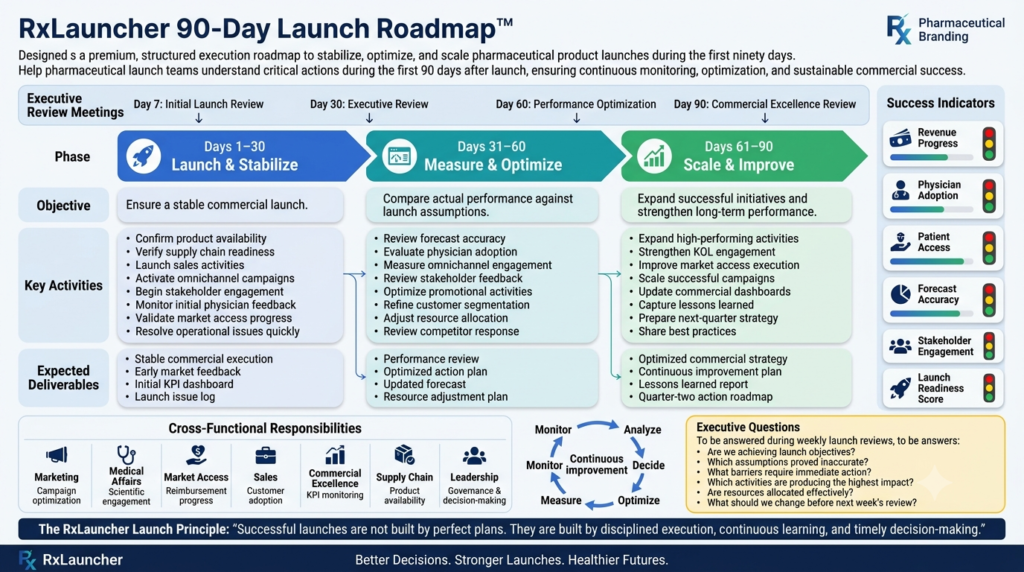
This framework encourages continuous review rather than waiting for formal business reviews before making important commercial decisions.
Build a Continuous Improvement Culture
Launch performance improves when learning becomes part of the organization’s routine.
Establish regular review meetings that answer questions such as:
- What exceeded expectations?
- Which assumptions proved inaccurate?
- Which barriers emerged unexpectedly?
- What should we stop doing?
- What should we increase?
- What have competitors changed?
Learning should become an ongoing commercial capability—not an annual exercise.
Keep Cross-Functional Teams Aligned
The first ninety days require close collaboration across departments.
Marketing, Medical Affairs, Market Access, Sales, Supply Chain, Commercial Excellence, and Leadership should review performance together rather than independently.
Shared visibility improves decision-making and ensures corrective actions are coordinated across the organization.
The Launch Is Only the Beginning
A successful launch creates momentum for the entire product lifecycle.
Organizations that continuously improve forecasting, stakeholder engagement, market access, customer experience, and commercial execution are better positioned to sustain growth, expand indications, and strengthen long-term brand performance.
The objective is not simply to launch successfully.
The objective is to build a brand that continues creating value for patients, healthcare professionals, and the organization for years to come.
Decision Point
Before closing the first 90-day review, ask your leadership team:
- Have we compared actual performance against our original assumptions?
- Which activities are delivering the strongest commercial results?
- What barriers require immediate attention?
- Have we adjusted our plans based on market feedback?
- What lessons should be documented for future launches?
Continuous improvement begins by asking better questions—not by defending the original plan.
Executive Pitfalls
Many launches lose momentum after the initial excitement fades.
Avoid these common mistakes.
Treating Launch Day as the Finish Line
Launch marks the beginning of commercial execution—not its completion.
Waiting Too Long to Adjust
Small issues identified early are easier and less costly to resolve.
Measuring Activity Instead of Business Outcomes
Focus on physician adoption, patient access, stakeholder influence, and commercial performance rather than counting activities alone.
Working in Functional Silos
Launch reviews should involve all commercial functions to ensure coordinated decision-making.
Failing to Capture Lessons Learned
Every launch creates valuable knowledge that should strengthen future launches.
Leadership Perspective
The organizations that consistently outperform competitors are rarely those with the most detailed launch plans.
They are the organizations that learn faster, adapt earlier, and continuously improve execution based on evidence rather than assumptions.
Commercial excellence is not a project.
It is an organizational capability.
Action Plan
Complete the following activities during the first 90 days.
| Action | Primary Owner | Expected Deliverable |
|---|---|---|
| Conduct weekly launch reviews | Commercial Leadership | Launch Status Report |
| Compare forecasts with actual performance | Commercial Excellence | Performance Analysis |
| Review stakeholder feedback | Marketing & Medical Affairs | Stakeholder Insights Report |
| Update commercial action plans | Cross-Functional Launch Team | Optimized Launch Plan |
| Document lessons learned | PMO / Commercial Excellence | Post-Launch Review Report |
Recommended RxLauncher Toolkit
Marketing Plan Generator
Review objectives, initiatives, timelines, and KPIs as new commercial information becomes available.
Excel Chart Builder
Create executive dashboards that visualize launch performance, forecast accuracy, customer engagement, and commercial trends.
Manager Effectiveness Heatmap
Evaluate leadership effectiveness and identify capability gaps affecting launch execution.
Turnover Index
Monitor organizational stability and identify turnover risks within critical commercial teams during the launch period.
Deep Dive Resources
Continue strengthening your commercial capabilities with these resources from the RxLauncher Knowledge Hub.
- Pharma Commercial Excellence Framework
- How to Build a Pharma Dashboard for Decision-Making
- Pharma Sales Force Effectiveness Framework
- Pharma Resource Allocation Strategy
Congratulations
You have completed the RxLauncher Pharmaceutical Product Launch Playbook.
The frameworks, principles, and implementation guidance presented throughout this playbook are designed to help pharmaceutical professionals move beyond launch planning and build repeatable commercial excellence.
Every launch is different.
The organizations that succeed are those that combine disciplined planning, cross-functional collaboration, evidence-based decision-making, and continuous improvement throughout the product lifecycle.
Use this playbook as a working reference, revisit it at every major launch milestone, and adapt its principles to the unique challenges of your organization and market.