

Table of Contents
How Do You Build a Pharma Brand Lifecycle Management Framework?
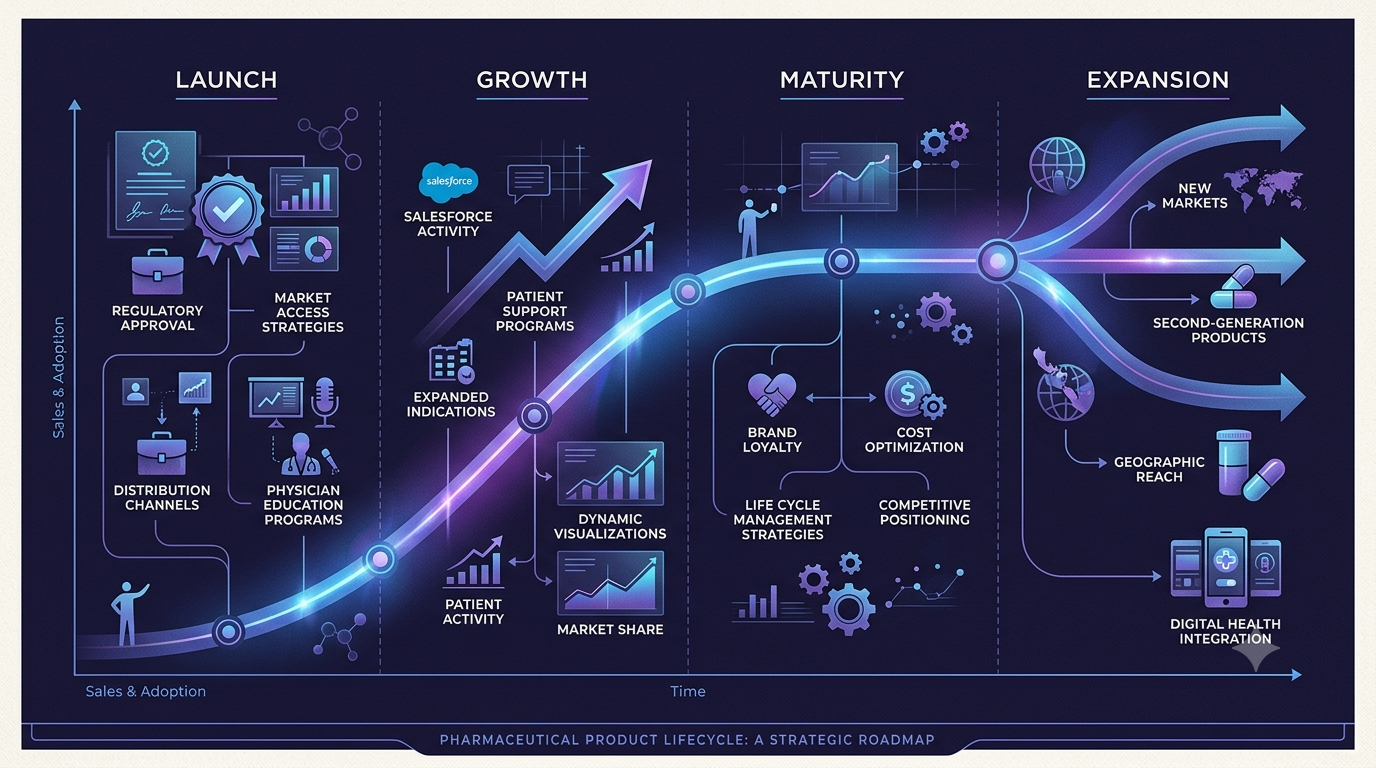
A pharma brand lifecycle management framework is built by managing a product strategically across launch, growth, maturity, expansion, and optimization phases.
Strong lifecycle management maximizes long-term value, market share, and sustainability.
It requires continuous adaptation, not one-time planning.
Without lifecycle strategy, even successful launches eventually decline.
What is pharma brand lifecycle management?
Pharma brand lifecycle management is the structured process of maximizing a brand’s value throughout its commercial life.
It includes:
- Launch planning
- Market penetration
- Indication expansion
- Competitive defense
- Portfolio optimization
- Forecast adaptation
Important reality:
A launch is only the beginning.
The real challenge is:
👉 Sustaining growth over time
Why is lifecycle management critical in pharma?
Pharmaceutical markets evolve continuously.
Challenges include:
- New competitors
- Generic erosion
- Pricing pressure
- Market saturation
- Stakeholder changes
Without lifecycle management:
Brands typically:
- Peak early
- Lose momentum
- Decline rapidly
Strong lifecycle management helps:
- Extend relevance
- Increase profitability
- Delay decline
👉 As explained in
🔗 Related Post: How to Build a Pharma Launch Plan: 7 Proven Steps
Launch success must be designed for long-term sustainability.
What are the 7 stages of pharma lifecycle management?
Stage 1: Pre-launch strategy development
Lifecycle management starts before launch.
Key activities include:
- Market assessment
- Forecasting
- Positioning
- Stakeholder mapping
- Access planning
Important principle:
The quality of pre-launch planning influences every later stage.
Research shows companies increasingly integrate marketing and stakeholder planning early in product development to improve launch success
Stage 2: Launch execution
The launch phase establishes:
- Market perception
- Initial adoption
- Competitive positioning
Critical launch priorities:
- Clear positioning
- Field force alignment
- KOL engagement
- Market access readiness
Common mistake:
Treating launch as an event instead of a system.
👉 As discussed in
🔗 Related Post: Why Pharma Launches Fail: 9 Critical Mistakes
Most failures originate from weak strategic alignment.
Stage 3: Growth acceleration
After launch, brands must scale intelligently.
Growth drivers typically include:
- New patient acquisition
- Switching strategy
- Geographic expansion
- Stakeholder influence
Strong growth phases require:
- KPI tracking
- Forecast refinement
- Resource optimization
👉 As explained in
🔗 Related Post: Pharma Switching Strategy: 6 Proven Ways to Win
Competitive conversion is often the strongest growth lever.
Stage 4: Indication expansion
One of the most powerful lifecycle tools.
Expansion opportunities include:
- New indications
- New specialties
- New patient populations
Strategic value:
Indication expansion:
- Extends product relevance
- Unlocks new revenue streams
- Strengthens market positioning
Important:
Each indication behaves like a new launch.
👉 As discussed in
🔗 Related Post: Pharma Indication Expansion: 6 Proven Growth Strategies
Expansion requires dedicated positioning and stakeholder planning.
Stage 5: Competitive defense
As brands grow, competitors respond aggressively.
Common threats include:
- Price competition
- Generic pressure
- New mechanisms
- Promotional noise
Defensive strategies include:
- Strong KOL relationships
- Better stakeholder engagement
- Access optimization
- Scientific differentiation
Important reality:
Defending market share is harder than gaining it.
Stage 6: Optimization and efficiency
Mature brands require smarter resource management.
Focus areas include:
- ROI optimization
- Resource prioritization
- Territory efficiency
- Targeting refinement
Key principle:
Mature brands should become:
- More efficient
- More focused
- More data-driven
👉 As explained in
🔗 Related Post: Pharma Sales Force Effectiveness: 8 Proven Frameworks
Execution quality becomes critical during maturity phases.
Stage 7: Lifecycle renewal or transition
Eventually, brands reach saturation or decline.
Strategic options include:
- New formulations
- Combination products
- New indications
- Portfolio integration
- Brand transition planning
Important mindset:
Lifecycle management is about adaptation, not preservation only.
How does forecasting support lifecycle management?
Forecasting guides lifecycle decisions continuously.
Forecasting helps determine:
- Investment levels
- Growth expectations
- Resource allocation
- Risk exposure
Best practice:
Forecasts must evolve with market conditions.
👉 As explained in
🔗 Related Post: How Do You Forecast a Pharma Launch Accurately?
Forecasting should remain dynamic and evidence-based.
How does market access influence lifecycle performance?
Access conditions change over time.
Lifecycle access challenges include:
- Reimbursement pressure
- Tender competition
- Pricing restrictions
- Budget controls
Strong lifecycle strategy includes:
- Ongoing payer engagement
- Evidence generation
- Value communication
👉 As discussed in
🔗 Related Post: Pharma Market Access Strategy: 7 Proven Success Steps
Access strategy directly influences long-term sustainability.
How do KPIs support lifecycle optimization?
Lifecycle management requires continuous measurement.
Important KPIs include:
- Market share
- Growth rate
- Switching rate
- Access wins
- Forecast accuracy
- ROI
Why this matters:
Different lifecycle stages require different priorities.
👉 As explained in
🔗 Related Post: Pharma KPIs That Matter: 8 Proven Metrics Guide
KPIs should evolve with strategic objectives.
How can tools improve lifecycle management?
1. Marketing Plan Generator
Use it to:
- Structure lifecycle strategies
- Plan expansion phases
- Align execution roadmaps
2. Excel Chart Builder
Use it to:
- Visualize lifecycle trends
- Track performance stages
- Compare growth patterns
3. Manager Effectiveness Heatmap
Use it to:
- Maintain leadership quality
- Improve execution consistency
4. Turnover Index
Use it to:
- Reduce organizational instability
- Protect commercial continuity
👉 Lifecycle success depends heavily on execution sustainability.
What is the biggest mistake in lifecycle management?
The biggest mistake is:
👉 Managing the brand the same way at every stage
Reality:
Each lifecycle phase requires:
- Different priorities
- Different investments
- Different strategies
Example:
What works during launch:
- May fail during maturity
Final Insight
The strongest pharma brands are not the ones with the best launch only.
They are the brands that:
- Adapt continuously
- Expand intelligently
- Defend strategically
- Optimize relentlessly
In pharma:
👉 Brands decline when strategy becomes static
👉 Brands grow when lifecycle management becomes dynamic
The companies that manage lifecycle best usually:
- Think long-term early
- Forecast continuously
- Invest strategically across phases
Related Guides You Should Review Next
🔗 Related Post: How to Build a Pharma Launch Plan: 7 Proven Steps
🔗 Related Post: How Do You Forecast a Pharma Launch Accurately?
🔗 Related Post: Pharma Indication Expansion: 6 Proven Growth Strategies
🔗 Related Post: Pharma Market Access Strategy: 7 Proven Success Steps
🔗 Related Post: Pharma Sales Force Effectiveness: 8 Proven Frameworks
🔗 Related Post: Pharma KOL Engagement: 7 Proven Strategy Principles
