
Table of Contents
How Do You Build a Strategic Customer Segmentation in Pharma?
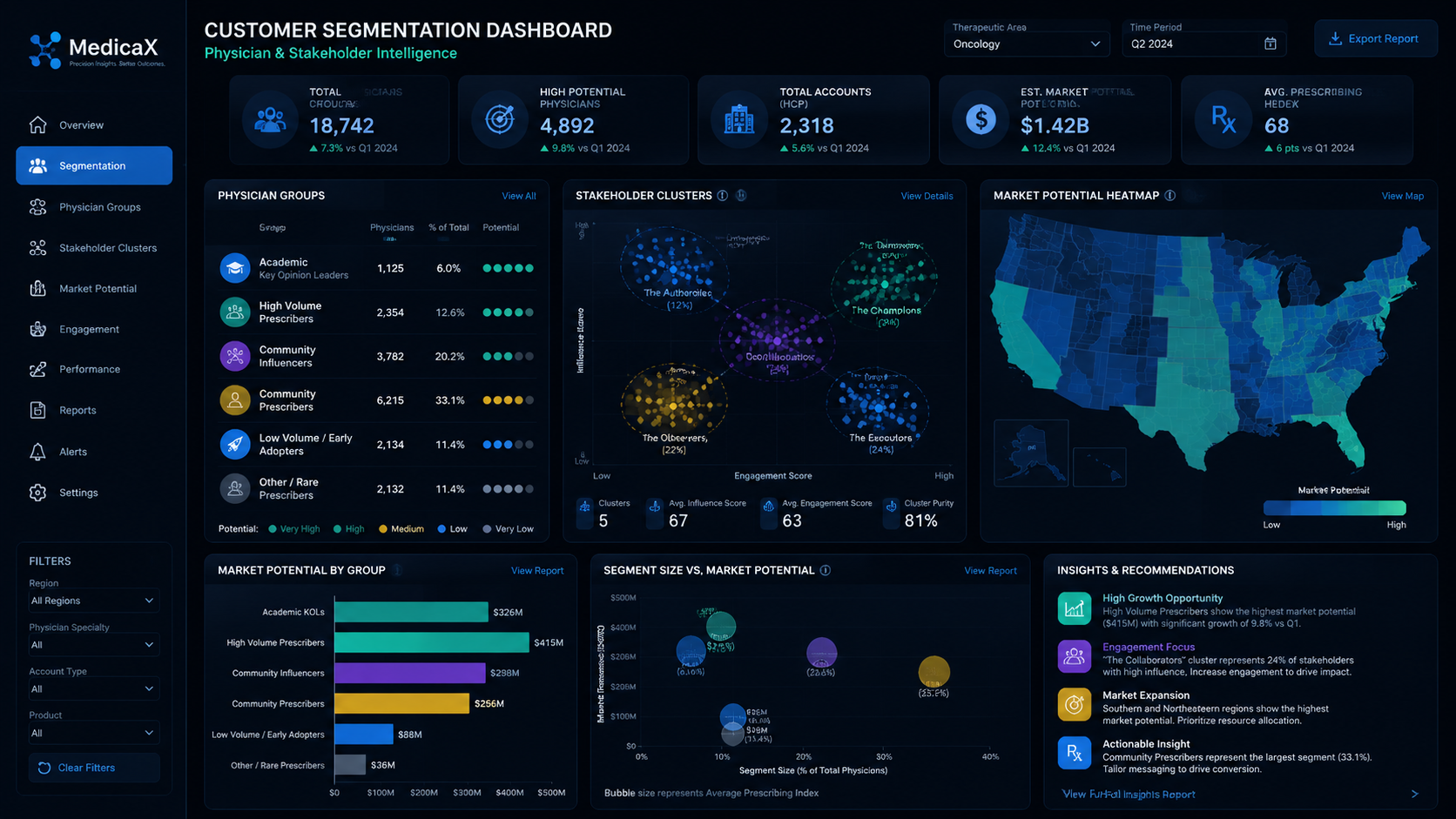
Strategic customer segmentation in pharma is the process of grouping healthcare stakeholders based on shared characteristics, behaviors, influence, needs, and commercial value.
Effective segmentation improves targeting, resource allocation, engagement quality, and commercial performance.
Without segmentation, organizations waste resources by treating all customers the same.
The strongest pharma companies understand that different stakeholders require different strategies.
What is customer segmentation in pharma?
Customer segmentation in pharma is the process of dividing stakeholders into meaningful groups.
These groups may include:
- High prescribers
- Emerging prescribers
- Key Opinion Leaders (KOLs)
- Institutional decision-makers
- Payers
- Specialists
- General practitioners
Important reality:
Not all customers create equal value.
Some stakeholders influence:
- Adoption
Others influence:
- Access
Others influence:
- Market perception
Segmentation helps answer:
- Who matters most?
- Why do they matter?
- How should we engage them?
Why is segmentation important in pharma?
Many organizations still use generic engagement models.
Common approach:
Same message
Same frequency
Same resource allocation
Result:
Poor efficiency
Poor engagement
Weak ROI
Effective segmentation improves:
- Resource allocation
- Targeting quality
- Sales productivity
- Stakeholder engagement
- Market penetration
👉 As discussed in
🔗 Related Post: Pharma Resource Allocation: 7 Proven Strategy Principles
Prioritization drives performance.
Why do segmentation strategies fail?
Most failures happen because segmentation is built for reporting instead of decision-making.
Common mistakes:
- Too many segments
- No practical application
- Static segmentation
- Focusing only on prescriptions
- Ignoring stakeholder influence
Important principle:
Good segmentation changes actions.
Bad segmentation creates spreadsheets.
What are the 8 dimensions of effective customer segmentation?
1. Prescription-based segmentation
This is the most common model.
Segment customers based on:
- Prescription volume
- Product utilization
- Market contribution
Example:
High Prescribers
- Significant market contribution
Medium Prescribers
- Growth opportunities
Low Prescribers
- Selective engagement
Limitation:
Volume alone does not capture influence.
2. Potential-based segmentation
Current performance and future potential are different.
Evaluate:
- Patient volume
- Specialty growth
- Market opportunity
- Competitive positioning
Example:
A physician may prescribe little today but have high future potential.
Important:
Potential often matters more than current volume.
3. Behavioral segmentation
Behavior often predicts future performance.
Analyze:
- Adoption speed
- Openness to innovation
- Switching behavior
- Educational engagement
Typical groups:
Innovators
Adopt early
Pragmatists
Require validation
Conservative adopters
Need stronger evidence
👉 As discussed in
🔗 Related Post: Pharma Switching Strategy: 6 Proven Ways to Win
Behavior heavily influences conversion opportunities.
4. Influence-based segmentation
Influence matters beyond prescriptions.
Evaluate:
- Professional reputation
- Scientific activity
- Network reach
- Institutional influence
Example:
A KOL may prescribe less but influence hundreds of physicians.
Research highlights the growing importance of stakeholder influence networks in commercial success.
Important:
Influence and volume should be evaluated separately.
5. Specialty segmentation
Different specialties require different approaches.
Examples:
- Psychiatry
- Cardiology
- Internal Medicine
- Neurology
- Oncology
Why this matters:
Each specialty has:
- Different priorities
- Different evidence requirements
- Different treatment behaviors
Important principle:
Specialty drives messaging.
6. Access-based segmentation
Some stakeholders influence access directly.
Examples include:
- Hospital committees
- Procurement teams
- Payers
- Institutional leaders
Why this matters:
Commercial success increasingly depends on access stakeholders.
👉 As discussed in
🔗 Related Post: Pharma Market Access Strategy: 7 Proven Success Steps
Access stakeholders require dedicated engagement strategies.
7. Geographic segmentation
Markets differ by region.
Evaluate:
- Territory opportunity
- Population density
- Access environment
- Competitive intensity
Benefits:
- Better territory planning
- Better resource allocation
- Better deployment decisions
👉 As discussed in
🔗 Related Post: Pharma Territory Targeting: 7 Proven Strategy Steps
Geography influences opportunity.
8. Lifecycle segmentation
Stakeholders change over time.
Segment by:
- Awareness level
- Adoption stage
- Relationship maturity
Example:
New customers
Need education
Adopters
Need support
Advocates
Need engagement and collaboration
Important:
Segmentation should evolve with customer behavior.
How does segmentation support launch success?
Launches require prioritization.
Segmentation helps identify:
- Early adopters
- High-value stakeholders
- Growth opportunities
- Resource priorities
👉 As discussed in
🔗 Related Post: How to Build a Pharma Launch Plan: 7 Proven Steps
Launch success depends on focusing resources where they matter most.
How does segmentation improve forecasting?
Forecasting depends on understanding customer behavior.
Segmentation improves:
- Adoption assumptions
- Growth estimates
- Market potential calculations
Forecasting frameworks emphasize understanding market drivers and customer behavior before building projections.
👉 As discussed in
🔗 Related Post: How Do You Forecast a Pharma Launch Accurately?
Forecast quality depends on segmentation quality.
How can tools improve segmentation?
1. Marketing Plan Generator
Use it to:
- Define target segments
- Align engagement plans
- Structure launch strategies
2. Excel Chart Builder
Use it to:
- Visualize segments
- Build segmentation matrices
- Compare stakeholder groups
3. Manager Effectiveness Heatmap
Use it to:
- Assess execution quality across segments
- Improve targeting consistency
4. Turnover Index
Use it to:
- Protect relationships with high-priority segments
- Reduce disruption risk
👉 Strong segmentation only creates value when execution follows it.
What are the biggest segmentation mistakes?
1. Segmenting only by volume
Misses influence and opportunity.
2. Creating too many segments
Makes execution difficult.
3. Never updating segments
Markets evolve.
4. No action plans
Segmentation without execution creates no value.
5. Ignoring stakeholder diversity
Modern pharma is multi-stakeholder.
Final Insight
Customer segmentation is not a CRM exercise.
It is a strategic capability.
The strongest pharma organizations understand:
- Who matters most
- Why they matter
- How to engage them
- How to allocate resources around them
In pharma:
👉 Better segmentation leads to better targeting
👉 Better targeting leads to better performance
Organizations that segment effectively usually:
- Forecast more accurately
- Allocate resources better
- Execute more efficiently
- Grow more consistently
Related Guides You Should Review Next
🔗 Related Post: Pharma Territory Targeting: 7 Proven Strategy Steps
🔗 Related Post: Pharma Resource Allocation: 7 Proven Strategy Principles
🔗 Related Post: Stakeholder Mapping Framework in Pharma
🔗 Related Post: Pharma Market Access Strategy: 7 Proven Success Steps
🔗 Related Post: How Do You Forecast a Pharma Launch Accurately?
🔗 Related Post: Pharma Sales Force Effectiveness: 8 Proven Frameworks