
Table of Contents
How Do You Forecast a Pharma Launch Accurately?
Accurate pharma forecasting is built on structured assumptions, market understanding, scenario planning, and continuous validation.
It is not about predicting the future, but about modeling possible outcomes based on data and logic.
Strong forecasts guide investment, resource allocation, and strategy decisions.
Weak forecasts lead to misalignment, wasted budget, and failed launches.
What is pharma forecasting and why does it matter?
Pharma forecasting is the process of estimating future sales, demand, and market performance.
A forecast is not a guess.
It is a belief about the future based on assumptions and probabilities
Why forecasting matters:
- Guides launch investment
- Aligns marketing and sales
- Supports supply planning
- Sets realistic expectations
👉 As explained in
🔗 Related Post: How to Build a Pharma Launch Plan: 7 Proven Steps
Forecasting is the backbone of planning.
Why do most pharma forecasts fail?
Most forecasts fail because they are:
- Too optimistic
- Based on weak assumptions
- Not linked to real market behavior
Common failure patterns:
- Ignoring competition
- Overestimating uptake speed
- No scenario planning
- Static forecasts
👉 As discussed in
🔗 Related Post: Why Pharma Launches Fail: 9 Critical Mistakes
Poor forecasting leads to poor decisions across the entire launch.
What are the 7 steps to build an accurate pharma forecast?
Step 1: Define your market correctly
Everything starts with market definition.
You must understand:
- Total market size
- Growth rate
- Patient population
- Treatment flow
- Market segmentation
Important:
Do not forecast in isolation.
👉 Strong launch plans analyze:
- Sources of business
- Patient flow
- Channel contribution
These elements are essential in real pharma planning frameworks
Step 2: Break down growth drivers
Forecasting must be structured around how growth happens.
The 3 core drivers:
- New patients
- Switching from competitors
- Repeat usage
👉 As explained in
🔗 Related Post: Pharma Switching Strategy: 6 Proven Ways to Win
Switching is often the dominant growth driver.
Why this matters:
Without this breakdown:
👉 Your forecast is just a number, not a model
Step 3: Build realistic assumptions
Your forecast is only as strong as your assumptions.
You must define:
- Market growth rate
- Expected market share
- Uptake speed
- Competitive reaction
- Pricing impact
Golden rule:
Challenge every assumption.
From forecasting best practices:
👉 You must question:
- The rationale
- The methodology
- The probability of occurrence
Step 4: Standardize your units and metrics
One of the most ignored steps.
Define clearly:
- Units (SU, DOT, DDD)
- Value vs volume
- Time periods
Why it matters:
Inconsistent measurement leads to:
- Wrong analysis
- Misaligned teams
- Poor decisions
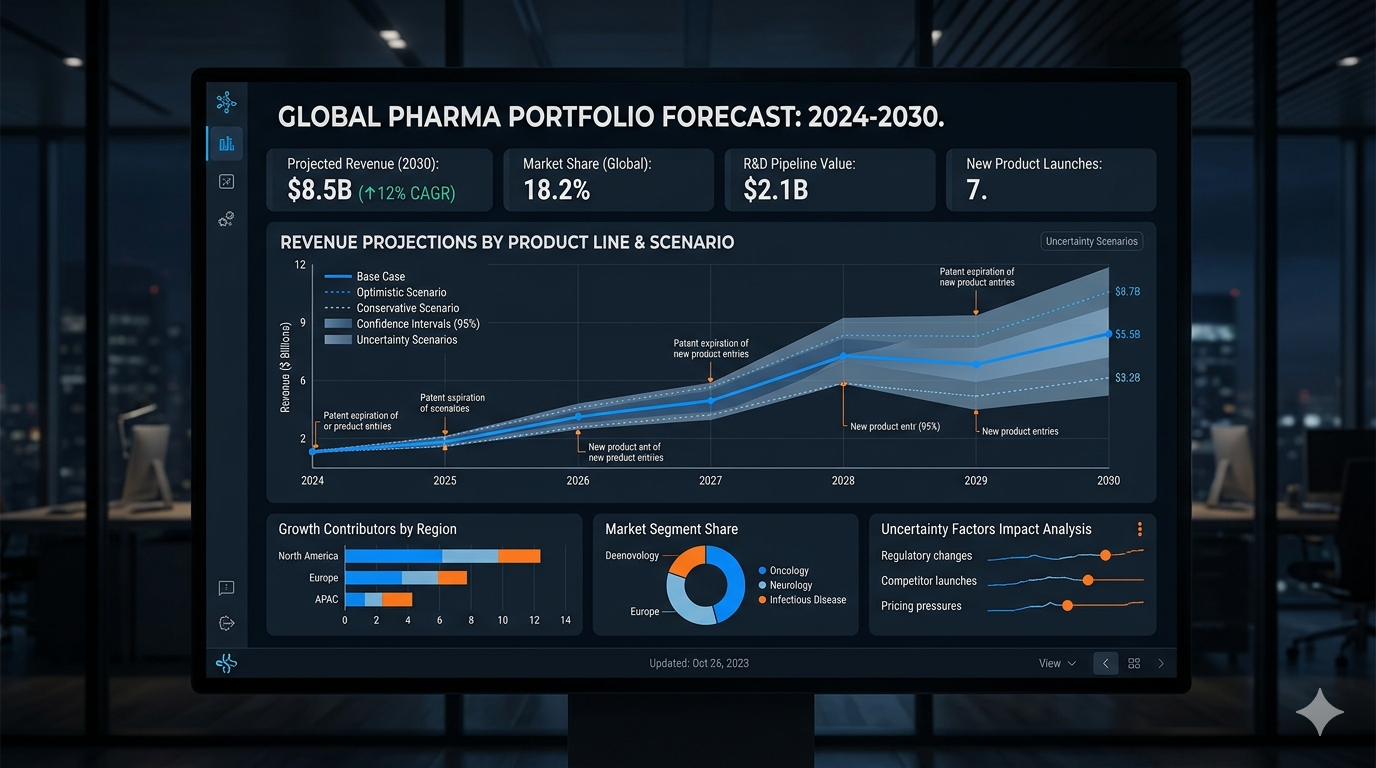
Step 5: Build multiple scenarios
Never rely on a single forecast.
Minimum requirement:
- Conservative scenario
- Base scenario
- Accelerated scenario
Why this matters:
Pharma operates in uncertainty (VUCA environment).
👉 Best practice:
Plan for the best, but prepare for the worst
Step 6: Validate using multiple data sources
Do not rely on one source.
Use:
- Market data (IMS or equivalent)
- Primary research
- Physician insights
- Competitive benchmarking
Advanced methods include:
- Interviews
- Surveys
- Conjoint analysis
Why this matters:
Better data = better assumptions = better forecast
Step 7: Track, adjust, and improve continuously
Forecasting does not end at launch.
You must track:
- Forecast vs actual
- Deviation %
- Trend changes
Key metric:
MAPE (Mean Absolute Percentage Error)
Best practice:
Revisit and adjust forecasts regularly
👉 As explained in
🔗 Related Post: Pharma KPIs That Matter: 8 Proven Metrics Guide
Tracking performance is critical for decision-making.
What does a strong pharma forecast look like?
A strong forecast is:
- Realistic
- Structured
- Transparent
- Flexible
- Data-supported
It includes:
- Clear assumptions
- Defined drivers
- Scenario models
- KPI linkage
How does forecasting connect to go-to-market strategy?
Forecasting is not separate from strategy.
👉 As explained in
🔗 Related Post: Pharma Go-To-Market Strategy: 7 Clear Steps Guide
Forecasting determines:
- Resource allocation
- Market prioritization
- Channel investment
Without forecasting:
Your strategy becomes guesswork.
How can tools improve pharma forecasting?
1. Excel Chart Builder
Use it to:
- Visualize forecast trends
- Compare scenarios
- Identify deviations
2. Marketing Plan Generator
Use it to:
- Link forecast to strategy
- Align assumptions
- Structure planning
3. Manager Effectiveness Heatmap
Use it to:
- Validate execution capability
- Adjust expectations
4. Turnover Index
Use it to:
- Identify team risk
- Protect forecast stability
👉 Forecast accuracy depends on both market logic and execution capability
What is the biggest mistake in pharma forecasting?
The biggest mistake is:
👉 Treating forecasting as a number exercise instead of a decision system
What this leads to:
- Unrealistic expectations
- Poor resource allocation
- Strategy failure
Correct mindset:
Forecasting is:
- Strategic
- Dynamic
- Evidence-based
Final Insight
You cannot predict the future.
But you can:
- Understand the market
- Structure your assumptions
- Model your scenarios
- Adjust your plan
In pharma:
👉 The best forecasts are not the most accurate
👉 They are the most useful for decision-making
Related Guides You Should Review Next
🔗 Related Post: How to Build a Pharma Launch Plan: 7 Proven Steps
🔗 Related Post: Why Pharma Launches Fail: 9 Critical Mistakes
🔗 Related Post: Pharma KPIs That Matter: 8 Proven Metrics Guide
🔗 Related Post: Pharma Switching Strategy: 6 Proven Ways to Win
🔗 Related Post: Pharma Go-To-Market Strategy: 7 Clear Steps Guide