
Table of Contents
How Do You Build a Pharma Resource Allocation Strategy That Maximizes Commercial Performance?
A pharma resource allocation strategy is built by distributing budgets, people, activities, and investments according to market opportunity, growth potential, and strategic priorities.
Strong allocation improves ROI, execution quality, and growth efficiency.
Weak allocation creates wasted spending and poor performance.
Commercial success depends not only on resources available but on how intelligently they are deployed.
What is resource allocation in pharma?
Resource allocation is the process of deciding:
- Where investments go
- How teams are deployed
- Which activities receive funding
- Which opportunities receive priority
Resources may include:
- Marketing budgets
- Sales force headcount
- Educational spending
- Digital investments
- Market access resources
- Time and management attention
Important reality:
Resources are always limited.
Therefore:
👉 Allocation is fundamentally a prioritization exercise.
Why is pharma resource allocation important?
Most organizations cannot maximize everything simultaneously.
Poor allocation creates:
- Overspending low-value activities
- Underfunding high-potential opportunities
- Field force inefficiencies
- Slow growth
Strong allocation improves:
- ROI
- Speed of execution
- Market penetration
- Competitive advantage
Important principle:
Growth rarely comes from spending more.
It usually comes from:
👉 Spending smarter
Why do pharma resource allocation strategies fail?
Common reasons include:
- Historical budgeting habits
- Equal distribution logic
- Weak forecasting
- Poor prioritization
- Lack of performance visibility
Common mistake:
“We allocated resources this way last year.”
Markets change.
Resources should change too.
👉 As discussed in
🔗 Related Post: Pharma Commercial Excellence: 8 Proven Framework Pillars
Commercial systems fail when execution becomes static.
What are the 7 principles of effective pharma resource allocation?
1. Start with strategic priorities
Allocation should support strategy.
Define priorities such as:
- Launch growth
- Market share expansion
- New indication support
- Access improvement
- Territory growth
Important question:
What outcomes matter most?
Without priorities:
Resource allocation becomes random.
2. Use forecasting to guide investment
Forecasting should drive allocation decisions.
Evaluate:
- Market opportunity
- Expected growth
- Scenario modeling
- Adoption assumptions
Forecasting frameworks emphasize using structured assumptions rather than intuition when planning investments
Example:
High forecast confidence:
→ Higher investment
Low forecast confidence:
→ Controlled investment
👉 As discussed in
🔗 Related Post: How Do You Forecast a Pharma Launch Accurately?
Forecasting supports resource prioritization.
3. Allocate according to market opportunity
Resources should follow opportunity.
Assess:
- Market size
- Growth potential
- Competitive intensity
- Stakeholder influence
- Access conditions
Common mistake:
Equal distribution across markets.
Better principle:
Higher opportunity should receive greater investment.
4. Align resources with territory potential
Territories require different resource intensity.
Consider:
- Geographic opportunity
- Account concentration
- Access complexity
- Specialty density
Example:
High-potential territories may require:
- More field support
- Higher frequency
- More educational activities
👉 As discussed in
🔗 Related Post: Pharma Territory Targeting: 7 Proven Strategy Steps
Targeting strongly influences allocation quality.
5. Balance short-term and long-term investments
Many organizations optimize only for immediate returns.
Strong allocation balances:
Short-term investments
- Promotions
- Sales activities
- Immediate growth drivers
Long-term investments
- KOL development
- Evidence generation
- Market access
- Capability building
Why this matters:
Short-term optimization alone creates future weakness.
6. Measure ROI continuously
Allocation decisions require feedback.
Measure:
- Revenue contribution
- Cost efficiency
- Adoption impact
- Territory productivity
- Access improvements
Important principle:
If investments are not measured:
You cannot optimize.
👉 As explained in
🔗 Related Post: Pharma KPIs That Matter: 8 Proven Metrics Guide
Measurement drives better decisions.
7. Reallocate continuously
Markets evolve constantly.
Triggers for reallocation include:
- Forecast changes
- Competitive shifts
- Access barriers
- Territory performance
- New opportunities
Best practice:
Allocation should be dynamic.
Because:
Static allocation creates inefficiency.
How does market access affect allocation?
Access requirements influence investment priorities.
Examples:
- Tender markets may require institutional investment
- Restricted markets may require evidence generation
- Complex payer systems may require specialized resources
👉 As discussed in
🔗 Related Post: Pharma Market Access Strategy: 7 Proven Success Steps
Access realities influence resource decisions heavily.
How does stakeholder strategy affect allocation?
Stakeholders require resources.
Examples include:
- Educational investment
- KOL engagement
- Scientific activities
- Access discussions
Strong stakeholder mapping helps determine:
- Where investment creates the greatest influence
👉 As discussed in
🔗 Related Post: Stakeholder Mapping Framework in Pharma
Influence networks should guide investment priorities.
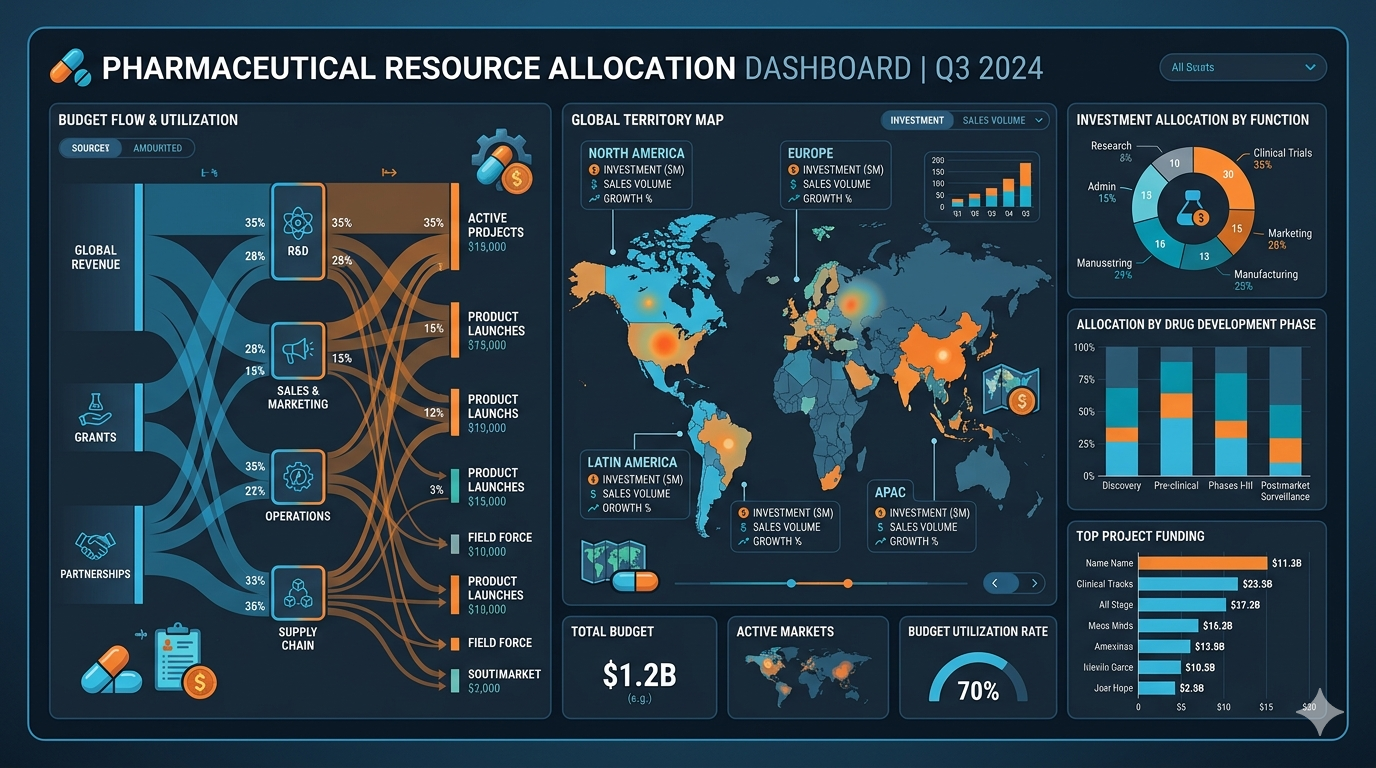
How can dashboards improve allocation decisions?
Dashboards improve visibility.
Track:
- Budget performance
- Territory productivity
- Forecast deviations
- Resource efficiency
👉 As discussed in
🔗 Related Post: How Do You Build a Pharma Dashboard for Better Decision-Making?
Visibility improves allocation quality.
How can tools improve resource allocation?
1. Marketing Plan Generator
Use it to:
- Structure investment plans
- Align objectives
- Organize commercial priorities
2. Excel Chart Builder
Use it to:
- Visualize investment allocation
- Compare ROI
- Monitor performance trends
3. Manager Effectiveness Heatmap
Use it to:
- Improve leadership allocation decisions
- Identify capability gaps
4. Turnover Index
Use it to:
- Detect organizational risk
- Protect critical investments
👉 Resource allocation depends heavily on execution quality.
What are the biggest allocation mistakes?
1. Equal distribution
Creates inefficiency.
2. Historical budgeting
Ignores market reality.
3. Weak forecasting
Leads to poor investment choices.
4. No ROI tracking
Prevents optimization.
5. Static allocation
Reduces agility.
Final Insight
Resource allocation is not budgeting.
It is strategic decision-making.
The strongest pharma organizations ask:
Where can resources create the greatest commercial impact?
Not:
Where did we spend last year?
In pharma:
👉 Better allocation often produces greater growth than larger budgets
Organizations that allocate well usually:
- Forecast better
- Prioritize better
- Measure continuously
- Reallocate faster
Related Guides You Should Review Next
🔗 Related Post: How Do You Forecast a Pharma Launch Accurately?
🔗 Related Post: Pharma Territory Targeting: 7 Proven Strategy Steps
🔗 Related Post: Pharma Commercial Excellence: 8 Proven Framework Pillars
🔗 Related Post: Stakeholder Mapping Framework in Pharma
🔗 Related Post: How Do You Build a Pharma Dashboard for Better Decision-Making?
🔗 Related Post: Pharma Market Access Strategy: 7 Proven Success Steps