
Table of Contents
How Do You Build a Pharma Territory Targeting Strategy That Improves Commercial Performance?
A pharma territory targeting strategy is built by identifying market potential, segmenting customers correctly, prioritizing resources, and aligning field execution with measurable opportunities.
Strong territory targeting improves productivity, increases ROI, and accelerates growth.
Weak targeting creates resource waste and inconsistent execution.
In competitive markets, territory strategy becomes a major driver of commercial performance.
What is pharma territory targeting?
Territory targeting is the process of deciding:
- Which accounts to prioritize
- Which geographies deserve investment
- Which customers receive greater focus
- How resources should be distributed
Territory targeting determines:
- Coverage models
- Sales force deployment
- Resource allocation
- Growth opportunities
Important reality:
Territories are not geographical units only.
They are:
👉 Commercial opportunity systems
Why is pharma territory targeting important?
Many pharma organizations still distribute resources equally.
This creates major inefficiencies.
Poor targeting causes:
- Over-served low potential areas
- Under-served high potential accounts
- Weak field productivity
- Lower ROI
Strong targeting improves:
- Sales productivity
- Coverage quality
- Market penetration
- Resource efficiency
👉 As discussed in
🔗 Related Post: Pharma Sales Force Effectiveness: 8 Proven Frameworks
Execution quality depends heavily on proper targeting.
What are the 7 steps to build a territory targeting strategy?
Step 1: Calculate market potential
Everything begins with market opportunity.
Evaluate:
- Market size
- Patient volume
- Specialty concentration
- Growth trends
- Competitive density
Important principle:
Potential should drive targeting.
Not habit.
Forecasting best practices emphasize understanding:
- Market growth
- Molecule performance
- Growth assumptions
- Market dynamics before resource allocation
Step 2: Segment customers strategically
Not every doctor contributes equally.
Segmentation variables include:
- Prescription volume
- Specialty
- Growth potential
- Influence level
- Switching opportunity
Common segmentation models:
- A/B/C segmentation
- Potential-based segmentation
- Behavioral segmentation
Important:
Segmentation should drive action.
Not reporting.
Step 3: Analyze competitive intensity
Territories behave differently depending on competition.
Assess:
- Competitor presence
- Market leadership concentration
- Access barriers
- Promotional noise
Why this matters:
High potential territories may:
- Require more investment
- Require different messaging
- Require stronger stakeholder engagement
👉 As explained in
🔗 Related Post: Pharma Switching Strategy: 6 Proven Ways to Win
Competitive environments heavily influence growth opportunities.
Step 4: Define territory prioritization rules
Now convert analysis into action.
Common prioritization dimensions:
- Potential size
- Growth opportunity
- Accessibility
- Strategic importance
Example prioritization:
Tier 1 Territories
- High opportunity
- High investment
Tier 2 Territories
- Moderate opportunity
- Optimized investment
Tier 3 Territories
- Maintenance focus
Important principle:
Not every territory deserves equal investment.
Step 5: Align sales force deployment
Territory design must align with resources.
Decisions include:
- Headcount allocation
- Territory size
- Coverage frequency
- Manager assignments
Common mistake:
Equal deployment across territories.
Better approach:
Resource intensity should reflect:
- Opportunity
- Complexity
- Strategic importance
👉 As discussed in
🔗 Related Post: How Do You Forecast a Pharma Launch Accurately?
Resource allocation should follow structured assumptions.
Step 6: Track territory KPIs continuously
Territory performance should be measurable.
Important KPIs:
- Sales growth
- Market share
- Coverage quality
- Rx behavior
- Switching rate
- ROI
Territory KPIs answer:
- Which territories are improving?
- Which require intervention?
- Which need more resources?
👉 As explained in
🔗 Related Post: Pharma KPIs That Matter: 8 Proven Metrics Guide
Metrics should support decisions rather than reporting alone.
Step 7: Optimize continuously
Territories change.
Markets evolve.
Competitors react.
Optimization includes:
- Territory redesign
- Resource shifts
- Segmentation updates
- Targeting refinement
Strong organizations:
- Review frequently
- Adapt rapidly
- Reallocate resources dynamically
How does forecasting improve territory strategy?
Forecasting helps determine:
- Opportunity size
- Resource requirements
- Growth expectations
Forecast assumptions influence:
- Coverage plans
- Team size
- Investment level
Best practice:
Forecast territories separately when possible.
Because:
Different markets behave differently.
How does market access affect territory targeting?
Access conditions vary across regions.
Examples:
- Different reimbursement environments
- Institutional concentration
- Insurance differences
- Competitive restrictions
Strong targeting includes:
- Access assessment
- Institutional mapping
- Regional opportunity analysis
👉 As discussed in
🔗 Related Post: Pharma Market Access Strategy: 7 Proven Success Steps
Access conditions strongly influence commercial performance.
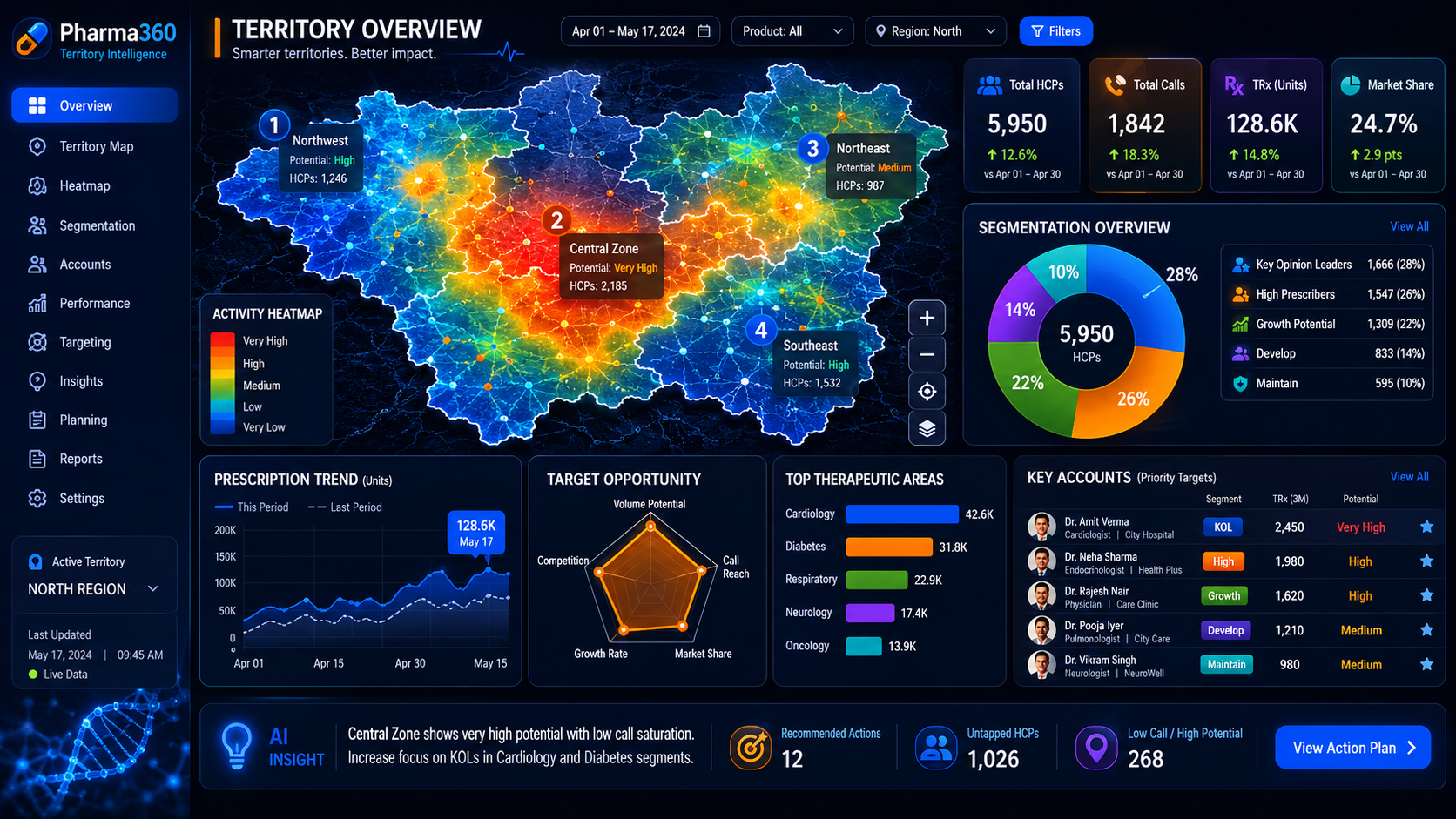
How can dashboards improve territory management?
Dashboards provide territory visibility.
Track:
- Territory trends
- Coverage gaps
- Sales productivity
- Geographic comparisons
👉 As explained in
🔗 Related Post: How Do You Build a Pharma Dashboard for Better Decision-Making?
Visibility improves execution speed.
How can tools improve territory targeting?
1. Excel Chart Builder
Use it to:
- Build territory heatmaps
- Compare regional performance
- Visualize segmentation
2. Marketing Plan Generator
Use it to:
- Structure targeting strategy
- Define territory objectives
- Align execution plans
3. Manager Effectiveness Heatmap
Use it to:
- Identify leadership gaps across territories
- Improve coaching quality
4. Turnover Index
Use it to:
- Detect territory instability
- Protect critical regions from disruption
👉 Strong targeting requires both market intelligence and operational stability.
What are the biggest territory targeting mistakes?
1. Equal coverage everywhere
Creates inefficient resource use.
2. Ignoring market potential
Leads to poor prioritization.
3. Static territory design
Markets evolve constantly.
4. Weak KPI tracking
Makes optimization impossible.
5. Overcomplicated segmentation
Reduces usability.
Final Insight
Territory targeting is not geography management.
It is:
- Opportunity management
- Resource management
- Growth management
The strongest pharma organizations do not ask:
“Where are our representatives located?”
They ask:
“Where can our resources create the greatest impact?”
In pharma:
👉 Better targeting usually creates faster growth than simply increasing resources.
Related Guides You Should Review Next
🔗 Related Post: Pharma Sales Force Effectiveness: 8 Proven Frameworks
🔗 Related Post: Pharma KPIs That Matter: 8 Proven Metrics Guide
🔗 Related Post: How Do You Forecast a Pharma Launch Accurately?
🔗 Related Post: Pharma Market Access Strategy: 7 Proven Success Steps
🔗 Related Post: How Do You Build a Pharma Dashboard for Better Decision-Making?
🔗 Related Post: Pharma Commercial Excellence: 8 Proven Framework Pillars